Notable people · Suffrage · Reformer
Frances Dana Gage
McConnelsville reformer who presided over the 1851 Akron women's rights convention and in 1863 published the 'Ar'n't I a woman?' version of Sojourner Truth's speech there, the version most people know but which differs sharply from the 1851 record.
Born October 12, 1808, near Marietta
Died November 10, 1884, Greenwich, Connecticut
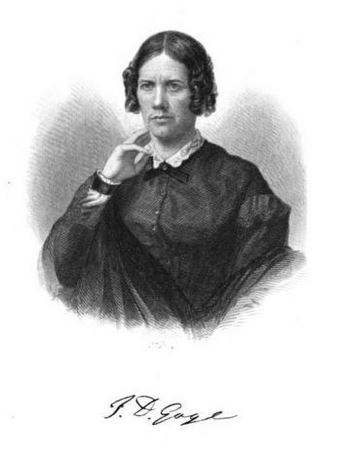
At a glance
- Born
- October 12, 1808, near Marietta (Washington County) source
- Died
- November 10, 1884, Greenwich, Connecticut source
- Buried
- New Burial Grounds Association Cemetery, Greenwich, Connecticut source
- Also known as
- Frances D. Gage, Aunt Fanny, Frances Dana Barker
- Known as
- Suffrage, Reformer
Life story
Frances Barker was born in 1808 in Washington County, one of eleven children of Col. Joseph Barker, a settler who had come to the Northwest Territory with Rufus Putnam's party. She had little formal schooling.
She married James Gage in 1829 and raised eight children, four of whom later fought for the Union. She wrote poems, articles and children's stories.
In 1850 she held a rights convention in McConnelsville and in 1851 presided at the Akron women's rights convention, where she introduced Sojourner Truth. She also led the 1853 national convention in Cleveland.
During the Civil War she ran a refuge for freed people at Parris Island. A carriage accident in 1865 and a stroke in 1867 left her disabled; she died in Connecticut in 1884.
Ohio ties
- Muskingum Township near Marietta (Barker farm, Wiseman's Bottom) (1808-1829)
birth and childhood on her father's farm on the Muskingum River Washington County · source - McConnelsville (1829-1853)
married home (Mount Airy); organized the 1850 women's meeting in the Masonic hall Morgan County · source - Chesterfield (1850)
gave her 'ox-sled speech' at a women's rights meeting held in a barn Morgan County · source - Akron (1851)
president of the Ohio Women's Convention, 28-29 May 1851 Summit County · source - Mount Gilead (1851)
main speaker at a December women's rights convention called by a 19-year-old Morrow County · source - Cleveland (1853)
president of the National Woman's Rights Convention, October 1853 Cuyahoga County · source - Columbus (1860-1863)
editor of the Ohio Cultivator's ladies' department; campaigned for Ohio's 1861 married women's rights law Franklin County · source
Timeline
- 1808 Born on 12 October near Marietta, the tenth of eleven children of Elizabeth Dana and Col. Joseph Barker. source
- 1811 Her father completed the brick house in Devola, Muskingum Township, that still stands as the Colonel Joseph Barker House. source
- 1829 Married James L. Gage, an abolitionist lawyer of McConnelsville, on 1 January. source
- 1843 The Federal-style Mount Airy mansion in McConnelsville, later known as the Gage home, was built. source
- 1850 In May about seventy women met in McConnelsville's Masonic hall, and forty signed her memorial asking the state constitutional convention to omit the words 'white' and 'male'. source
- 1850 Late in May, after being refused a church and a schoolhouse, she spoke to three or four hundred people on a barn's threshing floor at Chesterfield, Morgan County. source
- 1851 Presided over the Ohio Women's Convention at Akron on 28-29 May, where Sojourner Truth spoke on the second day. source
- 1851 Marius Robinson printed his transcript of Truth's Akron speech in the Anti-Slavery Bugle on 21 June. It contains no 'ain't I a woman' refrain. source
- 1851 In December spoke at a women's rights convention in Mount Gilead called by a 19-year-old, John Andrews. source
- 1853 Moved with her family to St. Louis, and in October presided over the National Woman's Rights Convention in Cleveland. source
- 1860 Moved back to Ohio, settling in Columbus, and became editor of the ladies' department of the Ohio Cultivator. source
- 1861 Took part in the campaign that won Ohio's first law on married women's rights. source
- 1863 Her recollection of Truth's Akron speech, with the refrain 'Ar'n't I a woman?', appeared in The Independent on 23 April and in the National Anti-Slavery Standard on 2 May. source
- 1863 Served as superintendent of the freedpeople's settlement on Parris Island, South Carolina, under Gen. Rufus Saxton, and met Clara Barton there. source
- 1863 Her husband James died in Columbus before she could reach him. source
- 1867 Spoke at the first anniversary of the American Equal Rights Association, then suffered a disabling stroke. source
- 1881 Her account of the Akron convention and her 'Reminiscences' of the 1850 Morgan County meetings were printed in volume 1 of the History of Woman Suffrage. source
- 1884 Died on 10 November in Greenwich, Connecticut. source
What Frances is known for
- Presided at 1851 Akron convention
- Poems (1867)
- Elsie Magoon (1872)
- Aunt Fanny children's books
- Hymn 'A Hundred Years Hence' (1875)
Stories
The meeting in the barn
In May 1850 Gage and three McConnelsville allies called a county women's rights meeting at Chesterfield, in Morgan County. They hired a hack and rode sixteen miles over the hills before 10 a.m., only to be refused both the Methodist church and the schoolhouse. The Rev. Philo Matthews found them the threshing floor of a large barn, and three or four hundred farm families came, most of them Quakers and abolitionists. Gage stood on an ox-sled to speak, and afterwards an old Quaker preacher told her, 'Frances, thee had great freedom. The ox-cart inspired thee.' Many more names went onto the memorial asking Ohio's constitutional convention to drop 'white' and 'male'.
John's Convention
In December 1851 Gage answered a newspaper call, signed by a John Andrews, for a women's rights convention at Mount Gilead in Morrow County. After two days of travel by steamboat and rail she found that Andrews was a beardless boy of nineteen. The Christian Church was empty, the stove was cold and the benches were upturned. Gage paid five local boys ten cents each to tell every house in town that 'Aunt Fanny' would speak at 11 a.m. She lit the stove with a brand of fire borrowed next door, and at least fifty people came. She held five more sessions over two days, and the meeting was voted a success.
Two versions of one speech
Marius Robinson, one of the convention's secretaries and editor of the Anti-Slavery Bugle, printed Sojourner Truth's Akron speech within three weeks, on 21 June 1851. In his version Truth says 'I am a woman's rights' and ends with man in a tight place, 'between a hawk and a buzzard'. Twelve years later, prompted by Harriet Beecher Stowe's April 1863 Atlantic article on Truth, Gage published her own recollection in The Independent and the National Anti-Slavery Standard. Her version uses an imitation Southern slave dialect and the refrain 'ar'n't I a woman?', and its wording is hardly like Robinson's even with the dialect set aside. Truth was born in Ulster County, New York, was enslaved and escaped in the North, and spoke only Dutch until she was nine. In 1863, with the Civil War under way, Southern slavery made a stronger appeal than slavery in a loyal Northern state.
A canoe to grandmother's
Gage's grandmother, Mary Bancroft Dana, lived 14 miles south of the Barker farm on the Ohio River, across from slave territory, and three generations of Dana women helped people escaping slavery. As a girl Frances often paddled a canoe to her grandmother's house to bring food and comfort to the refugees. She also remembered helping a visiting cooper make a barrel and being scolded by her father, who said it was a pity she was not a boy. She later called that the moment she resolved to fight the limits set for women.
Honors and things named for them
- Ohio Women's Hall of Fame (1995)
Family
- father: Joseph Barker
- spouse: James L. Gage
Sites to know
Homes, graves, markers, museums and monuments; the numbered ones are on the map.
- 1 Ohio Historical Marker 12-58, Frances Dana Gage / Mount Airy Mansion
just north of 210 N. Kennebec Avenue, McConnelsville Morgan County · source - Mount Airy Mansion (1843), the Gage home where she hosted women's rights meetings in the ballroom (unknown)
Kennebec Avenue, McConnelsville Morgan County · source - 2 Ohio Historical Marker 21-84, Frances Dana Gage / Catherine Fay Ewing
342 Muskingum Drive, Marietta Washington County · source - 3 Colonel Joseph Barker House (NRHP 1978), her father's house and her childhood home (unknown)
Devola, Muskingum Township Washington County · source - 4 Ohio Historical Marker 6-77, Site of Sojourner Truth's Speech on Women's Rights (Universalist Stone Church site, where Gage presided)
37 N. High Street, Akron Summit County · source - Grave, New Burial Grounds Association Cemetery
Greenwich, Connecticut source
Places in Ohio to see
- Colonel Joseph Barker House (childhood home, per page) (home)
Marietta area, Washington County Washington County · official page
Ohio places
Where Frances Dana Gage was born, lived, worked and is remembered, with the ZIP code, town and county pages for each.
- Born: Marietta, Washington County ZIP 45750 · Marietta · Washington County
- Lived: McConnelsville, Morgan County ZIP 43756 · Mcconnelsville · Morgan County
- Lived: Columbus, Franklin County ZIP 43215 · Columbus · Franklin County
Myths and corrections
Things often said about Frances Dana Gage, and what the record shows.
Often said At Akron in 1851 Sojourner Truth asked again and again, 'Ain't I a woman?'
The record The refrain is Gage's. The only full report from 1851, Marius Robinson's in the Anti-Slavery Bugle of 21 June, which he went over with Truth, has no such line; its nearest phrase is 'I am a woman's rights.' The words first appear, as 'Ar'n't I a woman?', in Gage's recollection in The Independent of 23 April 1863, twelve years later. That version also gave Truth, a native of Ulster County, New York, whose first language was Dutch, a Southern slave dialect. source
Often said Truth said she had borne thirteen children and seen most of them sold into slavery.
The record That line exists only in Gage's 1863 version. Truth is generally believed to have had five children, one of whom was sold away, and she is not known to have claimed more. source
Often said The Akron convention was hostile, its leaders begged Gage not to let Truth speak, and her speech turned a jeering crowd.
The record This drama comes from Gage's 1863 account. In 1851 Gage herself described Akron and its press as largely friendly. Other eyewitness reports describe a harmonious session with no 'discordant note', and an audience made up mostly of long-time abolitionists who received Truth warmly. source
Often said Gage invited Sojourner Truth to give her speech (as Ohio marker 21-84 says).
The record Robinson's 1851 report says Truth came forward on her own and asked the president, 'May I say a few words?' Gage's own 1863 account also has Truth rising unannounced from her seat. Gage did let her speak, over objections according to Gage, but no source shows an invitation. source
Often said Gage was born in the Colonel Joseph Barker House, her family's surviving home near Marietta.
The record Gage was born in October 1808, and the brick Barker house was not completed until 1811. It was her childhood home, not her birthplace. source
- Disputed: Gage's 1863 account of Sojourner Truth's Akron speech, with its repeated phrase and Southern dialect, differs from the earlier report printed in 1851 by Marius Robinson. Gage's version became the standard one, and historians dispute it.
Documents
Primary records: patents, letters, court and government files, nominations and old county histories, each at the archive that holds it.
- 'Women's Rights Convention. Sojourner Truth' (Marius Robinson's transcript), Anti-Slavery Bugle, 21 June 1851, p. 4 1851, Library of Congress, Chronicling America
- Anti-Slavery Bugle, 7 June 1851, p. 2 (report of the Akron convention with Gage presiding) 1851, Library of Congress, Chronicling America
- History of Woman Suffrage, vol. 1, including Gage's account of the Akron convention and her letter on the 1850 Morgan County meetings and the Mount Gilead convention 1881, Project Gutenberg
- Letter, Frances D. Gage to William Lloyd Garrison ('Dear Friend Garrison'), holograph 1859, Boston Public Library (Internet Archive)
- Letter, Frances D. Gage to William Lloyd Garrison ('Friend Garrison'), holograph 1859, Boston Public Library (Internet Archive)
- Letter, Frances D. Gage to William Lloyd Garrison ('Mr. Wm L. Garrison, Dear Friend'), holograph 1867, Boston Public Library (Internet Archive)
Pictures
Free to use with the credit shown. Select a picture for the original and its license.
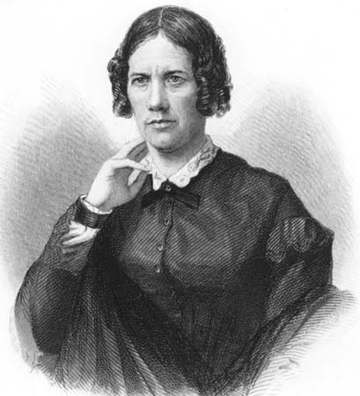
Frances Dana Barker Gage, (1808-1884) , a writer, activist, abolitionist and poet.
Public domain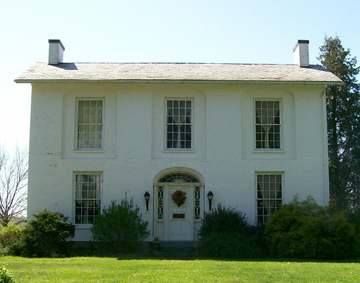
The Col. Joseph Barker House in Devola, Ohio. The house is photographed from its eastern exposure on Masonic P...
Bwsmith84 (talk) / CC BY 3.0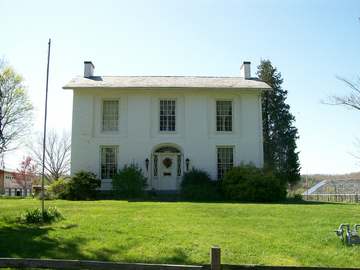
The Col. Joseph Barker House in Devola, Ohio. The house is photographed from its eastern exposure on Masonic P...
Bwsmith84 (talk) / CC BY 3.0


Further reading
Sources
Confidence. Medium: the main facts were confirmed, but some details (often an address or ZIP code) were not.
- Wikipedia: Frances Dana Gage dates, residences, Akron 1851
- Wikipedia: Frances Dana Gage early life, timeline, family, honors, works
- Wikipedia: Ain't I a Woman?
- Wikipedia: Ohio Women's Convention at Akron in 1851
- Wikipedia: Colonel Joseph Barker House
- blogs.loc.gov: sojourner truths most famous speech
- thesojournertruthproject.com: compare the speeches
- gutenberg.org
- uudb.org: gage frances dana barker
- remarkableohio.org: 12 58 frances dana gage mount airy mansion
- remarkableohio.org: 21 84 frances dana gage catherine fay ewing
- remarkableohio.org: 6 77 site of sojourner truths speech on womens rights
- findagrave.com: frances dana gage
- archive.org: lettertodearfrie00gage
- archive.org: lettertofriendga00gage
- archive.org: lettertomrwmlgar00gage
- Wikimedia Commons: Frances Dana Barker Gage
- Wikimedia Commons: Frances D. Gage
- Wikimedia Commons: Col Joseph Barker House
- Wikimedia Commons: Col Joseph Barker House Ohio

Every link goes to the original source. Profile researched 2026-10-15.