Water system
Marietta City
EPA ID OH8400412 · Washington County · 18,707 people served · owned by a local government
Marietta City treats its own water from Ohio/Muskingum River valley sand-and-gravel aquifer (own wells).
The system's record
- Aquifer
- Ohio River valley aquifer (shallow sand-and-gravel wells near Ohio/Muskingum confluence)
- Active wells
- 7
- Serves
- 18,707 people · Washington County
- EPA ID
- OH8400412
About this area's water
Did you know
- Marietta has been fighting a PCE dry-cleaning-solvent plume in its well-field aquifer since 1986 by running interceptor well #1 nonstop, pumping and aerating the chemical out of the ground.
- Parking is banned within 300 feet of any city drinking water well; the production wells sit on Linwood Avenue next to the Marietta Bantam Baseball Fields, and ballplayers are told to park at the Marietta Boat Ramp or…
- A 2026 investigation found that brine waste from a Class II injection well roughly two miles from the city's drinking water aquifer had already travelled about five miles underground into 28 oil and gas wells, with…
- The city is replacing its aging lime-and-soda-ash softening plants with a 4.5 MGD reverse osmosis plant, expandable to 6 MGD, aimed at near-total PFAS removal — funded partly by $10 million in Ohio EPA principal…
- Under Ohio Revised Code 4933.19 and city ordinance 927.99, tampering with a water meter or making an unmetered connection is a theft offense: $500 for a first offense, and up to $1,000 or three months in jail for a…
History6
- 1986Tetrachloroethylene (PCE) first detected in the city's sand-and-gravel well-field aquifer. Interceptor well #1 has been pumped and aerated continuously ever since to contain and strip PCE out of the…
- 2015In September 2015 Ohio EPA's Drinking Water Source Assessment rated Marietta's groundwater source HIGH susceptibility to contamination, citing the aquifer's shallow depth (less than 30 feet below…
- 2019-2020ODNR's Division of Oil and Gas Resource Management investigated and confirmed that brine waste from the Redbird #4 Class II injection well migrated underground, reaching oil and gas production wells…
- 2022A large section of 8- and 10-inch water main on Glendale Extension was replaced from Brentwood Drive to Swaney Court and returned to service.
- 2023Construction began in July on a new reverse-osmosis water treatment plant at the former Plant 2 site, to replace the city's aging lime-and-soda-ash softening plants. Ohio EPA awarded the project $10…
- 2026On July 1-2, four Washington County Class II injection wells — Redbird No. 4 and No. 5, American Growers No. 1 and Nichols No. 1-A — stopped operating amid brine-migration concerns.
Treatment & pressure
How it is treated
Seven production wells in a shallow sand-and-gravel aquifer along the Ohio/Muskingum River valley feed a plant that is staffed 24 hours a day, seven days a week and runs more than 600 water samples a month. Treatment is lime softening plus sodium hexametaphosphate for corrosion control, which EPA…
Source: cms3.revize.commariettaoh.net
Water pressure
Not published. No system psi figure appears in the 2025 CCR, the February 2026 utility rate book, or the city's water treatment pages.
Source: cms3.revize.comcms3.revize.com
What it costs
$11.39 per 1,000 gallons
Typical household bill about $57 a month for water.
Bimonthly billing, consumption metered in 100-cubic-foot increments (100 cu ft = 748 gal). Inside-city water, per the rate book revised February 9, 2026: $8.52 per 100 cu ft on…
Source: cms3.revize.com
Water quality & impurities10
| Contaminant | Level | Limit | Year |
|---|---|---|---|
| Total Trihalomethanes (TTHM) Disinfection byproduct; no violation. | 48.4 (range… ug/L | 80 | 2025 |
| Haloacetic Acids (HAA5) Disinfection byproduct; no violation. | 5.7 (range… ug/L | 60 | 2025 |
| Total Chlorine Residual disinfectant. | 1.2 (range… mg/L | MRDL = 4 | 2025 |
| Nitrate Fertilizer runoff, septic leaching, natural deposits. | 1.69 mg/L | 10 | 2025 |
| Fluoride Naturally occurring plus fluoridation additive. | 0.98 (range… mg/L | 4 | 2025 |
| Barium Drilling wastes, metal refineries, natural deposits. | 0.012 mg/L | 2 | 2025 |
| Lead (90th percentile) All 30 sampled taps non-detect; 0 of 30 over the action level. | 0.00 ug/L | 15 ppb action… | 2024 |
| Copper (90th percentile) 0 of 30 taps over the action level. | 0.01 mg/L | 1.3 ppm action… | 2024 |
| PFOA 5.2 ppt. Below the Ohio EPA action level in force when sampled, but above the 4 ppt federal MCL that becomes… | 0.0052 ug/L | 0.004 ug/L (4… | 2024 |
| PFOS 5.6 ppt; same status as PFOA above. | 0.0056 ug/L | 0.004 ug/L (4… | 2024 |
Source: cms3.revize.com
EPA compliance record
Lead at the tap: 90th-percentile result 0.6 ppb in 2026 (action level 15 ppb).
EPA record: no health-based violations since 2015.
2 violations of any kind logged since 2020: 2 for a report, record or notice that was missing, late or incomplete (the yearly water quality report, a public notice, lead line records).
Projects & plans5
Recent and current work
- Reverse osmosis water treatment plant (4.5 MGD, expandable to 6 MGD) · $35 million · 2023 · under construction
Broke ground July/August 2023 at the former Plant 2 site to replace the city's aging lime-and-soda-ash softening plants, which will then be demolished. Mayor… - Glendale Extension water main replacement · 2022 · completed
8- and 10-inch main replaced from Brentwood Drive to Swaney Court and returned to service. - Well-field monitoring expansion · 2025 · under construction
The city runs 7 production wells and roughly 20 monitoring wells near the Muskingum River, and is adding 3 more monitoring wells near the river and the…
Source: mariettaoh.netwtap.comwtap.com
Planned or needed
- Water main replacement capital improvement plan · $220 million · 2025 · planned
Reported by the Marietta Times in September 2025: a $220 million plan to replace more than 26 miles of water main over coming decades, with anticipated… - Brine-plume containment / remediation in the Muskingum valley aquifer · 2026 · needed
No funded project exists. Marietta College professor David Jeffery estimated that cleanup to keep radioactive brine from reaching aquifers or the surface would…
Supply stress
High. Ohio EPA's September 2015 source assessment rates the shallow (<30 ft) sand-and-gravel aquifer HIGH susceptibility to contamination, and the aquifer already hosts a PCE plume that has been actively contained since 1986. Since 2019 it has also faced brine migration from Class II oil and gas injection wells: ODNR confirmed waste from…
Sewers
Sanitary
The City of Marietta Water Reclamation (Wastewater) Treatment Plant is staffed 24 hours a day, seven days a week. Under Ordinance No. 167 (22-23) sewer is billed on water consumption or metered sewage in 100-cubic-foot increments: $8.90 per 100 cu ft plus a $24.60 administrative charge, bimonthly. Minimum inside-city sewer charge is…
Storm
Marietta operates a municipal separate storm sewer system (MS4) as defined in its own codified ordinances, regulated under an NPDES storm water discharge permit, with construction-site stormwater governed by the Ohio EPA general permit for land disturbance.…
Sourcesverified
Compiled from the utility's own reports and public records, then independently re-checked against primary sources.
Main supplier in 1 ZIP code
Serves
Main water supplier in 1 ZIP code
- 45750 · Marietta53% of residents
Population-weighted resident shares; a ZIP code can have more than one system on record. Recomputed from each ZIP's own system list, not from the map's cached footprint.
Buys from · Sells to
Marietta City does not buy water from another system on record; it treats its own source water.
3 systems on record buy water from Marietta City: Reno Water and Sewer - Kardex, Reno Water and Sewer 1, Reno Water and Sewer 2.
What the records show about Marietta City
Who runs it
EPA's record describes Marietta City as owned by a local government. It has 6,468 service connections and serves 18,707 people.
EPA classes it as a community water system, one that serves the same residents all year.
EPA's record says it has substantially implemented source water protection under Ohio's program, dating the program from 2023. Its office telephone on EPA's record is 740-373-1387.
Source: EPA Safe Drinking Water Information System (SDWIS), water system record.
How the water is treated
EPA's treatment table registers these steps for Marietta City: corrosion control, coagulation and settling, chlorine disinfection, fluoridation, lime softening, and sand or media filtration.
The list is what each system registered with EPA for treatment plants EPA still shows as active, and it can lag a plant upgrade.
Source: EPA Safe Drinking Water Information System (SDWIS) treatment table (EPA Envirofacts, pulled September 2026).
Violations
EPA's record shows no health-based violations for Marietta City since 2015.
EPA logs 2 violations of any kind since 2020: 2 for a report, record or notice that was missing, late or incomplete (the yearly water quality report, a public notice, lead line records).
Source: EPA Safe Drinking Water Information System (SDWIS) violation records: health-based violations with compliance periods beginning in 2015 or later, all violations from 2020 or later (EPA Envirofacts, pulled September 2026).
Lead and copper at the tap
In the sampling period ending June 2026, the 90th-percentile lead result at Marietta City was 0.6 ppb, under both the current 15 ppb action level and the 10 ppb level that applies from 2027.
EPA has 4 sampling periods on file for Marietta City since 2016, the first ending in 2018; no period was above 10 ppb.
Every water system has to inventory its service lines, the pipes from the main to each building. In the inventory Marietta City sent EPA, 5,358 lines are counted.
| Material | Lines |
|---|---|
| Lead | 49 |
| Galvanized, needing replacement | 31 |
| Unknown material | 4,741 |
| Not lead | 537 |
| All lines | 5,358 |
Systems sample taps in the homes most likely to have lead pipes or solder. The 90th-percentile result is the level nine in ten of the sampled homes were at or below. Lead comes mostly from service lines and house plumbing, not the source water, so a low result for the system does not clear an old house.
EPA's dashboard status for this inventory: reported all required service line types.
Source: EPA Safe Drinking Water Information System (SDWIS) lead and copper 90th-percentile results (EPA Envirofacts), sampling periods ending 2016 or later; EPA's service line inventory dashboard, Ohio's 2026 Q2 submission.
PFAS
EPA's fifth national round of testing (UCMR 5) took 4 samples of the water entering the pipes of Marietta City in 2024 to 2025 and measured 29 PFAS.
The highest PFOA or PFOS result, 5.6 ng/L, is at or above the federal limit of 4 ng/L that EPA set in 2024. Systems have until 2029 to comply, and in May 2026 EPA proposed letting systems apply for two more years. One sample over the limit is not a violation: compliance is judged on a running annual average.
The highest PFAS results were PFOS 5.6 ng/L, PFOA 5.2 ng/L, and PFBS 4.7 ng/L.
The system reported potential PFAS sources near its supply.
Ohio EPA's own statewide sampling tested 1 plant of Marietta City (latest sample April 2021). The highest result was PFOA at 5.6 ppt (ppt is the same unit as ng/L), against Ohio's action level of 70 ppt. Those action levels are the ones Ohio EPA used for the survey; the 2024 federal limit for PFOA and PFOS is 4 ng/L.
Ohio EPA's current sampling status map lists 1 plant of Marietta City as sampled, most recently February 2026.
| Compound | Highest result | Federal limit |
|---|---|---|
| PFOA | 5.2 ng/L | 4 ng/L |
| PFOS | 5.6 ng/L | 4 ng/L |
PFAS are the 'forever chemicals' from firefighting foam, plating shops and non-stick coatings. Results are for water leaving the plant, not your tap.
Source: EPA UCMR 5 occurrence data (final release, August 2026); Ohio EPA statewide PFAS sampling, 2019 to 2021, and its sampling status map.
Disinfection byproducts
Chlorine that disinfects water also reacts with organic matter to form byproducts. Two groups have federal limits: total trihalomethanes (TTHM, 80 µg/L) and five haloacetic acids (HAA5, 60 µg/L), judged on running yearly averages at each sampling site.
For TTHM, the average of Marietta City's samples in 2019, the last year it was sampled, was 30.8 µg/L. The worst yearly average was 44 µg/L and the highest single sample was 68 µg/L, from 113 samples taken from 2012 to 2019.
For HAA5, the average in the last year sampled was 5.9 µg/L. The worst yearly average was 15 µg/L and the highest single sample was 15.9 µg/L, from 113 samples.
| Byproduct | Limit | Latest yearly average | Worst yearly average | Highest sample | Samples |
|---|---|---|---|---|---|
| TTHM | 80 µg/L | 30.8 µg/L (2019) | 44 µg/L | 68 µg/L | 113 |
| HAA5 | 60 µg/L | 5.9 µg/L | 15 µg/L | 15.9 µg/L | 113 |
A yearly average of 0 means nothing was detected in that year's samples. EPA's file stops at 2019; Ohio EPA's Drinking Water Watch has newer results.
Source: EPA Six-Year Review 4 compliance monitoring data, 2012 to 2019, distribution-system samples (non-detects counted as zero).
Nitrate, arsenic and radioactivity
Nitrate: the highest of 8 samples was 1.61 mg/L (as nitrogen) in 2015; in 2019, the last year sampled, the highest was 1.48 mg/L. No sample was over the limit of 10 mg/L. Nitrate above 10 is unsafe for infants.
Arsenic was not detected in 3 samples (limit 10 µg/L).
| Contaminant | Samples | Highest result | Limit | Samples over limit |
|---|---|---|---|---|
| Nitrate (as nitrogen) | 8 | 1.61 mg/L | 10 mg/L | 0 |
| Arsenic | 3 | not detected | 10 µg/L | 0 |
Measured in finished water: at the plant's entry points and in the distribution system; raw well and intake samples are left out. Non-detects count as zero.
Source: EPA Six-Year Review 4 compliance monitoring data, 2012 to 2019, finished water.
Solvents and fuels
EPA's file holds results for all six solvent and fuel compounds it checked. Benzene, carbon tetrachloride, 1,2-dichloroethane, trichloroethylene, tetrachloroethylene, and vinyl chloride were not detected in 7 samples each.
| Compound | Limit | Samples | Detected in | Highest result | Samples over limit |
|---|---|---|---|---|---|
| Benzene | 5 µg/L | 7 | 0 of 7 | not detected | 0 |
| Carbon tetrachloride | 5 µg/L | 7 | 0 of 7 | not detected | 0 |
| 1,2-dichloroethane | 5 µg/L | 7 | 0 of 7 | not detected | 0 |
| Trichloroethylene (TCE) | 5 µg/L | 7 | 0 of 7 | not detected | 0 |
| Tetrachloroethylene (PCE) | 5 µg/L | 7 | 0 of 7 | not detected | 0 |
| Vinyl chloride | 2 µg/L | 7 | 0 of 7 | not detected | 0 |
"Not detected" means the lab's result was below what its method can measure, not that the compound is absent. Non-detects count as zero in the highest-result column.
Source: EPA Six-Year Review 4 compliance monitoring data, 2012 to 2019, finished water.
Farm chemicals and metals
EPA's file holds results for 8 of the nine herbicides and metals it checked. Detected: barium in 2 of 3 samples, highest 11 µg/L (limit 2,000). Not detected: atrazine, alachlor, chromium, cadmium, mercury, selenium, and thallium, in 3 samples each.
| Substance | Kind | Limit | Samples | Detected in | Highest result | Samples over limit |
|---|---|---|---|---|---|---|
| Atrazine | Farm chemical | 3 µg/L | 3 | 0 of 3 | not detected | 0 |
| Alachlor | Farm chemical | 2 µg/L | 3 | 0 of 3 | not detected | 0 |
| Chromium | Metal | 100 µg/L | 3 | 0 of 3 | not detected | 0 |
| Cadmium | Metal | 5 µg/L | 3 | 0 of 3 | not detected | 0 |
| Barium | Metal | 2,000 µg/L | 3 | 2 of 3 | 11 µg/L | 0 |
| Mercury | Metal | 2 µg/L | 3 | 0 of 3 | not detected | 0 |
| Selenium | Metal | 50 µg/L | 3 | 0 of 3 | not detected | 0 |
| Thallium | Metal | 2 µg/L | 3 | 0 of 3 | not detected | 0 |
Non-detects count as zero in the highest-result column.
Source: EPA Six-Year Review 4 compliance monitoring data, 2012 to 2019, finished water.
Bacteria in the pipes
From 2012 to 2019, 0 of 1,922 routine total coliform samples taken in the distribution system at Marietta City tested positive (0%); in 2019, the last year on file, 0 of 240 did.
A positive coliform test is a warning sign, not a violation by itself. E. coli is a sign that human or animal waste may have reached the water. Coliform counts are routine samples only; E. coli counts include repeat samples.
Source: EPA Six-Year Review 4 compliance monitoring data, 2012 to 2019, distribution-system presence/absence tests for total coliform and E. coli.
Fluoride
The Ohio Department of Health's report to the CDC (My Water's Fluoride) says Marietta City adjusts the fluoride level to the recommended level for preventing tooth decay.
EPA's treatment table lists fluoridation among the steps at Marietta City.
Measured fluoride: 0.91 mg/L on average at the plant's entry points in 2019 (in the range dentists aim for); samples ran from 0.86 to 1.05 mg/L across 3 samples in 2012 to 2019.
The recommended level for preventing tooth decay is 0.7 mg/L; the federal limit is 4 mg/L. The treatment list is what each system registered with EPA and can lag a plant upgrade.
Source: CDC My Water's Fluoride (fluoridation status as reported by the Ohio Department of Health, fetched September 2026); EPA Safe Drinking Water Information System (SDWIS) treatment table; EPA Six-Year Review 4 compliance monitoring data, 2012 to 2019, entry-point fluoride samples.
Lithium
Lithium was not detected in 2 UCMR 5 samples at Marietta City, last sampled in 2025 (the method reports from 9 µg/L).
Lithium is not regulated. EPA's draft health reference level is 10 µg/L, and it occurs naturally in deep groundwater, so well systems in the northwest run highest.
Source: EPA UCMR 5 occurrence data (final release, August 2026), samples from 2023 to 2025.
Water and sewer bills
Ohio EPA's 2023 rate survey puts the water bill at Marietta City for a household using 5,000 gallons a month at $605 a year, about $50 a month.
The sewer bill in the same survey is $895 a year at 5,000 gallons a month.
| Use | Water, per year | Sewer, per year |
|---|---|---|
| 2,500 gallons a month | $413 | $567 |
| 5,000 gallons a month | $605 | $895 |
| 8,000 gallons a month | $836 | $1,290 |
The survey lists it as “Marietta”. These are inside-city rates and annual bills at the use shown.
Source: Ohio EPA 2023 Sewer and Water Rate Survey (Ohio State University, May 2025).
How well the service area is mapped
EPA estimated the service area of Marietta City with a computer model rather than drawing it from the utility's map, so its edges are approximate.
Counting the people who live in the ZIP codes it overlaps, this atlas estimates 14,032 residents are inside the boundary, 75% of the 18,707 people Marietta City reports serving.
The resident count is an estimate from 2020 Census ZIP-code populations, not a count of customers.
Source: EPA Service Area Boundaries; resident estimate by this atlas from ZIP-code overlap.
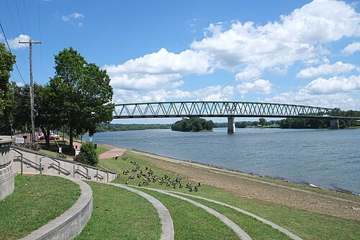
Photograph
On the map
Show this system's territory on the map — 1 ZIP code in all.
Sources
U.S. EPA SDWIS and Community Water System Service Area Boundaries (v3, 2026), Ohio EPA primacy data, 2020 census blocks: the system serving most residents, traced through purchases to the treating utility; Ohio EPA 2023 Sewer and Water Rate Survey (Ohio State, May 2025) for household bills; Ohio EPA DEFA loan awards since 2016 for the loans paragraph · EPA SDWIS · EPA service area boundaries · Ohio EPA drinking water · Ohio EPA rate survey
EPA's own record for this system: Enforcement and Compliance History report for OH8400412 (EPA ECHO).
Marietta City's own pages: mariettaoh.net, ohiocapitaljournal.com
Notable facts: cms3.revize.com, cms3.revize.com, yahoo.com, mariettaoh.net
History: cms3.revize.com, farmanddairy.com, mariettatimes.com, wtap.com
Water quality: cms3.revize.com
Planned work: mariettatimes.com, ohiocapitaljournal.com, yahoo.com, cms3.revize.com
Water pressure: cms3.revize.com, cms3.revize.com
Capital projects: mariettaoh.net, wtap.com, wtap.com, mariettatimes.com
Rates: cms3.revize.com
Sewers: cms3.revize.com, codelibrary.amlegal.com
Treatment: cms3.revize.com, mariettaoh.net
Supply stress: cms3.revize.com, farmanddairy.com, yahoo.com, mariettatimes.com
