Water system
Trumbull Co. - Mosquito Creek
EPA ID OH7806403 · Trumbull County · 1,708 people served
Trumbull Co. - Mosquito Creek buys its water from Warren City.
The system's record
- Water bodies
- Mosquito Creek Lake
- Raw intakes
- Warren Mosquito Reservoir
- Serves
- 49,130 people · Trumbull County
- EPA ID
- OH7803811
About this area's water Warren City
Did you know
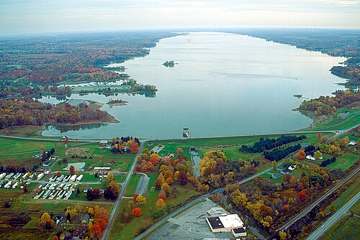
- Warren's water comes from Mosquito Creek Lake, a 7,850-acre Army Corps reservoir whose dam was finished in April 1944 — supplying Warren was one of the benefits contemplated when the Flood Control Act of 1938 authorized…
- Warren keeps an emergency interconnection with the City of Niles' water system; it was not used in 2025.
- Some of Warren's sewer infrastructure dates back to 1865, more than 150 years before the current plant overhaul debate.
- Warren passes its total organic carbon requirement using the alternate SUVA method rather than the usual removal ratio — its 2025 TOC ratio was 0.837, but all SUVA values were in the required range.
- The city invites the public to regular meetings held twice monthly at Council Chambers at 5:00 pm to weigh in on drinking water decisions.
History6
- 1938The Flood Control Act of 1938 authorized the Mosquito Creek reservoir; supplying water to Warren was among the contemplated benefits.
- 1944The US Army Corps of Engineers completed the earthen dam creating Mosquito Creek Lake in April 1944.
- 1962Warren's wastewater treatment plant was originally constructed; it now has a 16 MGD design capacity.
- 1987The wastewater plant received its last major update per city consultant AECOM; the city describes the upgrade as occurring in the 1980s.
- 2003Ohio EPA performed the state source water assessment of Warren's Mosquito Creek Reservoir supply.
- 2024EPA announced a partnership with Warren under its 'Get the Lead Out' initiative on July 9, 2024, providing technical assistance to identify lead service lines and educate the public.
Treatment & pressure
How it is treated
Conventional surface-water treatment of Mosquito Creek Reservoir water: filtration (highest 2025 turbidity 0.29 NTU against the 0.3 NTU limit, with 100% of monthly samples meeting limits) and chlorine disinfection (total chlorine 1.64 ppm, range 1.39-1.79). TOC removal is demonstrated via the…
Water pressure
Not published. No psi figure appears in the 2025 CCR or on the city water department pages.
What it costs
$7.74 per 1,000 gallons
Effective Jan. 1, 2026: in-city tiered water rate $5.79/100 cu ft (first 2,000 cf), $4.63 (next 2,000 cf), $3.21 (over 4,000 cf); $13.34 minimum monthly on a 5/8" meter ($10.00…
Water quality & impurities10
| Contaminant | Level | Limit | Year |
|---|---|---|---|
| TTHM (total trihalomethanes) Close to the 80 ppb MCL; range across samples 38-126 ppb. No violation. | 78.7 ppb | 80 | 2025 |
| HAA5 (haloacetic acids) Range 24.6-74.3 ppb; individual samples topped 60 but the average did not. No violation. | 44.4 ppb | 60 | 2025 |
| Lead (90th percentile) 0 of 30 samples exceeded the lead action level. | 3.7 ppb | 15 (action… | 2025 |
| Copper (90th percentile) 0 of 30 samples exceeded the copper action level. | 0.034 ppm | 1.3 (action… | 2025 |
| Nitrate Well below MCL; range <0.10-0.35 ppm. | 0.35 ppm | 10 | 2025 |
| Fluoride Natural plus additive; range 0.79-1.14 ppm. | 1.14 ppm | 4 | 2025 |
| Barium Well below the 2 ppm MCL. | 0.029 ppm | 2 | 2025 |
| Atrazine Herbicide runoff from row crops; well below MCL. | 0.11 ppb | 3 | 2024 |
| Turbidity Highest 2025 reading; range 0.02-0.29. 100% of monthly samples met limits. | 0.29 NTU | 0.3 (treatment… | 2025 |
| Total chlorine Disinfectant residual; range 1.39-1.79 ppm. | 1.64 ppm | 4 (MRDL) | 2025 |
EPA compliance record · Trumbull Co. - Mosquito Creek
Lead at the tap: 90th-percentile result 0 ppb in 2025 (action level 15 ppb).
EPA record: no health-based violations since 2015.
EPA compliance record · Warren City (treats the water)
Lead at the tap: 90th-percentile result 3.7 ppb in 2025 (action level 15 ppb).
EPA record: no health-based violations since 2015.
1 violation of any kind logged since 2020: 1 for required testing that was missed or reported late.
Projects & plans5
Recent and current work
- Water Line Replacement Program, Areas B and C · 2025 · under construction
Area B: 2nd St SW, Bane St SW, Miller. Area C: Union St SW, Burton St SW. Covered by an EPA Limited Environmental Review and Finding of No Significant Impact. - Lead service line inventory and customer survey · 2024 · completed
Warren built the Lead and Copper Rule service line inventory and ran a customer survey; the published inventory does not state a lead line count. - Downtown sewer separation · unknown · completed
Provided a dedicated storm sewer for downtown and stopped stormwater from overloading the sanitary system.
Planned or needed
- Lead service line replacement under EPA 'Get the Lead Out' · 2024 · planned
EPA is providing technical assistance to identify lead pipes and educate the public; no replacement count, cost, or schedule has been published. - Wastewater treatment plant overhaul · 2026 · proposed
AECOM study presented to the Water and Water Pollution Control Committee recommends a major rebuild of a plant last updated in 1987, driving the proposed sewer…
Supply stress
Not drought-stressed the way groundwater systems are: Mosquito Creek Lake is a 7,850-acre Corps of Engineers flood-control reservoir. Ohio EPA's source water assessment notes susceptibility to wastewater and home sewage discharges, construction, residential, agricultural and urban runoff, oil and gas activity, and spills from traffic and…
Sewers
Sanitary
City of Warren Water Pollution Control Department runs the sanitary system and treatment plant, originally built 1962 and upgraded in the 1980s (last major update 1987 per AECOM), with 16 MGD design capacity, five primary settling tanks, four aeration tanks and four secondary clarifiers, and over 195 miles of collection lines. The oldest…
Storm
Separate storm system: 138 miles of storm sewers, 241 miles of open ditches and over 5,500 catch basins, managed under NPDES. A completed downtown sewer separation project gave downtown its own storm sewer. We found no consent decree.
Sourcesverified
Compiled from the utility's own reports and public records, then independently re-checked against primary sources.
Present in 1 ZIP code
Serves
No ZIP code has Trumbull Co. - Mosquito Creek on record as its main water supplier.
Also present in 1 more ZIP code
- 44484 · Howland Township and Warren6% of residents
Population-weighted resident shares; a ZIP code can have more than one system on record. Recomputed from each ZIP's own system list, not from the map's cached footprint.
Buys from · Sells to
Trumbull Co. - Mosquito Creek buys its water from Warren City.
No other system is on record buying water from Trumbull Co. - Mosquito Creek.
What the records show about Trumbull Co. - Mosquito Creek
Who runs it
EPA's record says Trumbull Co. - Mosquito Creek has 668 service connections and serves 1,708 people.
EPA classes it as a community water system, one that serves the same residents all year.
Its office telephone on EPA's record is 330-675-7860.
Source: EPA Safe Drinking Water Information System (SDWIS), water system record.
How the water is treated
Trumbull Co. - Mosquito Creek buys water that Warren City treats first, so the steps that count are the seller's. EPA's treatment table registers these steps for Warren City: chloramine disinfection, corrosion control, coagulation and settling, chlorine disinfection, iron and manganese removal, fluoridation, powdered activated carbon, and sand or media filtration.
The list is what each system registered with EPA for treatment plants EPA still shows as active, and it can lag a plant upgrade.
Source: EPA Safe Drinking Water Information System (SDWIS) treatment table (EPA Envirofacts, pulled September 2026).
Violations
EPA's record shows no health-based violations for Trumbull Co. - Mosquito Creek since 2015.
EPA logs no violations of any kind for Trumbull Co. - Mosquito Creek since 2020.
Source: EPA Safe Drinking Water Information System (SDWIS) violation records: health-based violations with compliance periods beginning in 2015 or later, all violations from 2020 or later (EPA Envirofacts, pulled September 2026).
Lead and copper at the tap
In the sampling period ending December 2025, the 90th-percentile lead result at Trumbull Co. - Mosquito Creek was 0 ppb, under both the current 15 ppb action level and the 10 ppb level that applies from 2027. A result of 0 means at least nine in ten of the homes sampled had no lead detected.
EPA has 5 sampling periods on file for Trumbull Co. - Mosquito Creek since 2016, the first ending in 2017; no period was above 10 ppb.
Every water system has to inventory its service lines, the pipes from the main to each building. In the inventory Trumbull Co. - Mosquito Creek sent EPA, 648 lines are counted.
| Material | Lines |
|---|---|
| Lead | 0 |
| Galvanized, needing replacement | 0 |
| Unknown material | 0 |
| Not lead | 648 |
| All lines | 648 |
Systems sample taps in the homes most likely to have lead pipes or solder. The 90th-percentile result is the level nine in ten of the sampled homes were at or below. Lead comes mostly from service lines and house plumbing, not the source water, so a low result for the system does not clear an old house.
EPA's dashboard status for this inventory: reported all required service line types.
Source: EPA Safe Drinking Water Information System (SDWIS) lead and copper 90th-percentile results (EPA Envirofacts), sampling periods ending 2016 or later; EPA's service line inventory dashboard, Ohio's 2026 Q2 submission.
PFAS
The water Trumbull Co. - Mosquito Creek buys is treated by Warren City, so the results below are Warren City's.
EPA's fifth national round of testing (UCMR 5) took 9 samples of the water entering the pipes of Warren City in 2023 to 2024 and measured 29 PFAS.
PFOA and PFOS were not detected, against a federal limit of 4 ng/L each.
The highest PFAS result was PFBA 9.8 ng/L.
Ohio EPA's own statewide sampling tested 1 plant of Warren City (latest sample August 2020). Not one of the six PFAS tested (PFOA, PFOS, PFHxS, PFNA, GenX and PFBS) was detected.
| Compound | Highest result | Federal limit |
|---|---|---|
| PFOA | not detected | 4 ng/L |
| PFOS | not detected | 4 ng/L |
PFAS are the 'forever chemicals' from firefighting foam, plating shops and non-stick coatings. Results are for water leaving the plant, not your tap.
Source: EPA UCMR 5 occurrence data (final release, August 2026); Ohio EPA statewide PFAS sampling, 2019 to 2021, and its sampling status map.
Disinfection byproducts
Chlorine that disinfects water also reacts with organic matter to form byproducts. Two groups have federal limits: total trihalomethanes (TTHM, 80 µg/L) and five haloacetic acids (HAA5, 60 µg/L), judged on running yearly averages at each sampling site.
For TTHM, the average of Trumbull Co. - Mosquito Creek's samples in 2019, the last year it was sampled, was 64.5 µg/L. The worst yearly average was 78.4 µg/L and the highest single sample was 119 µg/L, from 56 samples taken from 2012 to 2019.
For HAA5, the average in the last year sampled was 33.4 µg/L. The worst yearly average was 45.2 µg/L and the highest single sample was 78.1 µg/L, from 56 samples.
| Byproduct | Limit | Latest yearly average | Worst yearly average | Highest sample | Samples |
|---|---|---|---|---|---|
| TTHM | 80 µg/L | 64.5 µg/L (2019) | 78.4 µg/L | 119 µg/L | 56 |
| HAA5 | 60 µg/L | 33.4 µg/L | 45.2 µg/L | 78.1 µg/L | 56 |
A yearly average of 0 means nothing was detected in that year's samples. EPA's file stops at 2019; Ohio EPA's Drinking Water Watch has newer results.
Source: EPA Six-Year Review 4 compliance monitoring data, 2012 to 2019, distribution-system samples (non-detects counted as zero).
Nitrate, arsenic and radioactivity
The water Trumbull Co. - Mosquito Creek buys is treated by Warren City, so the results below are Warren City's.
Nitrate: the highest of 97 samples was 0.47 mg/L (as nitrogen) in 2017; in 2019, the last year sampled, the highest was 0.22 mg/L. No sample was over the limit of 10 mg/L. Nitrate above 10 is unsafe for infants.
Arsenic was not detected in 8 samples (limit 10 µg/L).
| Contaminant | Samples | Highest result | Limit | Samples over limit |
|---|---|---|---|---|
| Nitrate (as nitrogen) | 97 | 0.47 mg/L | 10 mg/L | 0 |
| Arsenic | 8 | not detected | 10 µg/L | 0 |
Measured in finished water: at the plant's entry points and in the distribution system; raw well and intake samples are left out. Non-detects count as zero.
Source: EPA Six-Year Review 4 compliance monitoring data, 2012 to 2019, finished water of Warren City.
Solvents and fuels
The water Trumbull Co. - Mosquito Creek buys is treated by Warren City, so the results below are Warren City's.
EPA's file holds results for all six solvent and fuel compounds it checked. Benzene, carbon tetrachloride, 1,2-dichloroethane, trichloroethylene, tetrachloroethylene, and vinyl chloride were not detected in 8 samples each.
| Compound | Limit | Samples | Detected in | Highest result | Samples over limit |
|---|---|---|---|---|---|
| Benzene | 5 µg/L | 8 | 0 of 8 | not detected | 0 |
| Carbon tetrachloride | 5 µg/L | 8 | 0 of 8 | not detected | 0 |
| 1,2-dichloroethane | 5 µg/L | 8 | 0 of 8 | not detected | 0 |
| Trichloroethylene (TCE) | 5 µg/L | 8 | 0 of 8 | not detected | 0 |
| Tetrachloroethylene (PCE) | 5 µg/L | 8 | 0 of 8 | not detected | 0 |
| Vinyl chloride | 2 µg/L | 8 | 0 of 8 | not detected | 0 |
"Not detected" means the lab's result was below what its method can measure, not that the compound is absent. Non-detects count as zero in the highest-result column.
Source: EPA Six-Year Review 4 compliance monitoring data, 2012 to 2019, finished water of Warren City.
Farm chemicals and metals
The water Trumbull Co. - Mosquito Creek buys is treated by Warren City, so the results below are Warren City's.
EPA's file holds results for 8 of the nine herbicides and metals it checked. Detected: atrazine in 4 of 8 samples, highest 0.17 µg/L (limit 3); barium in 8 of 8 samples, highest 17 µg/L (limit 2,000). Not detected: alachlor, chromium, cadmium, mercury, selenium, and thallium, in 8 samples each.
| Substance | Kind | Limit | Samples | Detected in | Highest result | Samples over limit |
|---|---|---|---|---|---|---|
| Atrazine | Farm chemical | 3 µg/L | 8 | 4 of 8 | 0.17 µg/L | 0 |
| Alachlor | Farm chemical | 2 µg/L | 8 | 0 of 8 | not detected | 0 |
| Chromium | Metal | 100 µg/L | 8 | 0 of 8 | not detected | 0 |
| Cadmium | Metal | 5 µg/L | 8 | 0 of 8 | not detected | 0 |
| Barium | Metal | 2,000 µg/L | 8 | 8 of 8 | 17 µg/L | 0 |
| Mercury | Metal | 2 µg/L | 8 | 0 of 8 | not detected | 0 |
| Selenium | Metal | 50 µg/L | 8 | 0 of 8 | not detected | 0 |
| Thallium | Metal | 2 µg/L | 8 | 0 of 8 | not detected | 0 |
Non-detects count as zero in the highest-result column.
Source: EPA Six-Year Review 4 compliance monitoring data, 2012 to 2019, finished water of Warren City.
Bacteria in the pipes
From 2012 to 2019, 0 of 193 routine total coliform samples taken in the distribution system at Trumbull Co. - Mosquito Creek tested positive (0%); in 2019, the last year on file, 0 of 24 did.
A positive coliform test is a warning sign, not a violation by itself. E. coli is a sign that human or animal waste may have reached the water. Coliform counts are routine samples only; E. coli counts include repeat samples.
Source: EPA Six-Year Review 4 compliance monitoring data, 2012 to 2019, distribution-system presence/absence tests for total coliform and E. coli.
Fluoride
The Ohio Department of Health's report to the CDC (My Water's Fluoride) says Trumbull Co. - Mosquito Creek buys its water from Warren City, a system that adjusts the fluoride level to the recommended level for preventing tooth decay.
EPA's treatment table lists fluoridation among the steps at Warren City, which treats the water Trumbull Co. - Mosquito Creek buys.
Measured fluoride: 0.82 mg/L on average leaving the plants of Warren City, which supplies Trumbull Co. - Mosquito Creek, in 2019 (in the range dentists aim for); samples ran from 0.69 to 0.99 mg/L across 8 samples in 2012 to 2019.
The recommended level for preventing tooth decay is 0.7 mg/L; the federal limit is 4 mg/L. The treatment list is what each system registered with EPA and can lag a plant upgrade.
Source: CDC My Water's Fluoride (fluoridation status as reported by the Ohio Department of Health, fetched September 2026); EPA Safe Drinking Water Information System (SDWIS) treatment table; EPA Six-Year Review 4 compliance monitoring data, 2012 to 2019, entry-point fluoride samples.
Lithium
Lithium was not detected in 4 UCMR 5 samples at Warren City, which supplies Trumbull Co. - Mosquito Creek, last sampled in 2024 (the method reports from 9 µg/L).
Lithium is not regulated. EPA's draft health reference level is 10 µg/L, and it occurs naturally in deep groundwater, so well systems in the northwest run highest.
Source: EPA UCMR 5 occurrence data (final release, August 2026), samples from 2023 to 2025.
Algal toxins
The water Trumbull Co. - Mosquito Creek buys is treated by Warren City, so the results below are Warren City's.
Ohio EPA tests for microcystin, a toxin that harmful algal blooms can release, in raw water at the intake and in treated water.
At the intake, microcystin was detected 29 times in 222 raw-water samples, across 6 bloom seasons (2016 to 2026); the highest raw-water result was 2.12 µg/L on July 28, 2025. The highest raw-water result since 2024 was 2.12 µg/L.
Microcystin was never detected in treated water (247 samples).
In all, 469 samples from 2016 to 2026, the latest on August 24, 2026.
| Water | Samples | Detections | Highest result |
|---|---|---|---|
| Raw water, at the intake | 222 | 29 | 2.12 µg/L |
| Treated water | 247 | 0 | not detected |
The ten-day advisory levels for treated water are 0.3 µg/L for children under six and 1.6 µg/L for everyone else. Any detection at the intake triggers more frequent testing until two clean weeks.
Source: Ohio EPA public water system harmful algal bloom monitoring, 2016 to present (HAB data, fetched September 2026).
How well the service area is mapped
EPA estimated the service area of Trumbull Co. - Mosquito Creek with a computer model rather than drawing it from the utility's map, so its edges are approximate.
Source: EPA Service Area Boundaries; resident estimate by this atlas from ZIP-code overlap.
On the map
Show this system's territory on the map — 1 ZIP code in all.
Sources
U.S. EPA SDWIS and Community Water System Service Area Boundaries (v3, 2026), Ohio EPA primacy data, 2020 census blocks: the system serving most residents, traced through purchases to the treating utility; Ohio EPA 2023 Sewer and Water Rate Survey (Ohio State, May 2025) for household bills; Ohio EPA DEFA loan awards since 2016 for the loans paragraph · EPA SDWIS · EPA service area boundaries · Ohio EPA drinking water · Ohio EPA rate survey
EPA's own record for this system: Enforcement and Compliance History report for OH7806403 (EPA ECHO).
