Water system
New Lebanon Village
EPA ID OH5701812 · Montgomery County · 3,770 people served · owned by a local government
New Lebanon Village treats its own water from Groundwater wells (3 wells).
The system's record
- Active wells
- 3
- Serves
- 3,770 people · Montgomery County
- EPA ID
- OH5701812
About this area's water
Did you know
- The village's wells tap an aquifer more than 80 feet down beneath a thick clay layer, which Ohio EPA's source water assessment says gives it a low susceptibility to contamination.
- The 2025 report corrects the prior year's homework: it tells readers the 2024 CCR listed gross alpha as 2.75 pCi/L when the actual result was 0.275 pCi/L.
- Small-system reality check - the lead paragraph of New Lebanon's 2025 CCR still says "The Village of Farmersville is responsible for providing high quality drinking water," a leftover from the template it was built from.
- In 2025 one of 20 lead-and-copper sampling sites came back above the 15 ppb lead action level, yet the system's 90th-percentile result was just 1.2 ppb - a reminder that lead risk in this system is house-by-house…
Source: newlebanonoh.gov
History3
- 1843New Lebanon was platted; a post office called Medill opened in 1847 and was renamed New Lebanon in 1849.
- 1878The village was incorporated.
- 1979The village charter took effect on January 1, 1979.
Source: en.wikipedia.org
Treatment & pressure
How it is treated
The village treats its own groundwater. Per the 2025 Consumer Confidence Report, all drinking water comes from three groundwater production wells located next to the village water treatment plant in the northeast section of the village near Bear Creek, and the village held an unconditional Ohio EPA…
Source: newlebanonoh.govdata.epa.govdata.epa.gov
Water pressure
Not published. No system pressure figure appears in the CCR, on the village water pages, or in Ohio EPA/SDWIS records reviewed.
What it costs
No rate schedule is published. The village water page states only that "Water bills are due monthly and include water, sewer, and trash" and that bills can be paid online through…
Source: newlebanonoh.govnewlebanonoh.gov
Water quality & impurities10
| Contaminant | Level | Limit | Year |
|---|---|---|---|
| Lead (90th percentile) Below the action level, but the CCR states 1 of 20 sampled sites was above 15 ppb. | 1.2 ppb | 15 ppb action… | 2025 |
| Copper (90th percentile) 0 of 20 sites above the action level. | 0.191 ppm | 1.3 ppm action… | 2025 |
| Nitrate Runoff or leaching from fertilized soil, wastewater or septic systems; about 9% of the MCL. | 0.922 ppm | 10 ppm MCL | 2024 |
| Barium Erosion of natural deposits. | 0.0912 ppm | 2.0 ppm MCL | 2024 |
| Fluoride Very low - essentially natural background, not an optimized fluoridation level. | 0.026 ppm | 4.0 ppm MCL | 2024 |
| Total trihalomethanes (TTHM) Range 0.00-2.5 ppb; chlorination byproduct. | 2.5 ppb | 80 ppb MCL | 2025 |
| Haloacetic acids (HAA5) Not detected. | 0.000 ppb | 60 ppb MCL | 2025 |
| Total chlorine Range 0.57-3.86 ppm. | 2.22 ppm | 4 ppm MRDL | 2025 |
| Di(2-ethylhexyl)phthalate Discharge from rubber and chemical factories. | 0.26 ppb | 6 ppb MCL | 2025 |
| Gross alpha The 2025 CCR publishes a correction: the 2024 report had misprinted this as 2.75 pCi/L. | 0.275 pCi/L | 15 pCi/L MCL | 2024 |
Source: newlebanonoh.govdata.epa.gov
EPA compliance record
Lead at the tap: 90th-percentile result 1.5 ppb in 2025 (action level 15 ppb).
EPA record: no health-based violations since 2015.
3 violations of any kind logged since 2020, 3 of them paperwork (monitoring, reporting, public notice or consumer report).
Supply stress
No drought, yield or capacity data is published. The Ohio EPA source water assessment quoted in the CCR rates the aquifer's susceptibility to contamination as low, citing a thick protective clay layer, an aquifer more than 80 feet below the surface, and no evidence of significant human-caused chemical contamination. Nitrate at 0.922 ppm…
Source: newlebanonoh.govnewlebanonoh.gov
Sewers
Sanitary
The village bills water, sewer and trash together on one monthly utility bill, so New Lebanon handles its own sanitary sewer billing. No wastewater plant name, capacity or receiving stream is published on the village site.
Storm
Not published.
Source: newlebanonoh.gov
Sourcesverified
Compiled from the utility's own reports and public records, then independently re-checked against primary sources.
Main supplier in 1 ZIP code
Serves
Main water supplier in 1 ZIP code
- 45345 · New Lebanon61% of residents
Population-weighted resident shares; a ZIP code can have more than one system on record. Recomputed from each ZIP's own system list, not from the map's cached footprint.
Buys from · Sells to
New Lebanon Village does not buy water from another system on record; it treats its own source water.
No other system is on record buying water from New Lebanon Village.
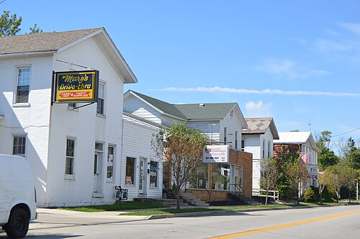
Photograph
On the map
Show this system's territory on the map — 1 ZIP code in all.
Sources
U.S. EPA SDWIS and Community Water System Service Area Boundaries (v3, 2026), Ohio EPA primacy data, 2020 census blocks: the system serving most residents, traced through purchases to the treating utility; Ohio EPA 2023 Sewer and Water Rate Survey (Ohio State, May 2025) for household bills; Ohio EPA DEFA loan awards since 2016 for the loans paragraph · EPA SDWIS · EPA service area boundaries · Ohio EPA drinking water · Ohio EPA rate survey
Notable facts: newlebanonoh.gov
History: en.wikipedia.org
Water quality: newlebanonoh.gov, data.epa.gov
Rates: newlebanonoh.gov, newlebanonoh.gov
Sewers: newlebanonoh.gov
Treatment: newlebanonoh.gov, data.epa.gov, data.epa.gov
Supply stress: newlebanonoh.gov, newlebanonoh.gov