Water system
Arcadia Village
EPA ID OH3200903 · Hancock County · 564 people served · owned by a local government
Arcadia Village buys its water from Fostoria City.
The system's record
- Water bodies
- East Branch Portage River, Lake Daugherty, Lake Mottram, Lake Lamberjack, Lake Mosier, Lake LeComte
- Raw intakes
- E Branch Portage River
E Br Portage River Reservoir - Serves
- 13,441 people · Seneca County
- EPA ID
- OH7400411
About this area's water Fostoria City
Did you know
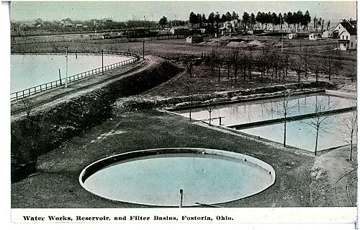
- Fostoria owns six reservoirs covering more than 450 acres of water and 700 acres of land — but two silted in too shallow to drink from, and when the current project finishes the whole city will drink from just…
- Lake Mosier, Fostoria's Reservoir 4, is being drained and turned into a wetland; at 91 water acres and 160 land acres it was the largest of the chain.
- The city was created in 1854 by merging Rome and Risdon, and named for landowner Charles W. Foster, whose son Charles Foster went on to be governor of Ohio and U.S. Secretary of the Treasury.
- The 1880s northwest Ohio natural-gas boom made Fostoria a major American glass-manufacturing center.
- In 2025 the plant distributed 791.26 million gallons of drinking water — about 160,000 gallons a day for every thousand residents served.
Source: destinationsenecacounty.orgfostoriaohio.goven.wikipedia.org
History6
- 1854City of Fostoria formed by the merger of the communities of Rome and Risdon, named for landowner Charles W. Foster.
- 1880sThe northwest Ohio natural gas boom drove rapid growth and a wave of glass-factory openings in Fostoria.
- 2024In February the city, working with ODNR, began permanently disconnecting Reservoirs 1 and 4 from the drinking water supply — both had grown too shallow to use — converting Reservoir 1 to a…
- 2025Monitoring and reporting violation: the utility failed to monitor for total microcystins during the weeks of 1/5/2025-1/18/2025. A sample was collected 1/19/2025. No health limit was exceeded.
- 2025System held an unconditioned license to operate and distributed 791.26 million gallons of drinking water.
- 2026In May, city finance staff outlined modest water and sewer rate increases to take effect in January, saying they used one-time funds where possible to hold the increases down.
Treatment & pressure
How it is treated
Surface water is the primary source. Raw water is pumped from the East Branch of the Portage River into a series of above-ground (upground) reservoirs, then treated at the Fostoria Water Treatment Plant by lime softening, coagulation with aluminum sulfate, sedimentation, stabilization, filtration…
Source: fostoriaohio.gov13abc.com
Water pressure
Not published in the CCR or on the city's water pages — no distribution-system psi figure is given.
Source: fostoriaohio.gov
What it costs
No current rate schedule is posted on the city's reachable water and sewer pages, and the codified rate structure (Fostoria Codified Ordinances 945.05) is behind a host that…
Source: citizenportal.aifostoriaohio.gov
Water quality & impurities10
| Contaminant | Level | Limit | Year |
|---|---|---|---|
| Total Organic Carbon (TOC) A value above 1 means the plant is meeting TOC removal requirements; at 2.03 it removes about twice what is required. | 2.03 (running… ratio | TT — ratio must… | 2025 |
| Turbidity Highest recorded result for the year was 0.09 NTU and 100% of samples met the 0.3 NTU limit — a filtration-performance… | 0.09 (range… NTU | TT: 1 NTU… | 2025 |
| Barium Naturally occurring; far below the limit. | 0.018 ppm | 2 | 2025 |
| Fluoride Added for dental health, plus natural erosion. | 1.23 (range… ppm | 4 | 2025 |
| Nitrate Highest inorganic detection; well below the MCL but reflects agricultural runoff in the Portage River watershed. | 2.26 (range… ppm | 10 | 2025 |
| Chlorine Residual disinfectant; compliant. | 1.35 (range… ppm | 4 (MRDL) | 2025 |
| HAA5 (haloacetic acids) Locational running annual average; disinfection byproduct, no violation. | 21.4 (LRAA… ppb | 60 | 2025 |
| TTHM (total trihalomethanes) Compliant on the locational running annual average at 89% of the MCL, but individual sample results ran as high as… | 71.13 (LRAA… ppb | 80 | 2025 |
| Copper (90th percentile) All sites below the action level. Next tap sampling round scheduled for August 2026. | 0.031 ppm | 1.3 (Action… | 2023 |
| Lead (90th percentile) All sites below the action level. Next tap sampling round scheduled for August 2026. | <0.0 (as… ppb | 15 (Action… | 2023 |
Source: fostoriaohio.gov
EPA compliance record · Arcadia Village
Lead at the tap: 90th-percentile result 0 ppb in 2023 (action level 15 ppb).
EPA health-based violations since 2015:
- 2025Total trihalomethanes (TTHM) · above the legal limit on average · measured 0.087 MG/L (limit 0.08 MG/L) · returned to compliance
- 2019Total trihalomethanes (TTHM) · above the legal limit on average · measured 0.084 MG/L (limit 0.08 MG/L) · returned to compliance
- 2018Total trihalomethanes (TTHM) · above the legal limit on average · measured 0.083 MG/L (limit 0.08 MG/L) · returned to compliance
- 2017Total trihalomethanes (TTHM) · above the legal limit on average · measured 0.084 MG/L (limit 0.08 MG/L) · returned to compliance
EPA's count of 12 includes 8 repeat quarterly violations of the problems listed.
5 violations of any kind logged since 2020: 2 for required testing that was missed or reported late; 3 health-based.
EPA compliance record · Fostoria City (treats the water)
Lead at the tap: 90th-percentile result 0 ppb in 2023 (action level 15 ppb).
EPA record: no health-based violations since 2015.
Projects & plans4
Recent and current work
- Reservoir 1 and Reservoir 4 disconnection and conversion · 2024-2025 · under construction
Permanently removing Reservoirs 1 (Lake Daugherty) and 4 (Lake Mosier) from the drinking water system — both had become too shallow to use — and converting…
Planned or needed
- Lead and copper tap sampling round · 2026 · planned
The city will conduct lead and copper tap testing in August 2026 under the Lead and Copper Rule; residents can volunteer their tap by contacting the water… - Water and sewer rate increase · 2026-2027 · planned
Staff briefed council in May 2026 on modest increases effective in January; formal rate legislation was to be presented at a following meeting. Dollar amounts… - Completion of transition to Reservoirs 5 and 6 as sole supply · planned
Once the Reservoir 1 and 4 conversions finish, all of Fostoria's drinking water will come from Reservoirs 5 and 6, the newest of the six.
Supply stress
Ohio EPA's source water assessment rates the East Branch of the Portage River as having HIGH susceptibility to contamination, owing to the nature of surface water sources generally and to surrounding land uses in the watershed — the CCR is explicit that this rates potential, not current safety. Two concrete pressures: harmful algal…
Source: fostoriaohio.gov13abc.com
Sewers
Sanitary
Operated by the City of Fostoria. The city is under an Ohio EPA consent order to separate stormwater from sanitary sewage — heavy rain has pushed sanitary flows into surface waters — which is the regulatory driver behind the reservoir conversion project. Plant capacity, receiving stream and the order's terms are not published on the city…
Storm
The Reservoir 1 and 4 conversions serve double duty as stormwater management, creating pools and a connecting stream to capture Portage River water during rainfall events and reduce downstream flooding. We found no separate stormwater utility or fee.
Sourcesverified
Compiled from the utility's own reports and public records, then independently re-checked against primary sources.
Present in 1 ZIP code
Serves
Main water supplier in 1 ZIP code
- 44804 · Arcadia38% of residents
Population-weighted resident shares; a ZIP code can have more than one system on record. Recomputed from each ZIP's own system list, not from the map's cached footprint.
Buys from · Sells to
Arcadia Village buys its water from Fostoria City.
No other system is on record buying water from Arcadia Village.
What the records show about Arcadia Village
Who runs it
EPA's record describes Arcadia Village as owned by a local government. It has 330 service connections and serves 564 people.
EPA classes it as a community water system, one that serves the same residents all year.
Its office telephone on EPA's record is 419-894-6315.
Source: EPA Safe Drinking Water Information System (SDWIS), water system record.
How the water is treated
Arcadia Village buys water that Fostoria City treats first, so the steps that count are the seller's. EPA's treatment table registers these steps for Fostoria City: corrosion control, coagulation and settling, chlorine disinfection, iron and manganese removal, fluoridation, lime softening, powdered activated carbon, and sand or media filtration.
Arcadia Village itself also registers: aeration.
The list is what each system registered with EPA for treatment plants EPA still shows as active, and it can lag a plant upgrade.
Source: EPA Safe Drinking Water Information System (SDWIS) treatment table (EPA Envirofacts, pulled September 2026).
Violations
EPA counts 12 health-based violations for Arcadia Village since 2015. Health-based means a contaminant above its legal limit or a required treatment step not carried out. They fall into 4 separate problems (one contaminant or rule in one year); the table lists them all.
EPA logs a violation for each compliance period a problem lasts, so the count of 12 includes 8 repeat entries of the problems listed.
EPA logs 5 violations of any kind since 2020: 2 for required testing that was missed or reported late; 3 health-based.
| Year | Contaminant or rule | Kind | Measured | Limit | Status in EPA's record |
|---|---|---|---|---|---|
| 2025 | Total trihalomethanes (TTHM) | above the legal limit on average | 0.087 mg/L | 0.08 mg/L | returned to compliance |
| 2019 | Total trihalomethanes (TTHM) | above the legal limit on average | 0.084 mg/L | 0.08 mg/L | returned to compliance |
| 2018 | Total trihalomethanes (TTHM) | above the legal limit on average | 0.083 mg/L | 0.08 mg/L | returned to compliance |
| 2017 | Total trihalomethanes (TTHM) | above the legal limit on average | 0.084 mg/L | 0.08 mg/L | returned to compliance |
Source: EPA Safe Drinking Water Information System (SDWIS) violation records: health-based violations with compliance periods beginning in 2015 or later, all violations from 2020 or later (EPA Envirofacts, pulled September 2026).
Lead and copper at the tap
In the sampling period ending December 2023, the 90th-percentile lead result at Arcadia Village was 0 ppb, under both the current 15 ppb action level and the 10 ppb level that applies from 2027. A result of 0 means at least nine in ten of the homes sampled had no lead detected.
EPA has 3 sampling periods on file for Arcadia Village since 2016, the first ending in 2017; no period was above 10 ppb.
Every water system has to inventory its service lines, the pipes from the main to each building. In the inventory Arcadia Village sent EPA, 376 lines are counted.
| Material | Lines |
|---|---|
| Lead | 0 |
| Galvanized, needing replacement | 0 |
| Unknown material | 0 |
| Not lead | 376 |
| All lines | 376 |
Systems sample taps in the homes most likely to have lead pipes or solder. The 90th-percentile result is the level nine in ten of the sampled homes were at or below. Lead comes mostly from service lines and house plumbing, not the source water, so a low result for the system does not clear an old house.
EPA's dashboard status for this inventory: reported all required service line types.
Source: EPA Safe Drinking Water Information System (SDWIS) lead and copper 90th-percentile results (EPA Envirofacts), sampling periods ending 2016 or later; EPA's service line inventory dashboard, Ohio's 2026 Q2 submission.
PFAS
The water Arcadia Village buys is treated by Fostoria City, so the results below are Fostoria City's.
EPA's fifth national round of testing (UCMR 5) took 7 samples of the water entering the pipes of Fostoria City in 2023 to 2024 and measured 29 PFAS. No PFAS was detected, PFOA and PFOS (federal limit 4 ng/L each) among them.
The system reported potential PFAS sources near its supply.
Ohio EPA's own statewide sampling tested 1 plant of Fostoria City (latest sample September 2020). Not one of the six PFAS tested (PFOA, PFOS, PFHxS, PFNA, GenX and PFBS) was detected.
Ohio EPA's current sampling status map lists 1 plant of Fostoria City as sampled, most recently June 2024.
PFAS are the 'forever chemicals' from firefighting foam, plating shops and non-stick coatings. Results are for water leaving the plant, not your tap.
Source: EPA UCMR 5 occurrence data (final release, August 2026); Ohio EPA statewide PFAS sampling, 2019 to 2021, and its sampling status map.
Disinfection byproducts
Chlorine that disinfects water also reacts with organic matter to form byproducts. Two groups have federal limits: total trihalomethanes (TTHM, 80 µg/L) and five haloacetic acids (HAA5, 60 µg/L), judged on running yearly averages at each sampling site.
For TTHM, the average of Arcadia Village's samples in 2019, the last year it was sampled, was 55.4 µg/L. The worst yearly average was 81.1 µg/L and the highest single sample was 125 µg/L, from 59 samples taken from 2012 to 2019. A yearly average over 80 is not itself a violation, because compliance is judged site by site.
For HAA5, the average in the last year sampled was 24 µg/L. The worst yearly average was 34.3 µg/L and the highest single sample was 43.9 µg/L, from 57 samples.
| Byproduct | Limit | Latest yearly average | Worst yearly average | Highest sample | Samples |
|---|---|---|---|---|---|
| TTHM | 80 µg/L | 55.4 µg/L (2019) | 81.1 µg/L | 125 µg/L | 59 |
| HAA5 | 60 µg/L | 24 µg/L | 34.3 µg/L | 43.9 µg/L | 57 |
A yearly average of 0 means nothing was detected in that year's samples. EPA's file stops at 2019; Ohio EPA's Drinking Water Watch has newer results.
Source: EPA Six-Year Review 4 compliance monitoring data, 2012 to 2019, distribution-system samples (non-detects counted as zero).
Nitrate, arsenic and radioactivity
The water Arcadia Village buys is treated by Fostoria City, so the results below are Fostoria City's.
Nitrate: the highest of 96 samples was 2.89 mg/L (as nitrogen) in 2017; in 2019, the last year sampled, the highest was 1.53 mg/L. No sample was over the limit of 10 mg/L. Nitrate above 10 is unsafe for infants.
Arsenic was not detected in 8 samples (limit 10 µg/L).
| Contaminant | Samples | Highest result | Limit | Samples over limit |
|---|---|---|---|---|
| Nitrate (as nitrogen) | 96 | 2.89 mg/L | 10 mg/L | 0 |
| Arsenic | 8 | not detected | 10 µg/L | 0 |
| Combined radium | 1 | 0.9 pCi/L | 5 pCi/L | 0 |
Measured in finished water: at the plant's entry points and in the distribution system; raw well and intake samples are left out. Non-detects count as zero.
Source: EPA Six-Year Review 4 compliance monitoring data, 2012 to 2019, finished water of Fostoria City.
Solvents and fuels
The water Arcadia Village buys is treated by Fostoria City, so the results below are Fostoria City's.
EPA's file holds results for all six solvent and fuel compounds it checked. Benzene, carbon tetrachloride, 1,2-dichloroethane, trichloroethylene, tetrachloroethylene, and vinyl chloride were not detected in 8 samples each.
| Compound | Limit | Samples | Detected in | Highest result | Samples over limit |
|---|---|---|---|---|---|
| Benzene | 5 µg/L | 8 | 0 of 8 | not detected | 0 |
| Carbon tetrachloride | 5 µg/L | 8 | 0 of 8 | not detected | 0 |
| 1,2-dichloroethane | 5 µg/L | 8 | 0 of 8 | not detected | 0 |
| Trichloroethylene (TCE) | 5 µg/L | 8 | 0 of 8 | not detected | 0 |
| Tetrachloroethylene (PCE) | 5 µg/L | 8 | 0 of 8 | not detected | 0 |
| Vinyl chloride | 2 µg/L | 8 | 0 of 8 | not detected | 0 |
"Not detected" means the lab's result was below what its method can measure, not that the compound is absent. Non-detects count as zero in the highest-result column.
Source: EPA Six-Year Review 4 compliance monitoring data, 2012 to 2019, finished water of Fostoria City.
Farm chemicals and metals
The water Arcadia Village buys is treated by Fostoria City, so the results below are Fostoria City's.
EPA's file holds results for 8 of the nine herbicides and metals it checked. Detected: atrazine in 10 of 16 samples, highest 0.31 µg/L (limit 3); barium in 7 of 8 samples, highest 15 µg/L (limit 2,000). Not detected: alachlor in 16 samples, chromium in 8 samples, cadmium in 8 samples, mercury in 8 samples, selenium in 8 samples, thallium in 8 samples.
| Substance | Kind | Limit | Samples | Detected in | Highest result | Samples over limit |
|---|---|---|---|---|---|---|
| Atrazine | Farm chemical | 3 µg/L | 16 | 10 of 16 | 0.31 µg/L | 0 |
| Alachlor | Farm chemical | 2 µg/L | 16 | 0 of 16 | not detected | 0 |
| Chromium | Metal | 100 µg/L | 8 | 0 of 8 | not detected | 0 |
| Cadmium | Metal | 5 µg/L | 8 | 0 of 8 | not detected | 0 |
| Barium | Metal | 2,000 µg/L | 8 | 7 of 8 | 15 µg/L | 0 |
| Mercury | Metal | 2 µg/L | 8 | 0 of 8 | not detected | 0 |
| Selenium | Metal | 50 µg/L | 8 | 0 of 8 | not detected | 0 |
| Thallium | Metal | 2 µg/L | 8 | 0 of 8 | not detected | 0 |
Non-detects count as zero in the highest-result column.
Source: EPA Six-Year Review 4 compliance monitoring data, 2012 to 2019, finished water of Fostoria City.
Bacteria in the pipes
From 2012 to 2019, 0 of 96 routine total coliform samples taken in the distribution system at Arcadia Village tested positive (0%); in 2019, the last year on file, 0 of 11 did.
A positive coliform test is a warning sign, not a violation by itself. E. coli is a sign that human or animal waste may have reached the water. Coliform counts are routine samples only; E. coli counts include repeat samples.
Source: EPA Six-Year Review 4 compliance monitoring data, 2012 to 2019, distribution-system presence/absence tests for total coliform and E. coli.
Fluoride
The Ohio Department of Health's report to the CDC (My Water's Fluoride) says Arcadia Village buys its water from Fostoria City, a system that adjusts the fluoride level to the recommended level for preventing tooth decay.
EPA's treatment table lists fluoridation among the steps at Fostoria City, which treats the water Arcadia Village buys.
Measured fluoride: 0.9 mg/L on average leaving the plants of Fostoria City, which supplies Arcadia Village, in 2019 (in the range dentists aim for); samples ran from 0.9 to 1.12 mg/L across 8 samples in 2012 to 2019.
The recommended level for preventing tooth decay is 0.7 mg/L; the federal limit is 4 mg/L. The treatment list is what each system registered with EPA and can lag a plant upgrade.
Source: CDC My Water's Fluoride (fluoridation status as reported by the Ohio Department of Health, fetched September 2026); EPA Safe Drinking Water Information System (SDWIS) treatment table; EPA Six-Year Review 4 compliance monitoring data, 2012 to 2019, entry-point fluoride samples.
Lithium
Lithium was not detected in 4 UCMR 5 samples at Fostoria City, which supplies Arcadia Village, last sampled in 2023 (the method reports from 9 µg/L).
Lithium is not regulated. EPA's draft health reference level is 10 µg/L, and it occurs naturally in deep groundwater, so well systems in the northwest run highest.
Source: EPA UCMR 5 occurrence data (final release, August 2026), samples from 2023 to 2025.
Algal toxins
The water Arcadia Village buys is treated by Fostoria City, so the results below are Fostoria City's.
Ohio EPA tests for microcystin, a toxin that harmful algal blooms can release, in raw water at the intake and in treated water.
No microcystin was detected in the 236 raw-water samples.
Microcystin was never detected in treated water (253 samples).
In all, 489 samples from 2016 to 2026, the latest on August 24, 2026.
| Water | Samples | Detections | Highest result |
|---|---|---|---|
| Raw water, at the intake | 236 | 0 | not detected |
| Treated water | 253 | 0 | not detected |
The ten-day advisory levels for treated water are 0.3 µg/L for children under six and 1.6 µg/L for everyone else. Any detection at the intake triggers more frequent testing until two clean weeks.
Source: Ohio EPA public water system harmful algal bloom monitoring, 2016 to present (HAB data, fetched September 2026).
How well the service area is mapped
EPA estimated the service area of Arcadia Village with a computer model rather than drawing it from the utility's map, so its edges are approximate.
Source: EPA Service Area Boundaries; resident estimate by this atlas from ZIP-code overlap.
On the map
Show this system's territory on the map — 1 ZIP code in all.
Sources
U.S. EPA SDWIS and Community Water System Service Area Boundaries (v3, 2026), Ohio EPA primacy data, 2020 census blocks: the system serving most residents, traced through purchases to the treating utility; Ohio EPA 2023 Sewer and Water Rate Survey (Ohio State, May 2025) for household bills; Ohio EPA DEFA loan awards since 2016 for the loans paragraph · EPA SDWIS · EPA service area boundaries · Ohio EPA drinking water · Ohio EPA rate survey
EPA's own record for this system: Enforcement and Compliance History report for OH3200903 (EPA ECHO).
