Water system
Clark County Park Layne
EPA ID OH1201112 · Clark County · 4,221 people served · owned by a local government
Clark County Park Layne treats its own water from Groundwater wells (3 wells).
The system's record
- Active wells
- 3
- Serves
- 4,221 people · Clark County
- EPA ID
- OH1201112
About this area's water
Did you know
- Park Layne's three wells sit in the Great Miami Buried Valley Aquifer and average about 439,000 gallons a day - roughly 104 gallons per person served.
- Clark County runs eight separately priced water and sewer districts; Park Layne is one of the cheapest because it pumps its own groundwater, while the Northridge and Rockway districts carry a 12% City of Springfield…
- In the Medway and Crystal Lakes vacuum sewer systems, sewage is pulled to the collection stations under vacuum rather than pushed by gravity - and because the collection tank cannot be taken out of service without…
- The county's own 2025 report misspells its system as the 'Park Lanye PWS' in the unregulated contaminant section.
Source: clarkcountyohio.govclarkcountyohio.govclarkcountyohio.gov
History6
- 1958Clark County's utilities operation was established by the Board of County Commissioners; it now runs the Park Layne, Green Meadows I and II, Limecrest, Northridge, Center Point 70, Rockway…
- 1816Medway, the village the Park Layne district supplies, was platted and named for sitting midway between Springfield and Dayton (Wikipedia).
- 1992The county's two Airvac vacuum sewage collection systems serving Medway and Crystal Lakes were constructed.
- 2023-11A contractor's survey of the Crystal Lakes vacuum station steel collection tank found wall thickness reduced to the point that both station tanks needed replacement; pinholes had earlier been patched…
- 2024Park Layne participated in the fifth round of the Unregulated Contaminant Monitoring Rule (UCMR5); results are available only by phoning the utilities director.
- 2025Clark County held an unconditioned license to operate the Park Layne system and recorded no water quality violations.
Source: clarkcountyohio.govclarkcountyohio.govclarkcountyohio.gov
Treatment & pressure
How it is treated
Groundwater. The Park Layne Well Field at 886 Weinland Street draws from the Great Miami Buried Valley Aquifer through three wells producing an average of about 439,000 gallons per day. Treatment documented in the 2025 CCR is chlorination (total chlorine 0.79-1.27 ppm in distribution) and…
Source: clarkcountyohio.govdata.epa.gov
Water pressure
Not published; the county's CCR and billing pages give no system pressure figures.
Source: clarkcountyohio.gov
What it costs
$5.68 per 1,000 gallons
Typical household bill about $33 a month for water.
Park Layne district water, effective on bills sent after 1-29-2026 (Appendix A of the Clark County Water and Sewer Regulations): 5/8-inch meter minimum $16.16 per month, which…
Water quality & impurities5
| Contaminant | Level | Limit | Year |
|---|---|---|---|
| Nitrate Roughly 41% of the MCL in a shallow, highly susceptible buried-valley aquifer with agricultural and septic sources… | 4.14 ppm | 10 (MCL) | 2025 |
| Copper 0 of 20 samples over the action level. No lead result appears in the 2025 CCR's detected-contaminant table. | 0.360 (90th… ppm | 1.3 (action… | 2024 |
| Total trihalomethanes (TTHM) Low, as expected for chlorinated groundwater with little organic carbon. | 17.2 (range… ppb | 80 (MCL) | 2025 |
| Total chlorine Residual disinfectant in the Park Layne distribution system. | 1.13 (range… ppm | 4 (MRDL) | 2025 |
| Fluoride Fluoridated to about the optimal 0.7-1.0 ppm range. | 1.01 (range… ppm | 4 (MCL) | 2025 |
Source: clarkcountyohio.gov
EPA compliance record
Lead at the tap: 90th-percentile result 0 ppb in 2024 (action level 15 ppb).
EPA record: no health-based violations since 2015.
Projects & plans2
Recent and current work
- Crystal Lakes and Medway vacuum sewer tank replacement · $1.1 million · 2026 · planned
Fiberglass replacement collection tanks at the Medway Station (214 Sycamore Street) and Crystal Lakes Station (5 Elm Road), with the corroded 1992 steel tanks… - Lead service line inventory · 2024 · completed
Published as a shared spreadsheet linked from the Park Layne CCR.
Source: clarkcountyohio.govclarkcountyohio.govclarkcountyohio.gov
Supply stress
Ohio EPA's source water assessment found the aquifer supplying Park Layne has a high susceptibility to contamination because a relatively thin clay layer overlies it, the water table is shallow, and potential contamination sources sit in the protection areas. The district has only three wells averaging about 439,000 gpd for roughly 4,200…
Source: clarkcountyohio.govdata.epa.gov
Sewers
Sanitary
Clark County Utilities also provides sanitary sewer in the Park Layne district (5/8-inch minimum $22.07 per month plus $5.05 per 100 cubic feet over 300 cf). Nearby Medway and Crystal Lakes are served by two 1992 Airvac vacuum collection systems in which up to four houses drain by gravity into each vacuum pit; the county does not publish…
Storm
Not documented in county utilities materials.
Source: clarkcountyohio.govclarkcountyohio.govclarkcountyohio.gov
Sourcesverified
Compiled from the utility's own reports and public records, then independently re-checked against primary sources.
Main supplier in 1 ZIP code
Serves
Main water supplier in 1 ZIP code
- 45341 · Bethel Township and Medway34% of residents
Also present in 1 more ZIP code
- 45344 · Bethel Township and New Carlisle24% of residents
Population-weighted resident shares; a ZIP code can have more than one system on record. Recomputed from each ZIP's own system list, not from the map's cached footprint.
Buys from · Sells to
Clark County Park Layne does not buy water from another system on record; it treats its own source water.
1 system on record buys water from Clark County Park Layne: Bethel Township Water System.
What the records show about Clark County Park Layne
Who runs it
EPA's record describes Clark County Park Layne as owned by a local government. It has 1,702 service connections and serves 4,221 people.
EPA classes it as a community water system, one that serves the same residents all year.
Source: EPA Safe Drinking Water Information System (SDWIS), water system record.
How the water is treated
EPA's treatment table registers these steps for Clark County Park Layne: corrosion control, chlorine disinfection, and fluoridation.
The list is what each system registered with EPA for treatment plants EPA still shows as active, and it can lag a plant upgrade.
Source: EPA Safe Drinking Water Information System (SDWIS) treatment table (EPA Envirofacts, pulled September 2026).
Violations
EPA's record shows no health-based violations for Clark County Park Layne since 2015.
EPA logs no violations of any kind for Clark County Park Layne since 2020.
Source: EPA Safe Drinking Water Information System (SDWIS) violation records: health-based violations with compliance periods beginning in 2015 or later, all violations from 2020 or later (EPA Envirofacts, pulled September 2026).
Lead and copper at the tap
In the sampling period ending December 2024, the 90th-percentile lead result at Clark County Park Layne was 0 ppb, under both the current 15 ppb action level and the 10 ppb level that applies from 2027. A result of 0 means at least nine in ten of the homes sampled had no lead detected.
EPA has 3 sampling periods on file for Clark County Park Layne since 2016, the first ending in 2018; no period was above 10 ppb.
Every water system has to inventory its service lines, the pipes from the main to each building. In the inventory Clark County Park Layne sent EPA, 1,702 lines are counted.
| Material | Lines |
|---|---|
| Lead | 0 |
| Galvanized, needing replacement | 0 |
| Unknown material | 1,362 |
| Not lead | 340 |
| All lines | 1,702 |
Systems sample taps in the homes most likely to have lead pipes or solder. The 90th-percentile result is the level nine in ten of the sampled homes were at or below. Lead comes mostly from service lines and house plumbing, not the source water, so a low result for the system does not clear an old house.
EPA's dashboard status for this inventory: reported all required service line types.
Source: EPA Safe Drinking Water Information System (SDWIS) lead and copper 90th-percentile results (EPA Envirofacts), sampling periods ending 2016 or later; EPA's service line inventory dashboard, Ohio's 2026 Q2 submission.
PFAS
EPA's fifth national round of testing (UCMR 5) took 2 samples of the water entering the pipes of Clark County Park Layne in 2024 and measured 29 PFAS. No PFAS was detected, PFOA and PFOS (federal limit 4 ng/L each) among them.
Ohio EPA's own statewide sampling tested 1 plant of Clark County Park Layne (latest sample July 2020). Not one of the six PFAS tested (PFOA, PFOS, PFHxS, PFNA, GenX and PFBS) was detected.
PFAS are the 'forever chemicals' from firefighting foam, plating shops and non-stick coatings. Results are for water leaving the plant, not your tap.
Source: EPA UCMR 5 occurrence data (final release, August 2026); Ohio EPA statewide PFAS sampling, 2019 to 2021, and its sampling status map.
Disinfection byproducts
Chlorine that disinfects water also reacts with organic matter to form byproducts. Two groups have federal limits: total trihalomethanes (TTHM, 80 µg/L) and five haloacetic acids (HAA5, 60 µg/L), judged on running yearly averages at each sampling site.
For TTHM, the average of Clark County Park Layne's samples in 2019, the last year it was sampled, was 20 µg/L. The worst yearly average was 20 µg/L and the highest single sample was 33.8 µg/L, from 14 samples taken from 2013 to 2019.
For HAA5, the average in the last year sampled was 0 µg/L. The worst yearly average was 4.1 µg/L and the highest single sample was 5.2 µg/L, from 14 samples.
| Byproduct | Limit | Latest yearly average | Worst yearly average | Highest sample | Samples |
|---|---|---|---|---|---|
| TTHM | 80 µg/L | 20 µg/L (2019) | 20 µg/L | 33.8 µg/L | 14 |
| HAA5 | 60 µg/L | 0 µg/L | 4.1 µg/L | 5.2 µg/L | 14 |
A yearly average of 0 means nothing was detected in that year's samples. EPA's file stops at 2019; Ohio EPA's Drinking Water Watch has newer results.
Source: EPA Six-Year Review 4 compliance monitoring data, 2012 to 2019, distribution-system samples (non-detects counted as zero).
Nitrate, arsenic and radioactivity
Nitrate: the highest of 8 samples was 5.61 mg/L (as nitrogen) in 2013; in 2019, the last year sampled, nitrate was not detected. No sample was over the limit of 10 mg/L. Nitrate above 10 is unsafe for infants.
Arsenic was not detected in 2 samples (limit 10 µg/L).
| Contaminant | Samples | Highest result | Limit | Samples over limit |
|---|---|---|---|---|
| Nitrate (as nitrogen) | 8 | 5.61 mg/L | 10 mg/L | 0 |
| Arsenic | 2 | not detected | 10 µg/L | 0 |
Measured in finished water: at the plant's entry points and in the distribution system; raw well and intake samples are left out. Non-detects count as zero.
Source: EPA Six-Year Review 4 compliance monitoring data, 2012 to 2019, finished water.
Solvents and fuels
EPA's file holds results for all six solvent and fuel compounds it checked. Benzene, carbon tetrachloride, 1,2-dichloroethane, trichloroethylene, tetrachloroethylene, and vinyl chloride were not detected in 2 samples each.
| Compound | Limit | Samples | Detected in | Highest result | Samples over limit |
|---|---|---|---|---|---|
| Benzene | 5 µg/L | 2 | 0 of 2 | not detected | 0 |
| Carbon tetrachloride | 5 µg/L | 2 | 0 of 2 | not detected | 0 |
| 1,2-dichloroethane | 5 µg/L | 2 | 0 of 2 | not detected | 0 |
| Trichloroethylene (TCE) | 5 µg/L | 2 | 0 of 2 | not detected | 0 |
| Tetrachloroethylene (PCE) | 5 µg/L | 2 | 0 of 2 | not detected | 0 |
| Vinyl chloride | 2 µg/L | 2 | 0 of 2 | not detected | 0 |
"Not detected" means the lab's result was below what its method can measure, not that the compound is absent. Non-detects count as zero in the highest-result column.
Source: EPA Six-Year Review 4 compliance monitoring data, 2012 to 2019, finished water.
Farm chemicals and metals
EPA's file holds results for 8 of the nine herbicides and metals it checked. Detected: barium in 2 of 2 samples, highest 90 µg/L (limit 2,000). Not detected: atrazine in 3 samples, alachlor in 3 samples, chromium in 2 samples, cadmium in 2 samples, mercury in 2 samples, selenium in 2 samples, thallium in 2 samples.
| Substance | Kind | Limit | Samples | Detected in | Highest result | Samples over limit |
|---|---|---|---|---|---|---|
| Atrazine | Farm chemical | 3 µg/L | 3 | 0 of 3 | not detected | 0 |
| Alachlor | Farm chemical | 2 µg/L | 3 | 0 of 3 | not detected | 0 |
| Chromium | Metal | 100 µg/L | 2 | 0 of 2 | not detected | 0 |
| Cadmium | Metal | 5 µg/L | 2 | 0 of 2 | not detected | 0 |
| Barium | Metal | 2,000 µg/L | 2 | 2 of 2 | 90 µg/L | 0 |
| Mercury | Metal | 2 µg/L | 2 | 0 of 2 | not detected | 0 |
| Selenium | Metal | 50 µg/L | 2 | 0 of 2 | not detected | 0 |
| Thallium | Metal | 2 µg/L | 2 | 0 of 2 | not detected | 0 |
Non-detects count as zero in the highest-result column.
Source: EPA Six-Year Review 4 compliance monitoring data, 2012 to 2019, finished water.
Bacteria in the pipes
From 2012 to 2019, 0 of 676 routine total coliform samples taken in the distribution system at Clark County Park Layne tested positive (0%); in 2019, the last year on file, 0 of 85 did.
A positive coliform test is a warning sign, not a violation by itself. E. coli is a sign that human or animal waste may have reached the water. Coliform counts are routine samples only; E. coli counts include repeat samples.
Source: EPA Six-Year Review 4 compliance monitoring data, 2012 to 2019, distribution-system presence/absence tests for total coliform and E. coli.
Fluoride
The Ohio Department of Health's report to the CDC (My Water's Fluoride) says Clark County Park Layne adjusts the fluoride level to the recommended level for preventing tooth decay.
EPA's treatment table lists fluoridation among the steps at Clark County Park Layne.
Measured fluoride: 1.17 mg/L on average at the plant's entry points in 2017 (in the range dentists aim for); samples ran from 1.06 to 1.17 mg/L across 2 samples in 2012 to 2019.
The recommended level for preventing tooth decay is 0.7 mg/L; the federal limit is 4 mg/L. The treatment list is what each system registered with EPA and can lag a plant upgrade.
Source: CDC My Water's Fluoride (fluoridation status as reported by the Ohio Department of Health, fetched September 2026); EPA Safe Drinking Water Information System (SDWIS) treatment table; EPA Six-Year Review 4 compliance monitoring data, 2012 to 2019, entry-point fluoride samples.
Lithium
Lithium was not detected in 2 UCMR 5 samples at Clark County Park Layne, last sampled in 2024 (the method reports from 9 µg/L).
Lithium is not regulated. EPA's draft health reference level is 10 µg/L, and it occurs naturally in deep groundwater, so well systems in the northwest run highest.
Source: EPA UCMR 5 occurrence data (final release, August 2026), samples from 2023 to 2025.
How well the service area is mapped
EPA estimated the service area of Clark County Park Layne with a computer model rather than drawing it from the utility's map, so its edges are approximate.
Counting the people who live in the ZIP codes it overlaps, this atlas estimates 5,377 residents are inside the boundary, 127% of the 4,221 people Clark County Park Layne reports serving.
The resident count is an estimate from 2020 Census ZIP-code populations, not a count of customers.
Source: EPA Service Area Boundaries; resident estimate by this atlas from ZIP-code overlap.
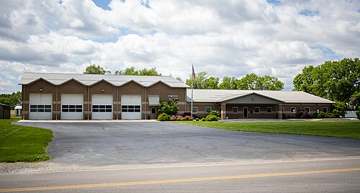
Photograph
On the map
Show this system's territory on the map — 2 ZIP codes in all.
Sources
U.S. EPA SDWIS and Community Water System Service Area Boundaries (v3, 2026), Ohio EPA primacy data, 2020 census blocks: the system serving most residents, traced through purchases to the treating utility; Ohio EPA 2023 Sewer and Water Rate Survey (Ohio State, May 2025) for household bills; Ohio EPA DEFA loan awards since 2016 for the loans paragraph · EPA SDWIS · EPA service area boundaries · Ohio EPA drinking water · Ohio EPA rate survey
EPA's own record for this system: Enforcement and Compliance History report for OH1201112 (EPA ECHO).
Notable facts: clarkcountyohio.gov, clarkcountyohio.gov, clarkcountyohio.gov
History: clarkcountyohio.gov, clarkcountyohio.gov, clarkcountyohio.gov, en.wikipedia.org
Water quality: clarkcountyohio.gov
Water pressure: clarkcountyohio.gov
Capital projects: clarkcountyohio.gov, clarkcountyohio.gov, clarkcountyohio.gov
Rates: clarkcountyohio.gov, clarkcountyohio.gov
Sewers: clarkcountyohio.gov, clarkcountyohio.gov, clarkcountyohio.gov
Treatment: clarkcountyohio.gov, data.epa.gov
Supply stress: clarkcountyohio.gov, data.epa.gov
