How Delaware Township, Delaware County began
Delaware Township was organized June 16, 1808 around ground the Lenape (Delaware) and Mingo peoples had occupied until 1802, drawn there by a mineral spring the Delawares called the "Medicine Waters" and a deer lick on the same ground where the county courthouse now stands. Land speculators Moses Byxbe and Henry Baldwin platted the city of Delaware there in 1808 after an earlier, abandoned plat, and the sulphur spring's reputation as a watering place led directly to the site's second life: in 1842 Delaware citizens bought the old spring-side hotel and offered it to the Methodist Episcopal Church, founding Ohio Wesleyan University. The township has shrunk repeatedly as neighboring townships were carved from it - Troy in 1816, Berlin in 1820, Brown in 1826, a piece to Concord in 1852 - until today it is largely coextensive with the city of Delaware itself.
Settled 1808, platted 1808, incorporated 1808-06-16, by Moses Byxbe and Henry Baldwin (city plat); Delaware County Commissioners (township).
Where the name comes from
The township, like the county and city, takes its name from the Lenape (Delaware) people, who had villages on the ground before white settlement, and whose own name in turn derives from the Delaware River and ultimately from Thomas West, 3rd Baron De La Warr, an early Virginia colonial governor - the Lenape's English exonym rather than their own name for themselves. The township was organized June 16, 1808 as one of the county's original divisions, at first covering all of Township 5 and the northern half of Township 4 of the U.S. Military Survey plus parts of Brown and Berlin.
Before the town
Delaware Township holds some of the best-documented site-specific Native history in the county. The 1880 county history states that two Delaware villages stood within the limits of the present city of Delaware - one around the east end of Williams Street, the other at the west end, extending from near a saw-mill to the hillside - with a cultivated corn-field of about 400 acres on the ground the town now occupies; a Mingo village stood a short distance above town on "Horse-shoe Bottom," where they too raised corn. Indian agent John Johnston, quoted in the same source, gave the Delawares' own name for themselves as "Wa-be-nugh-ka," meaning "the people from the East." A noted deer lick and "medicine spring" - later called the White Sulphur Springs, celebrated by the Delawares as sacred healing water - stood on ground within today's city, at the foot of the ridge where the courthouse and, later, Ohio Wesleyan University's campus would rise; local tradition held it was also visited by the prophet associated with Pontiac's movement, urging resistance to encroaching settlement. The Treaty of Greenville (1795) had already ceded this ground to the United States, but the Delawares did not leave the area until 1802, the last Native occupants recorded here before the arrival of the township's first white settlers.
Nations recorded here: Lenape (Delaware), Mingo (Seneca-Cayuga), Shawnee, Wyandot.
- Delaware villages at Williams Street (village) — east and west ends of present Williams Street, city of Delaware, until 1802 (dn710906.ca.archive.org)
- Mingo village at Horse-shoe Bottom (village) — on the Olentangy River just above the city of Delaware, until early 1800s (dn710906.ca.archive.org)
- White Sulphur Springs / deer lick (other) — within the city of Delaware, on ground later occupied by Ohio Wesleyan University's campus, pre-1808 (dn710906.ca.archive.org)
Timeline
- — The Treaty of Fort McIntosh cedes land south of the later Greenville line, though the cession is not secured until Wayne's victory a decade later.
- — The Treaty of Greenville confirms the cession of this territory to the United States after the defeat of the Northwest Confederacy.
- — The Delawares leave the site of the future city of Delaware, ending their occupation of the ground around the sulphur spring and the Olentangy villages.
- — President John Adams patents 4,000-acre military tracts to Abraham Baldwin of Georgia, land that later passes to his half-brother Henry Baldwin and becomes part of the city plat.
- — Henry Baldwin and Moses Byxbe agree to plat a town of Delaware on the east side of the Olentangy River; this plat is abandoned and never recorded.
- — A second plat locates the town of Delaware on the west side of the Olentangy River, the site that becomes the permanent city.
- — Delaware Township is organized as one of the county's original divisions.
- — The first mill at Stratford, on the Olentangy, is built - the beginning of a milling site that later becomes a paper-mill village.
- — Troy Township is set off from the northern part of Delaware Township.
- — The Berlin section is taken off from Delaware Township.
- — Brown Township is organized from part of Delaware Township, leaving Delaware in a regular five-mile-square shape.
- — Judge Henry Baldwin and Moses Byxbe donate four acres including the sulphur spring, plus the town park, to the village of Delaware.
- — The "Mansion House" hotel is completed at the sulphur spring grounds, built under the direction of Judge Thomas W. Powell.
- — The old flouring-mill property at Stratford is purchased for conversion into a paper mill.
- — John Hoyt's paper mill begins operation at Stratford, and Hoyt gives the settlement its classical name.
- — Judge Powell sells the Mansion House property to the Methodist Episcopal Church.
- — Ohio Wesleyan University is chartered by the Ohio Legislature on the former sulphur-spring hotel property.
- — The college regularly organizes and opens for instruction in the fall, with Rev. Edward Thompson as its first president.
- — The Wesleyan Female College is founded in the spring, opening to students that September under the North Ohio Annual Conference.
- — A square mile is transferred from Delaware Township's southwest corner to Concord Township, fixing the township's present boundaries.
- — Austin Hall is built on the Ohio Wesleyan University campus.
Stories
The Medicine Waters
Where Ohio Wesleyan University's campus now stands, in the southern part of the city of Delaware, a sulphur spring rose from the ground that the Delaware and Mingo people who lived nearby called the "Medicine Waters." The 1880 county history, quoting the Delaware Herald, records that the earliest white visitors found the spring already a place of note among Native people, who gathered there in large numbers and camped on the surrounding ground, and that buffalo tracks were still visible around the spring when the first settlers arrived, drawn by the same healthful waters. A deer lick at the foot of the ridge added to the site's importance long before Judge Henry Baldwin and Moses Byxbe donated four acres including the spring to the new village of Delaware in 1828, setting the stage for everything that followed: a hotel, a college, and a university that today counts the old spring within its campus grounds.
From Hotel to University
In 1833 a speculator named C. W. Kent leased the four acres around the sulphur spring for ninety-nine years, renewable forever, and set out to build a hotel over the objections of his own thin finances; he bought $10,000 in furnishings on credit in New York, only to have his creditors seize the goods before they ever reached Delaware. The half-built hotel stood empty until Judge Thomas W. Powell, who had drawn its plans himself for lack of a nearer architect, finished it as the "Mansion House" in 1834 and leased it out as a spa where visitors came to bathe in the sulphur water for their health. In 1840, with the hotel's fortunes still uncertain, Powell sold the property to the Methodist Episcopal Church; within a few years the college was organized on the same ground, and the old Mansion House became, and remains, the north building of Ohio Wesleyan University.
Two Girls Lost Among the Plum Trees
In the fall of 1806, before Delaware Township had a single white settler of its own, two sixteen-year-old girls from the Liberty Township settlement, Rilla Welch and Rena Carpenter, walked to what was then called the Delaware Plains to gather wild plums growing thick along the future townsite. Absorbed in their picking, they lost track of the hour, and when they finally started for home in the fading light they took the wrong course, following Delaware Run instead of the trail back to Liberty. Night overtook them before they reached familiar ground, and they ended up, hungry and lost, at the cabin of a settler named Penry - in Radnor Township, an entirely different direction from home - where they had no choice but to spend the night. In the morning, as their hosts walked them back, they met the entire Liberty settlement out searching for them with torches and noisemakers, certain the girls had been lost in the woods overnight - which, in a sense, they had.
Photographs
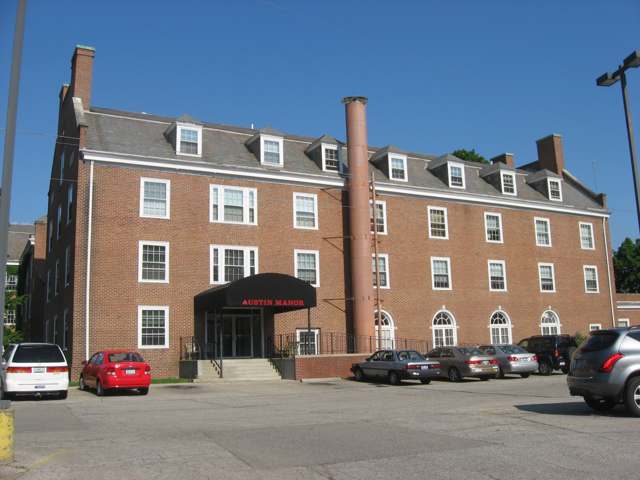
Photo: Nyttend, public domain · Wikimedia Commons
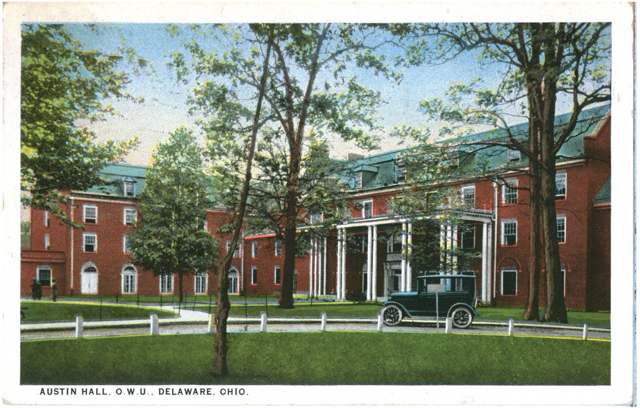
Photo: Columbus Metropolitan Library postcard collection, via DPLA/Ohio Digital Network, no known copyright restrictions · Wikimedia Commons
Local history sources: dn710906.ca.archive.org · en.wikipedia.org · en.wikipedia.org · en.wikipedia.org · commons.wikimedia.org · commons.wikimedia.org · en.wikipedia.org
Water
Olentangy River, drawn via the city's North and South intakes upstream of town (blended with 5 active deep wells) The water here
- Delaware City60% of residentsOlentangy River (blended with deep wells)
- Del-co Water Company, Inc.40% of residentsOlentangy River, O'Shaughnessy and Alum Creek reservoirs, plus Knox County wells
- Marysville City0% of residentsMill Creek via Marysville Reservoir (Raymond Rd) + wells
Its ZIP codes
Each ZIP code that touches Delaware Township, Delaware County, with the share of its residents who live here and the same headline figures as the ZIP page.
| ZIP | Share | Water | Radon | Home value | Schools | Flood |
|---|---|---|---|---|---|---|
| 43015 Delaware | 3% | Olentangy River, drawn via the city's North and South intakes upstream of town (blended with 5 active deep wells) | 6.5 pCi/L average radon | Parcel list only | Delaware City · 4 stars overall | 1.0% of residents in the 1% floodplain |
Local government
Who holds office in Delaware Township, Delaware County, how its elections and ballot issues came out, and the state auditor's record.
Money issues on the ballot since 2023: 1 of 1 passed.
Ballot issues
| Date | Issue | For | Against | Result |
|---|---|---|---|---|
| 2023-11-07 | Issue: Tax Levy - Renewal - Delaware Township - Roads - 0.8 mill/5 yrs - Comm 2023 | 821 | 529 | Passed (60.81% for) |
Elections for office
| Date | Office | Candidates and votes |
|---|---|---|
| 2023-11-07 | Township Trustee | Kevin Hennessy 1,057, 100.0% |
| 2023-11-07 | Township Fiscal Officer | Patricia Y. Montgomery 1,029, 100.0% |
| 2021-11-02 | Township Trustee | Beau Euton 327, 45.1%; Randy Ormeroid 398, 54.9% |
| 2019-11-05 | Township Trustee | Kevin Hennessy 285, 100.0% |
| 2019-11-05 | Township Fiscal Officer | Barbara J. Thomas 283, 100.0% |
Winners in bold. Results from the county board of elections' official canvass unless marked.
The county
Delaware County: 11 ZIP codes, 26 cities, villages and townships, 214,126 people.
Nearby places
Cite this page
Cite this page as:
Cracked Buckeye (Open Shower Co), "Delaware Township, Delaware County", https://crackedbuckeye.com/place/delaware-township-delaware-county/, built 2026-09-17, accessed [date].
Machine-readable: /api/place/delaware-township-delaware-county.json (open JSON, CC BY 4.0 for the compilation; the underlying records keep their own terms) · How to cite · Report a correction · Built 2026-09-17