Notable people · Military
William Rosecrans
Delaware County-born Union general who won at Iuka, Corinth and Stones River and maneuvered Bragg out of Tennessee before his Army of the Cumberland was routed at Chickamauga in 1863.
Born September 6, 1819, farm on (Little) Taylor Run, Kingston Township
Died March 11, 1898, Rancho Sausal Redondo, Redondo Beach
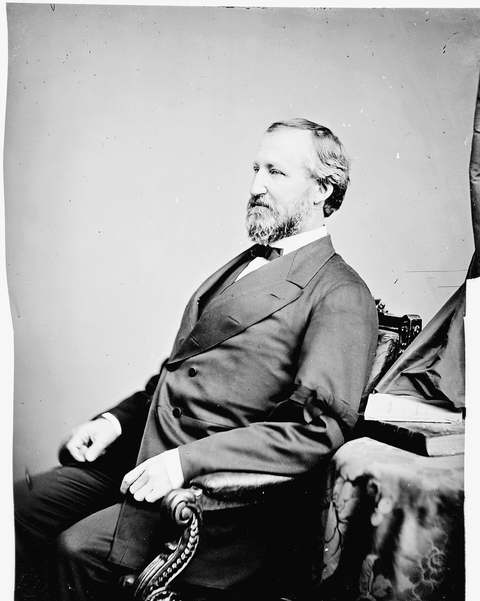
At a glance
- Born
- September 6, 1819, farm on (Little) Taylor Run, Kingston Township (Delaware County) source
- Died
- March 11, 1898, Rancho Sausal Redondo, Redondo Beach source
- Buried
- Arlington National Cemetery, Section 3, Site 1862 (reburied May 17, 1902) source
- Also known as
- William S. Rosecrans, Old Rosy, The Great Decliner
- Education
- US Military Academy, West Point, NY, 1838-1842, graduate, 5th of 56
- Known as
- Military
Life story
William Starke Rosecrans was born in 1819 in Delaware County, Ohio, with limited schooling. He won a place at West Point and graduated fifth in the class of 1842.
He taught at the academy, joined the Catholic Church in 1845, and married Anna Hegeman in 1843. He left the Army and worked as an engineer and in business before the war.
In 1861 he won in western Virginia, then led the Army of the Cumberland at Stones River and in the Tullahoma Campaign. He lost at Chickamauga in September 1863 and Grant relieved him.
After the war he served as minister to Mexico, then represented California in Congress from 1881 and was Register of the Treasury. He died in California in 1898 and was reburied at Arlington in 1908.
Ohio ties
- Kingston Township (Taylor Run) (1819)
birthplace; memorial boulder and plaque beside Rosecrans Road Delaware County · source - Homer (about 1820-1838)
boyhood home; his father farmed and kept a hotel; brother Sylvester born nearby in 1827 Licking County · source - Utica (about 1832)
store clerk at age 13 Licking County · source - Mansfield (1830s)
store clerk Richland County · source - Cincinnati (1850s-1861)
partner in one of the first oil refineries west of the Alleghenies; badly burned in an 1859 lamp explosion at the Preston Coal Oil Company Hamilton County · source - Columbus (1861, 1870s)
appointed colonel of the 23rd Ohio by Gov. William Dennison in 1861; came to Columbus in 1870 to help design St. Joseph Cathedral for his brother Franklin County · source - Sunbury (present)
state marker, equestrian statue on a glacial erratic on the village square, and General Rosecrans Elementary School Delaware County · source
Timeline
- 1819 Born September 6 on Taylor Run in Kingston Township, Delaware County, the son of Crandall Rosecrans and Jemima Hopkins; soon afterward the family moved to Homer in Licking County. source
- 1832 At 13 went to work as a store clerk in Utica, Ohio, and later in Mansfield. source
- 1838 Obtained a cadetship at West Point and passed the entrance examination. source
- 1842 Graduated from West Point fifth in a class of 56 and entered the Corps of Engineers. source
- 1845 Converted to Catholicism while teaching at West Point and wrote the news to his brother Sylvester, then a student at Kenyon College, who soon converted too. source
- 1854 Resigned from the Army because of failing health and went into civil engineering and business. source
- 1859 Was badly burned when an experimental lamp exploded at the Preston Coal Oil Company in Cincinnati; recovery took about 18 months and left facial scars. source
- 1861 Was appointed colonel of the 23rd Ohio Infantry by Gov. William Dennison, was soon made a brigadier general, and was prominent in the western Virginia campaign that year. source
- 1862 Won at Iuka in September and at Corinth on October 3-4, and on October 24 took command of the force that became the Army of the Cumberland. source
- 1863 After Stones River (December 31, 1862-January 2, 1863), the Ohio General Assembly voted him its thanks on January 14; he replied from Murfreesboro on February 3. source
- 1863 Maneuvered Bragg out of middle Tennessee in the Tullahoma campaign (June 24-July 3), then lost at Chickamauga on September 19-20 when a badly worded order opened a gap in his line; Grant replaced him with George Thomas in October. source
- 1868 Appointed U.S. Minister to Mexico on July 27, listed as a resident of Ohio; he served from December 10, 1868 to June 26, 1869. source
- 1869 Declined the Democratic nomination for governor of Ohio, as he had declined the Union party's in 1866, earning the nickname 'The Great Decliner'. source
- 1870 Came to Columbus to help with the design of St. Joseph Cathedral for his brother, Bishop Sylvester Rosecrans. source
- 1878 His brother Sylvester consecrated St. Joseph Cathedral on October 20 and died the next day. source
- 1881 Began two terms as a U.S. Representative from California (1881-1885). source
- 1885 Became Register of the Treasury, serving until 1893. source
- 1889 Spoke at a Chickamauga veterans' reunion on September 19 that helped lead to the Chickamauga and Chattanooga National Military Park. source
- 1898 Died March 11 at Rancho Sausal Redondo in Redondo Beach, California. source
- 1902 The Society of the Army of the Cumberland reburied him at Arlington National Cemetery on May 17, with President Theodore Roosevelt and Ohio Senator Joseph B. Foraker among the speakers. source
What William is known for
- Union commander at Stones River and Chickamauga
- US congressman from California from 1881
Stories
Thanks from Columbus, an answer from Murfreesboro
Twelve days after the battle of Stones River ended, on January 14, 1863, the Ohio General Assembly voted its thanks to Rosecrans and his army for the victory and capture of Murfreesboro, and its sympathy to the families of the dead. Governor David Tod sent the resolutions on January 20 with a letter praising his generalship at Iuka, Corinth and Murfreesboro. Rosecrans replied from Murfreesboro on February 3 with an attack on talk of 'peace on any terms', saying a man who uttered it was a traitor who deserved the scorn of honorable men. Ohio soldiers in his army sent their own address to the people of Ohio from the Stone River battlefield, and the legislature ordered 25,000 copies of the whole exchange printed in Columbus that spring.
Two brothers and a cathedral
Sylvester Rosecrans was born in 1827 about half a mile east of the Homer library, eight years after William. He attended Kenyon College and St. John's College, studied for the priesthood in Cincinnati and Rome, and was ordained in 1852; he later taught at the Cincinnati diocesan seminary and became its president in 1859. When the Diocese of Columbus was created in 1868 he became its first bishop, and he founded St. Aloysius Seminary, started a newspaper and backed temperance societies. His great project was St. Joseph's Cathedral in Columbus, which his brother the general helped design. Sylvester died in 1878, the day after the new cathedral was dedicated.
Four years in a Los Angeles vault
Rosecrans died in California in March 1898, and his remains were placed in a receiving vault in Los Angeles. At its annual meeting the Society of the Army of the Cumberland resolved to move him to Arlington, and on March 31, 1902 its officers asked both houses of Congress to be represented. He was buried at Arlington on May 17, 1902, in what the society called the most imposing ceremony of its kind since the cemetery began receiving the army's great dead. President Theodore Roosevelt spoke, as did Ohio's Senator Joseph B. Foraker and Congressman Charles H. Grosvenor, and the society published the full proceedings in Cincinnati in 1903.
Honors and things named for them
- Laetare Medal, University of Notre Dame (1896)
Named for William Rosecrans
- General Rosecrans Elementary School (Sunbury, Delaware County) source
- Rosecrans Road (Kingston Township, Delaware County) source
- Fort Rosecrans National Cemetery (San Diego), Rosecrans Avenue (Los Angeles County), Rosecrans Street (San Diego) (California) source
Family
- wife: Anna Hegeman Rosecrans
- father: Crandall Rosecrans
- mother: Jemima Hopkins Rosecrans
Sites to know
Homes, graves, markers, museums and monuments; the numbered ones are on the map.
- 1 Ohio historical marker 19-21, Major General William Starke Rosecrans / Glacial Erratics
Sunbury, north side of the Village Square at the glacial erratic Delaware County · source - Equestrian statue of Rosecrans on a glacial erratic boulder, Sunbury Town Hall square
Sunbury, Village Square Delaware County · source - Birthplace memorial boulder and plaque, beside Rosecrans Road
Kingston Township Delaware County · source - 2 Ohio historical marker 11-45, Major General William Starke Rosecrans / Bishop Sylvester Horton Rosecrans (reported missing September 2025) (unknown)
Homer, 385 South Street, in front of the Homer Public Library Licking County · source - 3 St. Joseph Cathedral, which he helped design for his brother
Columbus, 212 E. Broad Street Franklin County · source - Rosecrans grave, Arlington National Cemetery, Section 3, Site 1862
Arlington, Virginia source
Ohio places
Where William Rosecrans was born, lived, worked and is remembered, with the ZIP code, town and county pages for each.
- Born: Kingston Township, Delaware County (Farm near Little Taylor Run; ZIP is Sunbury, the nearest postal town, as a stand-in) ZIP 43074 (approximate) · Kingston Township · Delaware County
Myths and corrections
Things often said about William Rosecrans, and what the record shows.
Often said William Rosecrans studied at Kenyon College.
The record It was his brother Sylvester who attended Kenyon, in 1845. William had little formal schooling before West Point, having clerked in stores at Utica and Mansfield from age 13. source
Often said Rosecrans was buried at Arlington in 1908.
The record Wikipedia gives 1908, but the Society of the Army of the Cumberland's published proceedings show he was moved from a Los Angeles receiving vault and buried at Arlington on May 17, 1902, with President Theodore Roosevelt present. source
Often said Rosecrans cried 'Stand by your flag and country, my men!' at the Battle of Stones River on October 4, 1862 (as the Sunbury marker has it).
The record Stones River was fought December 31, 1862 to January 2, 1863; October 4, 1862 was the second day of the Battle of Corinth, so the marker's date and battle do not match. source
Often said Bishop Sylvester Rosecrans graduated from West Point and died in the summer of 1879 (1880 History of Delaware County).
The record Sylvester attended Kenyon and St. John's College in New York, studied in Cincinnati and Rome, and died on October 21, 1878, the day after consecrating St. Joseph Cathedral. source
Often said Rosecrans's mother descended from Stephen Hopkins, signer of the Declaration of Independence.
The record The 1880 Delaware County history says she was 'of the family' of the signer; Wikipedia reports the Hopkins descent only as a claim made by a Civil War website, not as established. source
Documents
Primary records: patents, letters, court and government files, nominations and old county histories, each at the archive that holds it.
- Ohio General Assembly, 'Resolutions of Thanks to Major General Rosecrans, with General Rosecrans' Reply; and the Address of the Ohio Soldiers to the People of Ohio' (Columbus: Richard Nevins, State Printer, 1863) 1863, Internet Archive
- Society of the Army of the Cumberland, 'Burial of General Rosecrans, Arlington National Cemetery, May 17, 1902' (Cincinnati: Robert Clarke, 1903) 1903, Internet Archive
- 'History of Delaware County and Ohio' (1880), Kingston Township chapter on the Rosecrans family 1880, Internet Archive (Allen County Public Library copy)
- War of the Rebellion: Official Records, Series I, Vol. 30, Part 1 (Chickamauga campaign reports, Aug. 11-Oct. 19, 1863) 1890, Cornell University Library via HathiTrust
Pictures
Free to use with the credit shown. Select a picture for the original and its license.
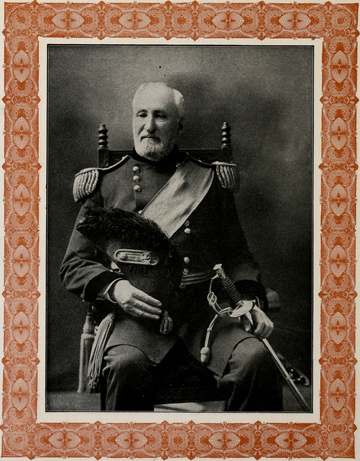
No known restrictions 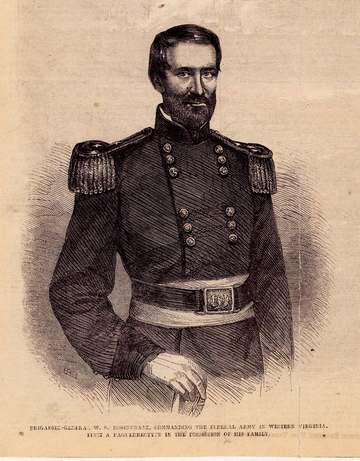
Half-length portrait of Gen. Rosecranz in uniform. "BRIGADIER-GENERAL W. S. ROSECRANZ, COMMANDING THE FEDERAL ...
Public domain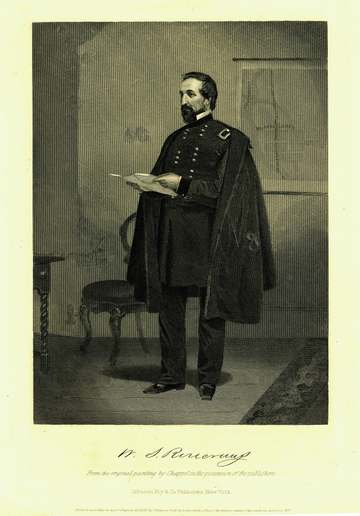
Print of Gen. Rosecrans in uniform. Chair, table, and map on wall with the words "MURFREESBORO" and "LYTLES CR...
Public domain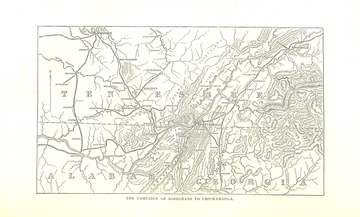
View this map on the BL Georeferencer service. Image taken from: Title: "History of the American Civil War, et...
No known restrictions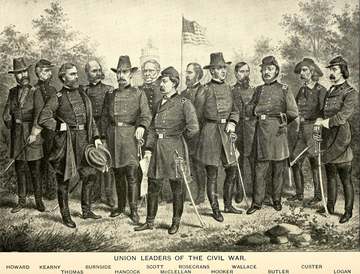
Union Leaders of the Civil War Identifier: angelsofbattlefi00bart (find matches) Title: Angels of the battlefi...
No known restrictions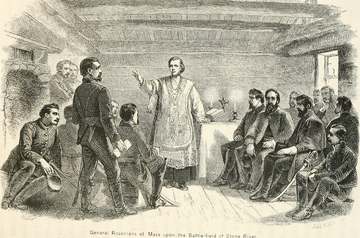
No known restrictions 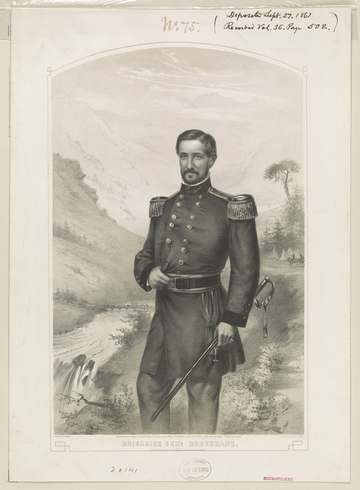
Title: Brigadier Genl. Rosecranz Physical description: 1 print. Notes: This record contains unverified data fr...
Public domain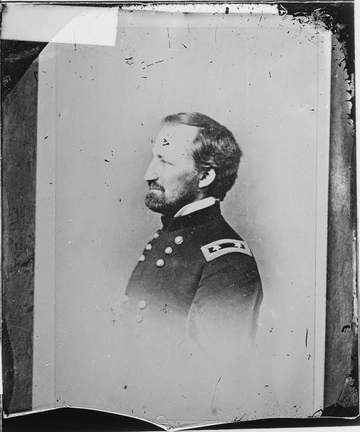
Public domain 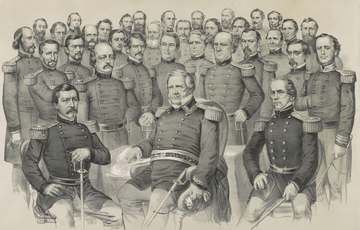
The champions of the Union. Print is a group portrait of Union Army generals and Navy commanders; caption iden...
Public domain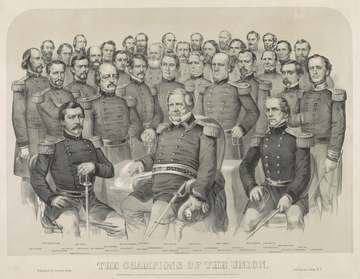
The champions of the Union. Print is a group portrait of Union Army generals and Navy commanders; caption iden...
Public domain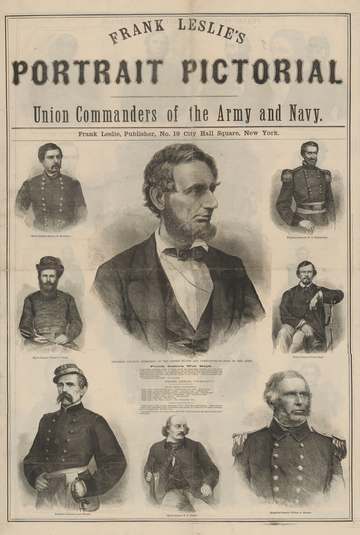
Frank Leslie's Portrait Pictorial, no. 19, 1862, National Portrait Gallery, Smithsonian Institution
Public domain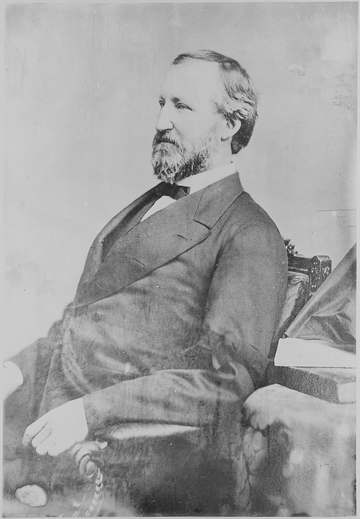
Not in original catalog. Possibly wrong.
Public domain


Further reading
Sources
Confidence. Medium: the main facts were confirmed, but some details (often an address or ZIP code) were not.
- 1808 Delaware: Delaware County roots of General William Rosecrans born 1819-09-06 in Kingston Township, Delaware County, Ohio
- Wikipedia: William Rosecrans all new fields; confirms death date 1898-03-11 and California congressional service
- Wikipedia: Sylvester Horton Rosecrans
- Wikipedia: St. Joseph Cathedral (Columbus, Ohio)
- archive.org: historyofdelawar02olba
- archive.org: resolutionsoftha00ohio
- archive.org: burialofgeneralr00soci
- remarkableohio.org: 11 45 major general william starke rosecrans bishop sylvester horton rosecrans
- remarkableohio.org: 19 21 major general william starke rosecrans glacial erratics
- history.state.gov: rosecrans william starke
- findagrave.com: william starke rosecrans
- collections.library.cornell.edu: waro
- Wikimedia Commons: Gen. William Rosecrans NARA 527378
- Wikimedia Commons: Col. William S. Rosecrans NARA 530358
- Wikimedia Commons: General William S. Rosecrans in camp near Murfreesboro, Tennessee, January 1863
- Wikimedia Commons: Hon. W.S. Rosecrans


Every link goes to the original source. Profile researched 2026-10-15.