Notable people · Inventor · Science
Thomas Midgley Jr.
Columbus-raised engineer in Charles Kettering's Dayton research lab who found tetraethyl lead as a gasoline anti-knock in 1921 and led the 1930 invention of Freon refrigerants, two products later banned for their harm.
Born May 18, 1889, College Hill, Beaver Falls
Died November 2, 1944, his home near Worthington (Sharon Township)
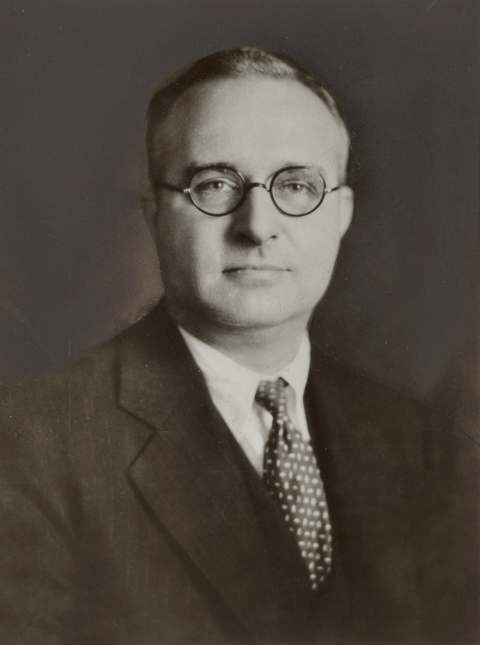
At a glance
- Born
- May 18, 1889, College Hill, Beaver Falls source
- Died
- November 2, 1944, his home near Worthington (Sharon Township) (Franklin County) source
- Buried
- Green Lawn Cemetery, Columbus, Section 100, Lot 113 (Franklin County) source
- Also known as
- Thomas Midgley, Tom Midgley, Midge
- Education
- Cornell University, Ithaca, NY, to 1911, Mechanical engineering
- Known as
- Inventor, Science
- Organizations
- General Motors Research, Delco
Life story
Thomas Midgley Jr. was born in Beaver Falls, Pennsylvania, and grew up in Columbus, Ohio. His father and grandfather were both inventors. He earned a mechanical engineering degree at Cornell in 1911.
He joined General Motors in 1916 and worked under Charles Kettering in Dayton. In December 1921 his team found tetraethyl lead as a gasoline anti-knock additive.
Lead plants killed workers, and Midgley himself took leave for lead poisoning in 1923. In the late 1920s he and Albert Henne developed Freon, the first CFC refrigerant.
Polio left him disabled in 1940; he died in 1944 at his Worthington home, entangled in a rope-and-pulley device he had designed, ruled a suicide by the coroner.
Ohio ties
- Columbus (about 1895-1905)
boyhood home; public schools until partway through high school, where he played baseball and football Franklin County · source - Delaware (1911)
home of his wife, Carrie M. Reynolds, whom he married August 3, 1911 Delaware County · source - Dayton (National Cash Register) (1911-1912)
draftsman and designer in NCR's inventions department, where Kettering had started Montgomery County · source - Dayton (Dayton Engineering Laboratories Co. / General Motors Research) (1916-1928)
research engineer under Kettering; anti-knock team worked in a converted house on Ludlow Street; tetraethyl lead 1921; Freon work for Frigidaire 1928 Montgomery County · source - near Worthington (Sharon Township estate) (1929-1944)
estate where he lived, worked on rubber chemistry and golf-green grasses, and died Franklin County · source - Columbus (Ohio State University) (1930s-1944)
director and vice president of the Ohio State University Research Foundation; honorary Doctor of Science 1944 Franklin County · source - Wooster (College of Wooster) (1936)
honorary Doctor of Science Wayne County · source - Columbus (Green Lawn Cemetery) (1944)
grave Franklin County · source
Timeline
- 1889 Born May 18 on College Hill in Beaver Falls, Pennsylvania, son of tire inventor Thomas Midgley Sr. source
- 1895 Moved with his family to Columbus at about age six, after two years in Trenton, New Jersey. source
- 1911 Graduated from Cornell in mechanical engineering, married Carrie M. Reynolds of Delaware, Ohio on August 3, and went to work at National Cash Register in Dayton. source
- 1916 Joined the research staff of Kettering's Dayton Engineering Laboratories Company at age 27. source
- 1921 On the morning of December 9, a small batch of tetraethyl lead silenced the knock in the Dayton lab's one-cylinder test engine. source
- 1923 Ethyl gasoline first went on sale in Dayton; Midgley had written in January that he had a touch of lead poisoning. source
- 1923 Filed on May 19 for the patent on leaded motor fuel with a scavenging agent, issued as US 1,592,954 on July 20, 1926. source
- 1924 After deaths at the Dayton pilot plant and at DuPont and Standard Oil plants, he inhaled tetraethyl lead vapor for sixty seconds at an October 30 press conference to argue it was safe. source
- 1928 In his last year in Dayton, Kettering asked him to find a new, safe refrigerant for GM's Frigidaire division. source
- 1929 Moved his family back to the Columbus area and built an estate, continuing research on rubber. source
- 1930 Filed on February 8, with Albert L. Henne and Robert R. McNary, the Frigidaire patent on fluorinated refrigerants, issued as US 1,833,847 on November 24, 1931. source
- 1930 Showed the American Chemical Society that Freon was nontoxic and nonflammable by inhaling it and blowing out a candle. source
- 1937 Received the Perkin Medal for his fluorocarbon refrigerant work. source
- 1940 Was struck by polio in the early fall and lost the use of his legs; he had therapy at Columbus Children's Hospital. source
- 1941 Received the Priestley Medal, the American Chemical Society's highest award. source
- 1944 Served as president of the American Chemical Society and received an honorary Doctor of Science from Ohio State. source
- 1944 Found dead on November 2 at his home near Worthington, strangled in his own pulley harness; the coroner ruled it a suicide. source
- 1944 The Worthington News reported his death on November 9 under the headline 'Thomas Midgley Succumbs At Home Near Here.' source
- 2003 Inducted into the National Inventors Hall of Fame. source
What Thomas is known for
- Tetraethyl lead antiknock, December 1921, GM Dayton lab
- Freon (CFC) refrigerants in the late 1920s with Albert Henne
- Tetraethyl lead (1921)
- Dichlorodifluoromethane (Freon-12)
- Over 100 patents
Stories
The periodic table on a peg board
Kettering's team in Dayton had chased engine knock for years. Iodine was the first chemical found to quiet it in small amounts, but it was far too expensive, and in 1920 and 1921 the search went on element by element. A peg board with part of the periodic table pasted on it guided the tests, from bromine, tellurium, tin and selenium toward silicon, germanium, tin and lead. On the morning of December 9, 1921, the chemists brought in a small amount of tetraethyl lead, and the knock in the one-cylinder laboratory engine stopped. Even at about one part in a thousand, two or three grams to the gallon, it worked.
Sixty seconds of lead vapor
In 1923 Midgley took a long rest in Florida to recover from lead poisoning, the same year General Motors formed a chemical company to make tetraethyl lead with Kettering as president and Midgley as vice president. In 1924 workers died at the Dayton pilot plant and at DuPont's Deepwater, New Jersey works, and five died within two months at the Ethyl company's Bayway refinery. On October 30, 1924, at a press conference, Midgley breathed tetraethyl lead vapor for sixty seconds to show it was safe. In April 1925 he was removed as vice president of the chemical company, though he stayed with General Motors.
A breath of Freon and a candle
Frigidaire needed a refrigerant that would not burn or poison anyone, and Midgley, guided again by the periodic table, decided it had to contain fluorine despite warnings about fluorine's hazards. His group made dichlorodifluoromethane. Of the three or four small batches they made, only the first left the test animals unharmed; the others killed them, which was later traced to an impurity, not the compound. Had they tested a later batch first, Kettering wrote, the discovery might have been dropped. Midgley showed off its safety by filling his lungs with the vapor and gently breathing it out to put out a candle.
Grass, records and polio near Columbus
Kettering wrote that Columbus was always home to Midgley, and at his death he was living in the country near the city. During his busiest research years he took up golf, studied the swing from books and professionals, and soon had his score down in the low 70s. Noticing how poor many greens were, he began experimenting with grasses on his estate near Columbus, and greens experts from all over the area came to see the work, though by then he had quit playing. He also backed a young man developing an improved recording machine and built a library of recordings, some made from the wings of the Metropolitan Opera. In the early fall of 1940 polio took the use of his legs; he reckoned the odds of a man his age catching it were like drawing one card from a stack as high as the Empire State Building. He kept working for the American Chemical Society and the war effort until he died on November 2, 1944, at 55.
Inventions and firsts
- Tetraethyl lead gasoline and Freon refrigerants (1921-1928)
Honors and things named for them
- Perkin Medal (1937)
- Priestley Medal (1941)
- American Chemical Society president-elect (1944)
Sites to know
Homes, graves, markers, museums and monuments; the numbered ones are on the map.
- 1 Midgley grave, Green Lawn Cemetery, Section 100, Lot 113
Columbus, 1000 Greenlawn Avenue Franklin County · source - Anti-knock laboratory, converted residence on Ludlow Street (unknown)
Dayton, Ludlow Street Montgomery County · source
Ohio places
Where Thomas Midgley Jr. was born, lived, worked and is remembered, with the ZIP code, town and county pages for each.
- Worked: Dayton, Montgomery County ZIP 45402 · Dayton · Montgomery County
- Lived: Worthington, Franklin County ZIP 43085 · Worthington · Franklin County
Myths and corrections
Things often said about Thomas Midgley Jr., and what the record shows.
Often said Midgley was accidentally killed by his own invention, the bed harness.
The record He was found strangled in the harness, and the death was widely reported as an accident, but the coroner ruled it a suicide. source
Often said U.S. Patent 1,491,998 is Midgley's 'Ethyl Gasoline' patent, as the National Inventors Hall of Fame lists it.
The record US 1,491,998, filed October 4, 1918 and issued April 29, 1924, claims a eutectic mixture of cyclohexane and benzene as a motor fuel, not tetraethyl lead. His lead anti-knock fuel patent is US 1,592,954, filed May 19, 1923 and issued July 20, 1926. source
- It is often claimed that leaded gas and CFCs made him the most damaging single inventor. Historian J. R. McNeill says exactly that, which is an opinion, not a measurement.
- Disputed: His death, caused by a pulley device he had rigged, was ruled a suicide by the coroner, though it is often described as accidental.
Documents
Primary records: patents, letters, court and government files, nominations and old county histories, each at the archive that holds it.
- Patent US 1,592,954, 'Fuel' (lead anti-knock with scavenger), Thomas Midgley Jr. of Dayton, assigned to General Motors 1926, Google Patents
- Patent US 1,833,847, 'Heat transfer' (fluorinated refrigerants), Midgley, Henne and McNary, assigned to Frigidaire Corporation, Dayton 1931, Google Patents
- Patent US 1,491,998, 'Motor fuel' (cyclohexane-benzene eutectic), Thomas Midgley Jr. of Dayton 1924, Google Patents
- Charles F. Kettering, 'Thomas Midgley, Jr. 1889-1944', National Academy of Sciences Biographical Memoirs vol. 24 1947, National Academy of Sciences
- 'Thomas Midgley Succumbs At Home Near Here', Worthington News, November 9, 1944 (clipping) 1944, Worthington Historical Society / Worthington Memory
- Charles F. Kettering, radio talk 'Thomas Midgley, Jr.' (Short Stories of Science and Invention, no. 37, 1942-45 broadcasts) 1942-1945, Today in Science History (from a General Motors booklet, 1959 reprint)
Pictures
Free to use with the credit shown. Select a picture for the original and its license.
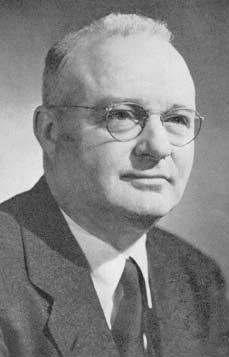
Thomas Midgley Jr. (1889 - 1944)
CC0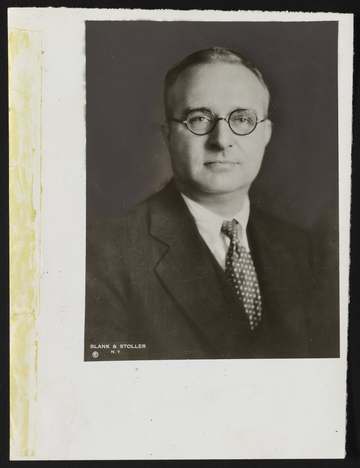
Portrait of Thomas Midgley, Jr. (1889-1944). Image from the Science History Institute, published "No known cop...
No known restrictions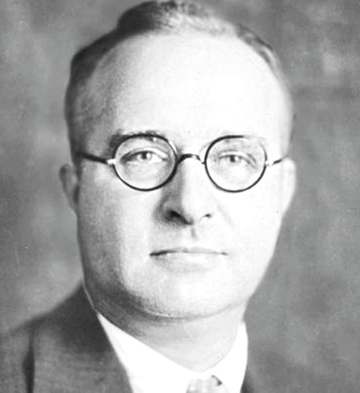
Thomas Midgley Jr.
Public domain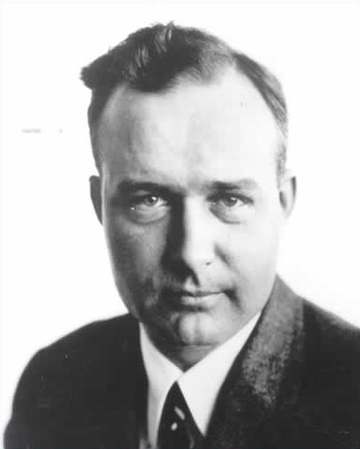
en:Thomas Midgley, Jr. was an American mechanical engineer and chemist.
Public domain


Further reading
Sources
Confidence. Medium: the main facts were confirmed, but some details (often an address or ZIP code) were not.
- Thomas Midgley Jr. (Wikipedia) birth Beaver Falls PA, death Worthington OH 1944, TEL 1921, Freon late 1920s, polio 1940, death by his pulley device
- nasonline.org: midgley thomas
- daytoninnovationlegacy.org: midgley
- chem.libretexts.org: 01: Tetraethyllead: Kettering and Midgley
- wral.com
- invent.org: thomas midgley
- todayinsci.com: story037
- worthingtonmemory.org: dr thomas midgley jr
- worthingtonmemory.org: thomas midgley succumbs home near here
- worthingtonmemory.org: honored o s u
- findagrave.com: thomas midgley
- patents.google.com
- patents.google.com
- patents.google.com
- digital.sciencehistory.org: 9s161624t
- Wikimedia Commons: Portrait of Thomas Midgley Jr.

Every link goes to the original source. Profile researched 2026-10-15.