Notable people · Governor · Justice · Abolitionist · Senator
Salmon P. Chase
Cincinnati lawyer who defended freedom seekers and their helpers so often he was called the 'Attorney General for Fugitive Slaves', then became Ohio's first Republican governor, Lincoln's Treasury secretary and Chief Justice.
Born January 13, 1808, Cornish, New Hampshire
Died May 7, 1873, New York City, NY
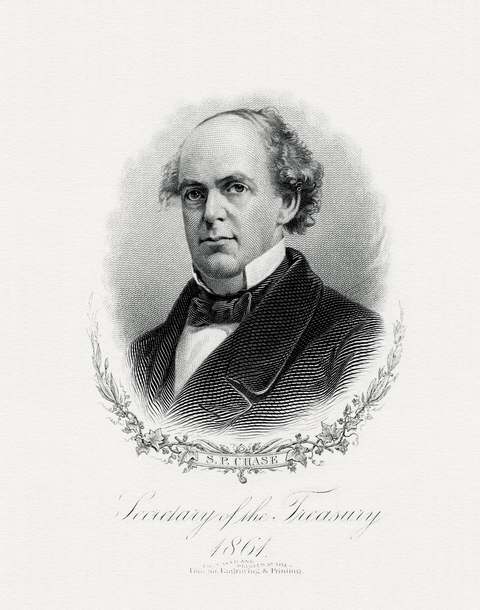
At a glance
- Born
- January 13, 1808, Cornish, New Hampshire source
- Died
- May 7, 1873, New York City, NY source
- Buried
- Spring Grove Cemetery, Cincinnati (Section 30, Lot 10; reinterred from Oak Hill Cemetery, Washington, in October 1886) (Hamilton County) source
- Also known as
- Salmon P. Chase, S. P. Chase, Attorney General for Fugitive Slaves
- Education
- Cincinnati College, Cincinnati, OH
- Dartmouth College, Hanover, NH, to 1826, graduate
- Known as
- Governor, Justice, Abolitionist, Senator
Life story
Salmon Portland Chase was born in Cornish, New Hampshire, in 1808. He went to schools in Vermont and in Worthington, Ohio, and studied at Cincinnati College before Dartmouth, graduating in 1826 with distinction. He read law under US Attorney General William Wirt and was admitted to the bar in 1829.
He began practicing in Cincinnati in 1830. He became known for defending escaped slaves, including in the Matilda case in 1837, and joined the antislavery politics that led to the Republican Party.
He was elected to the US Senate in 1849, served as Ohio's governor from 1856 to 1860, and was Lincoln's Treasury Secretary from 1861 to 1864. On December 15, 1864 he was sworn in as Chief Justice and in 1868 presided over President Johnson's impeachment trial.
He was married three times; his daughter Kate Chase became a Washington hostess. He died in New York on May 7, 1873, and in 1886 was reburied at Spring Grove Cemetery in Cincinnati. His likeness was on the $10,000 bill, and a law school and a bank carried his name.
Ohio ties
- Worthington (1820s)
lived with his uncle Bishop Philander Chase and attended school Franklin County · source - Cincinnati (1822-1823; 1830-1849)
Cincinnati College student; lawyer at Third and Main from 1830; city councilman 1840-41; antislavery counsel Hamilton County · source - near Loveland (1830s-1840s)
country home while practising in Cincinnati Hamilton County · source - Columbus (1856-1860)
governor of Ohio; his former home at East State and Sixth streets was photographed in 1909 Franklin County · source - Spring Grove Cemetery, Cincinnati (1844; 1886)
helped draft its articles of incorporation; reburied there in 1886 Hamilton County · source
Timeline
- 1808 Born on 13 January in Cornish, New Hampshire. source
- 1820 After his father's death, came to Ohio to live with his uncle, Bishop Philander Chase, and attended school in Worthington. source
- 1822 Attended Cincinnati College (1822-23) before going on to Dartmouth, where he graduated in 1826. source
- 1829 Admitted to the bar in December after reading law with U.S. Attorney General William Wirt in Washington. source
- 1830 In September set up his law office and home on the first floor of a brick building at the northeast corner of Third and Main streets, Cincinnati. source
- 1837 On 11 March argued in Hamilton County Common Pleas Court for the release of Matilda, a woman claimed as a fugitive by Larkin Lawrence of Missouri. source
- 1840 Elected to a one-year term on Cincinnati City Council as a Whig, then left the party in 1841 to lead Ohio's Liberty Party. source
- 1844 On 1 December he and others prepared the articles of incorporation for Spring Grove Cemetery, which was chartered in January 1845. source
- 1845 On 6 May, at the Union Baptist Church, Cincinnati's Black community presented him with an engraved silver pitcher. source
- 1847 Argued in the U.S. Supreme Court for John Van Zandt, an Ohio farmer sued under the 1793 Fugitive Slave Act. The court ruled unanimously against Van Zandt. source
- 1848 Drafted the Free Soil platform and helped make Martin Van Buren its presidential candidate. source
- 1849 Elected to the U.S. Senate by the Ohio legislature as a Free Soiler. source
- 1854 The 'Appeal of the Independent Democrats', written by Chase and Joshua Giddings against the Kansas-Nebraska bill, was published on 24 January. source
- 1855 Elected Ohio's first Republican governor, serving from 1856 to 1860. He signed the state's personal liberty laws. source
- 1860 Received 49 votes on the first ballot for the Republican presidential nomination, which went to Lincoln. source
- 1861 Resigned his new Senate seat in March to become Lincoln's Secretary of the Treasury. source
- 1861 Camp Chase, a training camp and later a prison for Confederates, was set up in May at Columbus and named for him. source
- 1862 An 1862 photograph of Chase supplied the likeness on the first federal one-dollar bill. source
- 1863 In December settled on the motto 'In God We Trust' for new coinage, after petitions such as the Rev. Mark R. Watkinson's of 1861. source
- 1864 Resigned from the Treasury in June. Nominated and confirmed as Chief Justice on 6 December, he was sworn in on 15 December. source
- 1868 Presided over the Senate impeachment trial of President Andrew Johnson. source
- 1873 Died of a stroke in New York City on 7 May and was buried in Oak Hill Cemetery, Washington. source
- 1886 Reinterred in October in Spring Grove Cemetery, Cincinnati. source
- 2003 Ohio Historical Marker 61-31 was put up at Third and Main streets, Cincinnati, near his first law office. source
- 2015 The National Park Service named the 'Salmon P. Chase 3rd Street Law Office' site to the Underground Railroad Network to Freedom. source
What Salmon is known for
- Governor of Ohio Jan 1856 - Jan 1860
- Chief Justice Dec 1864 - May 1873
Stories
A pitcher from the colored people of Cincinnati
On the evening of Tuesday, 6 May 1845, Cincinnati's Black community gathered at the Union Baptist Church to thank Chase. After a prayer by the Rev. Mr. Satchell, A. J. Gordon presented him with a silver pitcher made by E. & D. Kinsey, inscribed 'Testimonial of gratitude to Salmon P. Chase, from the Colored People of Cincinnati' for his services 'in behalf of the oppressed'. In reply Chase asked to be counted 'simply as one of the rank and file'. He then attacked the Ohio laws that kept Black residents from voting, from the public schools and from testifying in court: 'I arraign the whole policy of our legislation in relation to our colored population.' The evening ended with the hymn 'America'.
The Matilda case
In March 1837 an agent for Larkin Lawrence of Missouri swore that a woman named Matilda had escaped from Lawrence in May 1836 and was 'lurking' in Hamilton County. A justice of the peace committed her to the county jail. Chase obtained a writ of habeas corpus and on 11 March argued before the Hamilton County Court of Common Pleas that she must be freed. He said the commitment named no offence, that the federal law gave state magistrates no power to issue such warrants, and that the Fugitive Slave Act itself was unconstitutional and clashed with the Northwest Ordinance's guarantee of jury trial. Cincinnati printers Pugh & Dodd published the argument as a pamphlet that year.
Losing Van Zandt
John Van Zandt, a former Kentucky slaveholder turned Ohio abolitionist, was stopped before dawn one Sunday driving a covered wagon carrying several Black people. Two escaped, including a man named Andrew, and the slave catchers took the rest to jail in Covington, Kentucky. Their owner, Wharton Jones of Boone County, sued Van Zandt under the 1793 Fugitive Slave Act, and Chase lost the jury trial before Justice John McLean. With William H. Seward, Chase took the appeal to the Supreme Court, arguing that slavery existed only by state law, so a person who left a slave state left behind the law that made him a slave. In 1847 the court upheld the act unanimously.
Advice on a name
When Lucy Stone married Henry Blackwell in 1855 she kept her own name, but a registrar insisted she sign a property deed as 'Lucy Stone Blackwell'. The couple asked their friend Chase, then a Cincinnati lawyer, whether the law required the change, and he could not answer at once. After he assured them that no law required a married woman to take her husband's name, Stone announced at a Boston antislavery meeting on 7 May 1856 that her name remained Lucy Stone.
Honors and things named for them
- Portrait on the $10,000 bill
- Camp Chase, Columbus, OH
- Salmon P. Chase College of Law, Northern Kentucky University
- USCGC Chase
Named for Salmon P. Chase
- Camp Chase (1861 training and prison camp; Camp Chase Confederate Cemetery survives) (Hilltop, Columbus, Franklin County) source
- Salmon P. Chase Center for Civics, Culture, and Society, The Ohio State University (2024) (Columbus, Franklin County) source
- Salmon P. Chase College of Law, Northern Kentucky University (Highland Heights, Kentucky) source
- Chase County, Kansas (Kansas) source
- Chase National Bank (predecessor of JPMorgan Chase), named in his honour (New York) source
Family
- first wife: Katherine Jane Garniss
- second wife: Eliza Ann Smith
- third wife: Sarah Bella Dunlop Ludlow
- daughter: Kate Chase
Sites to know
Homes, graves, markers, museums and monuments; the numbered ones are on the map.
- 1 Ohio Historical Marker 61-31, Salmon Portland Chase (erected 2003)
SE corner of Main Street and E. 3rd Street, Cincinnati Hamilton County · source - Site of Chase's 1830 law office and residence, NE corner of 3rd and Main (Network to Freedom 2015, 'Salmon P. Chase 3rd Street Law Office') (demolished)
3rd and Main streets, Cincinnati Hamilton County · source - 2 Chase grave, Spring Grove Cemetery (Section 30, Lot 10), a Network to Freedom listing
Spring Grove Cemetery, Cincinnati Hamilton County · source - Former Chase residence, East State and Sixth streets (photographed 1909) (unknown)
Columbus Franklin County · source - 3 Cuyahoga County Soldiers' and Sailors' Monument (Emancipation panel shows Chase behind Lincoln)
Public Square, Cleveland Cuyahoga County · source
Places in Ohio to see
- Spring Grove Cemetery (Chase grave) (grave)
4521 Spring Grove Ave, Cincinnati, Hamilton County ZIP 45232 · Cincinnati · Hamilton County
Ohio places
Where Salmon P. Chase was born, lived, worked and is remembered, with the ZIP code, town and county pages for each.
- Lived: Cincinnati, Hamilton County ZIP 45202 · Cincinnati · Hamilton County
- Lived: Loveland, Hamilton County ZIP 45140 · Hamilton County
- Buried: Cincinnati, Hamilton County (Spring Grove Cemetery, 4521 Spring Grove Ave) ZIP 45232 · Cincinnati · Hamilton County
Myths and corrections
Things often said about Salmon P. Chase, and what the record shows.
Often said Salmon P. Chase came up with 'In God We Trust'.
The record The idea came to the Treasury in petitions, notably the Rev. Mark R. Watkinson's letter of 13 November 1861, and the phrase was already in use. Chase acted on the idea, had Mint director James Pollock draw up designs, and chose the final wording in December 1863. The motto first appeared on coins in 1864. source
Often said Chase founded, or was connected with, Chase National Bank, today's JPMorgan Chase.
The record The bank was named in his honour after his death, but he had no affiliation with it, financial or otherwise. source
Often said As 'Attorney General for Fugitive Slaves', Chase won freedom for the people he defended.
The record His fame came from his arguments, not his wins. In Jones v. Van Zandt (1847) the Supreme Court upheld the Fugitive Slave Act unanimously and the judgment against Van Zandt stood. Wikipedia notes that courts ruled against him in this and similar cases. source
Documents
Primary records: patents, letters, court and government files, nominations and old county histories, each at the archive that holds it.
- Speech of Salmon P. Chase in the case of the colored woman, Matilda, Court of Common Pleas of Hamilton County, 11 March 1837 (Cincinnati: Pugh & Dodd) 1837, Johns Hopkins University Sheridan Libraries (Internet Archive)
- Address and reply, on the presentation of a testimonial to S. P. Chase, by the colored people of Cincinnati 1845, Internet Archive (Anti-Slavery Pamphlet Collection)
- Reclamation of Fugitives from Service: an argument for the defendant in Wharton Jones vs. John Vanzandt, U.S. Supreme Court, December term 1846 1847, Library of Congress (Internet Archive)
- Union and Freedom, without Compromise: speech of S. P. Chase in the U.S. Senate, 26-27 March 1850 1850, Library of Congress (Internet Archive)
- Maintain Plighted Faith: speech of S. P. Chase in the Senate, 3 February 1854, against repeal of the Missouri prohibition 1854, University of Toronto, Robarts Library (Internet Archive)
Pictures
Free to use with the credit shown. Select a picture for the original and its license.
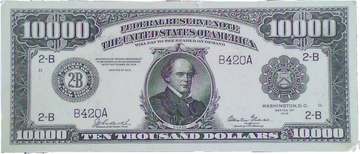
10'000 Dollar Schein, US-Dollar
Public domain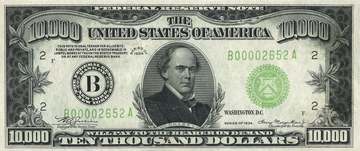
10,000 dollar bill (not in use today) Series: 1928, 1934, 1934A & 1934B Portrait: Salmon P. Chase, Secreta...
Public domain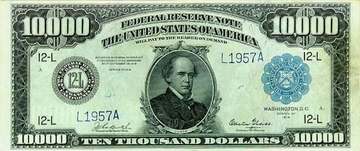
10.000 dollars bill (not in use today) Series: 1918 Portrait: Salmon P. Chase, Chief Justice of the United Sta...
Public domain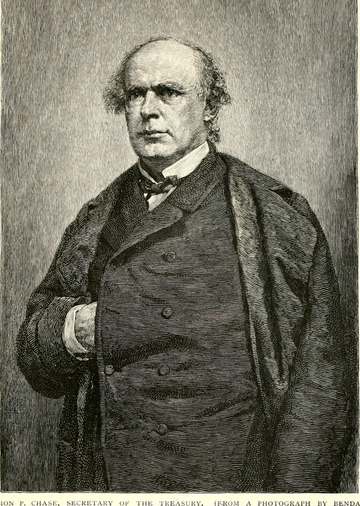
No known restrictions 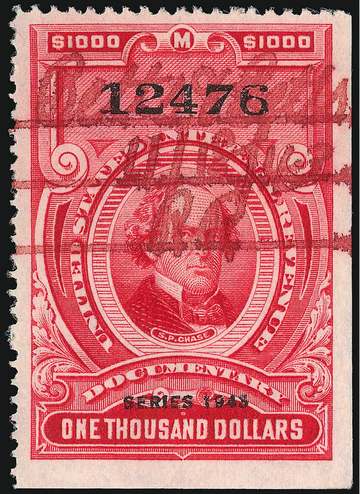
Image of Chase revenue stamp, 1000-dollars, issue of 1943 (Scotts# R385)
Public domain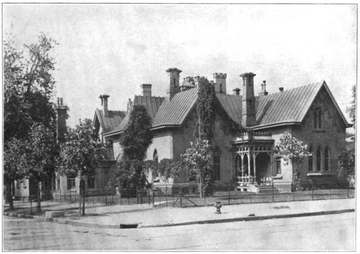
former home of Salmon P. Chase at E. State and Sixth Street, Columbus, Ohio, seen in 1909 photo.
Public domain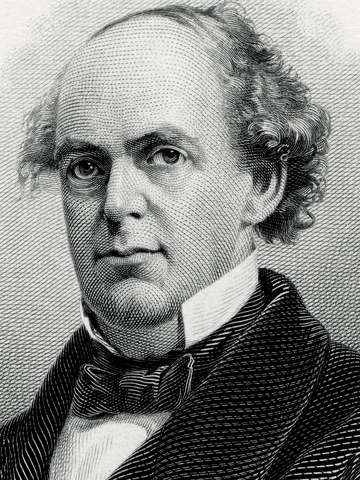
Engraved BEP portrait of U.S. Secretary of the Treasury Salmon P. Chase
Public domain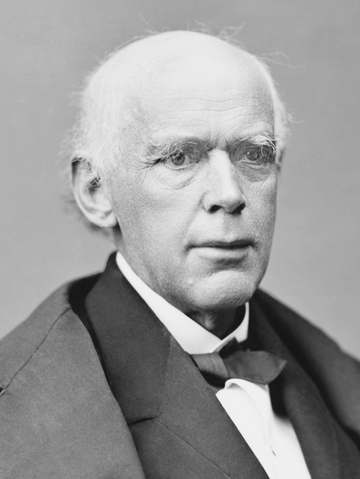
Photograph of Chief Justice Salmon P. Chase
Public domain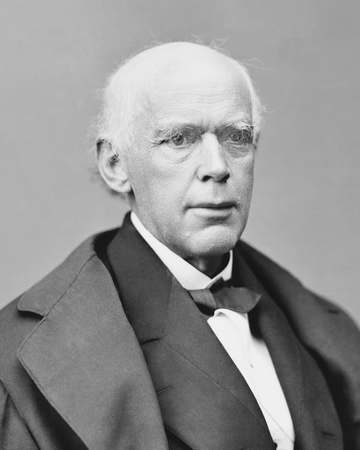
Photograph of Chief Justice Salmon P. Chase
Public domain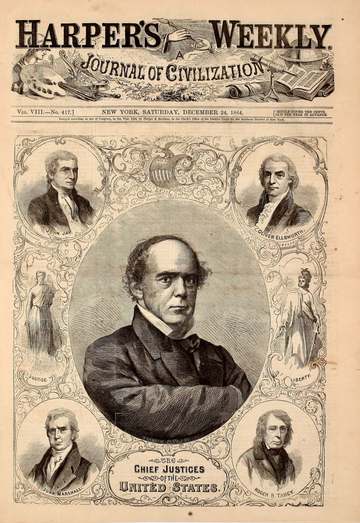
Chief Justices of the United States (Harper's Weekly, December 24, 1864)
Public domain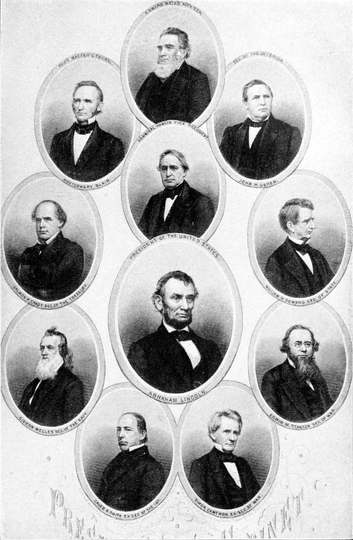
Oval-framed portrait of President of the United States Abraham Lincoln surrounded by oval-framed portraits of ...
Public domain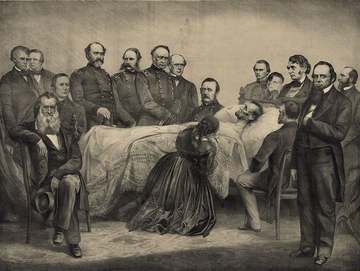
Print shows the interior of a room with Abraham Lincoln lying on a bed surrounded by cabinet members, generals...
Public domain


Further reading
Sources
Confidence. Medium: the main facts were confirmed, but some details (often an address or ZIP code) were not.
- Wikipedia: Salmon P. Chase dates, governor, chief justice, burial, Loveland home
- Wikipedia: Jones v. Van Zandt
- Wikipedia: In God We Trust
- Wikipedia: Camp Chase
- Wikipedia: Spring Grove Cemetery
- Wikipedia: Lucy Stone
- Wikipedia: Soldiers' and Sailors' Monument (Cleveland)
- remarkableohio.org: 61 31 salmon portland chase
- findagrave.com: salmon portland chase
- home.treasury.gov: salmon chase photo
- hamiltonavenueroadtofreedom.org
- hamiltonavenueroadtofreedom.org
- archive.org: speechofsalmonpc00chas
- archive.org: ASPC0023591100
- archive.org: reclamationoffug00chas
- archive.org: unionfreedomwith00chas
- archive.org: maintainplighted00chasuoft
- Wikimedia Commons: Chief Justice Salmon P. Chase
- Wikimedia Commons: Hon. Salmon P. Chase, Chief Justice U.S NARA 527071
- Wikimedia Commons: CHASE, Samuel P Treasury (BEP engraved portrait)
- Wikimedia Commons: Salmon P. Chase Residence (1909)
- Wikimedia Commons: Samuel Portland Chase Historical Marker, Cincinnati, OH (46306697595)
- Wikimedia Commons: Samuel Portland Chase Historical Marker, Cincinnati, OH (46306697435)
- Wikimedia Commons: SalmonChaseGrave
- Wikimedia Commons: Prominent Candidates for the Republican Presidential Nomination at Chicago


Every link goes to the original source. Profile researched 2026-10-15.