Notable people · Sports · African American History
Edwin Moses
Dayton-born physics student who won Olympic 400-metre hurdles gold in 1976 and 1984, went unbeaten in 107 straight finals from 1977 to 1987, and led reforms of athlete funding and drug testing.
Born August 31, 1955, Dayton
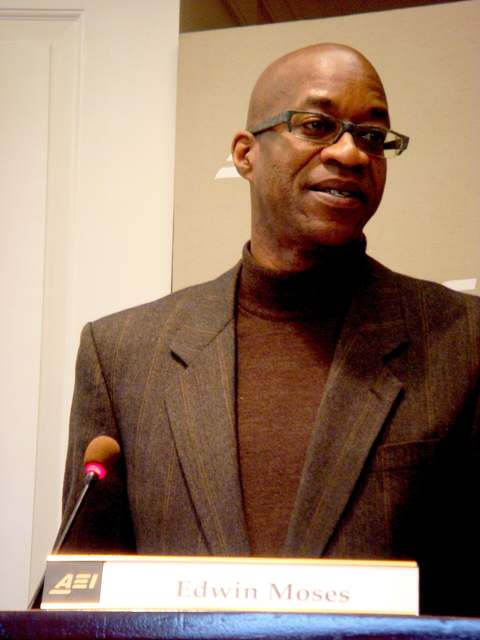
At a glance
- Born
- August 31, 1955, Dayton (Montgomery County) source
- Also known as
- Edwin Moses, Ed Moses, Edwin C. Moses
- Known as
- Sports, African American History
Edwin Moses is living. This page covers their public life only, from published sources. Correct this page · hello@crackedbuckeye.com
Life story
Edwin Moses was born in Dayton in 1955 to parents who were educators; his father was a Tuskegee Airman. He grew up in what he calls a prosperous, factory-town Dayton of the 1960s and played basketball and football, did gymnastics and ran track at Fairview High School, but by his own account he was a self-described nerd whom no college recruited. At 17 he went to Morehouse College in Atlanta on an academic scholarship to study physics, trained on high school tracks because Morehouse had none, and worked out mathematically that he could run the 400-metre hurdles in 13 strides between hurdles. In his first season in the event he won the 1976 Olympic gold in Montreal in world-record time; from September 1977 to June 1987 he did not lose a 400-metre hurdles race, winning 107 straight finals and lowering the world record to 47.02 in 1983, and he won a second Olympic gold in Los Angeles in 1984. He pushed through the trust funds that let Olympic athletes earn money without losing eligibility and helped design amateur sport's first random out-of-competition drug tests. Dayton renamed a riverfront road Edwin C. Moses Boulevard after his second gold.
Ohio ties
- Dayton (1955-1973)
birthplace and boyhood home Montgomery County · source - Fairview High School, Dayton (to 1973)
played basketball and football, did gymnastics and ran track Montgomery County · source - Edwin C. Moses Boulevard, Dayton (1984)
Miami Boulevard West and Sunrise Avenue renamed in his honour Montgomery County · source - Dayton (2008)
presented the Dayton Literary Peace Prize's lifetime achievement award to historian Taylor Branch Montgomery County · source - Sinclair Community College, Dayton (2025)
special guest at the UNCF Mayor's Luncheon, where he spoke about growing up in Dayton and at Fairview High School Montgomery County · source
Timeline
- 1955 Born August 31 in Dayton. source
- 1973 Entered Morehouse College in Atlanta at 17 on an academic scholarship, majoring in physics and industrial engineering. source
- 1976 Ran only his first 400-metre hurdles races that spring, then won Olympic gold in Montreal in his first international meet, setting a world record. source
- 1977 Set a world record of 47.45 at the U.S. championships, lost to Harald Schmid in Berlin on August 26, and began his winning streak on September 2. source
- 1980 Set a world record of 47.13. source
- 1980 Qualified for the U.S. Olympic team but missed the Moscow Games because of the boycott; named Track & Field News Athlete of the Year. source
- 1981 The IOC ratified his Athletes Trust Fund plan, letting athletes take stipends and endorsement money without losing Olympic eligibility; he received the first Jesse Owens Award. source
- 1983 Ran a world record of 47.02 on his 28th birthday. source
- 1983 Won the 400-metre hurdles at the first World Championships in Helsinki and received the Sullivan Award as the outstanding U.S. amateur athlete. source
- 1984 Took the athletes' Olympic oath at the Los Angeles Games and won a second gold medal; shared Sports Illustrated's Sportsman of the Year with Mary Lou Retton. source
- 1984 Dayton renamed Miami Boulevard West and Sunrise Avenue as Edwin C. Moses Boulevard. source
- 1987 Lost to Danny Harris in Madrid on June 4, ending a streak of 122 races and 107 finals over nine years, nine months and nine days; won a second world title in Rome that August. source
- 1988 Won bronze at the Seoul Olympics in his last race, and in December designed amateur sport's first random out-of-competition drug-testing programme. source
- 1990 Won a World Cup two-man bobsled bronze at Winterberg, Germany, with Brian Shimer. source
- 1994 Inducted into the National Track and Field Hall of Fame and earned an MBA at Pepperdine University. source
- 2000 Became chairman of the Laureus World Sports Academy; he also chaired the U.S. Anti-Doping Agency. source
- 2018 Received the Laureus Lifetime Achievement Award in Monaco on February 27. source
- 2024 The documentary MOSES-13 Steps premiered at Morehouse College on September 21. source
- 2025 Spoke about growing up in Dayton at the UNCF Mayor's Luncheon at Sinclair Community College on January 31. source
Stories
A physics major's 13 steps
Moses ran at Morehouse to relieve academic stress, and because the college had no track, he and his teammates hopped fences to train at Atlanta high schools; the year before the 1976 Olympics the college nearly cut the programme, and the students kept it going and found a coach themselves. He ran his first 400-metre hurdles race only a few months before the 1976 Olympics. As a physics major he worked out that the fastest way round was to stay close to the inside line and take 13 strides between hurdles, where most hurdlers then took 15. Months later he won the Olympic final in Montreal in world-record time. The documentary about his life, two decades in the making, is called MOSES-13 Steps.
The unrecruitable nerd from Dayton
Moses has described himself as a nerd from Dayton who was completely unrecruitable as an athlete coming out of high school; he went to Morehouse on an academic scholarship, a year ahead of his age. Talking about his documentary in 2024, he said he grew up in Dayton in the 1960s when it was one of the most prosperous cities to live in, a kind of smaller Detroit where factories meant everyone worked. In January 2025, at the UNCF Mayor's Luncheon at Sinclair Community College, he spoke about Fairview High School and the diversity of the Dayton he grew up in, calling it a peaceful place with only small conflicts. Daytonians, the station that covered the luncheon noted, know his name from the boulevard named for him after his second gold medal.
Getting athletes paid
In 1979 Moses took leave from his engineering job at General Dynamics to run full-time, and he found that Olympic eligibility rules kept athletes from earning money. He drew up a plan for trust funds that would hold stipends, direct payments and endorsement money without breaking amateur rules, and presented it to IOC President Juan Antonio Samaranch. The IOC ratified the idea in 1981, and it became the basis of later support programmes, including the U.S. Olympic Committee's direct athlete assistance. He then turned to doping and in December 1988 designed amateur sport's first random out-of-competition testing programme.
Named for Edwin Moses
- Edwin C. Moses Boulevard (Dayton, Montgomery County) source
- Edwin Moses Track, B. T. Harvey Stadium, Morehouse College (Atlanta, Georgia) source
Sites to know
Homes, graves, markers, museums and monuments.
- Edwin C. Moses Boulevard (formerly Miami Boulevard West and Sunrise Avenue)
Dayton Montgomery County · source - Fairview High School, 1305 W. Fairview Ave. (Dayton Public Schools, 1929-1982) (unknown)
Dayton Montgomery County · source
Ohio places
Where Edwin Moses was born, lived, worked and is remembered, with the ZIP code, town and county pages for each.
- Born: Dayton, Montgomery County Dayton · Montgomery County
- Connected: Dayton, Montgomery County Dayton · Montgomery County
- Connected: Fairview High School, Montgomery County Montgomery County
- Connected: Edwin C. Moses Boulevard, Montgomery County Montgomery County
- Connected: Dayton, Montgomery County Dayton · Montgomery County
- Connected: Sinclair Community College, Montgomery County Montgomery County
Documents
Primary records: patents, letters, court and government files, nominations and old county histories, each at the archive that holds it.
- Edwin Moses, U.S. Olympic & Paralympic Hall of Fame biography and quick facts U.S. Olympic & Paralympic Committee
- Edwin Moses, USA Track & Field Hall of Fame biography USA Track & Field
- Film reveals Morehouse alum Edwin Moses' imprint on the track and field stars of today (Andscape interview, September 19, 2024) 2024, Andscape (ESPN)
Pictures
Free to use with the credit shown. Select a picture for the original and its license.
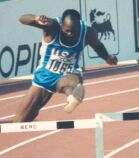
Ed Moses, the 1987 World Championship. Author: en:User:GingerBeast picture found on http://en.wikipedia.org/wi...
Public domain
First Lady Michelle Obama greets gymnast Nadia Comaneci, her husband gymnast Bart Connor, left, Paralympic ath...
Public domain
First Lady Michelle Obama greets gymnast Nadia Comaneci, her husband gymnast Bart Connor, left, Paralympic ath...
Public domain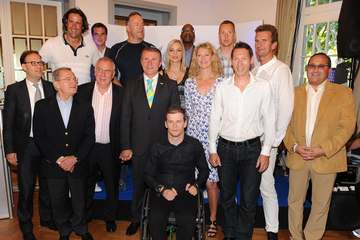
Inauguration participants 2009
Sportsforpeace / CC BY 3.0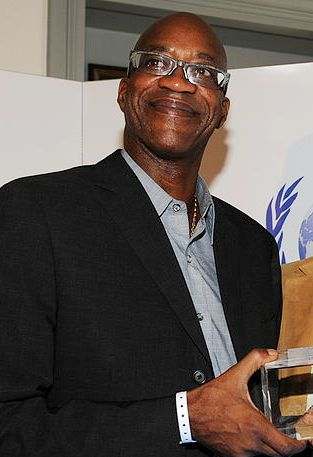
D. Wessfeldt hands over award to E. Moses
Moses_und_Wessfeldt.JPG: Sportsforpeace derivative work: MachoCarioca (talk) / CC BY 3.0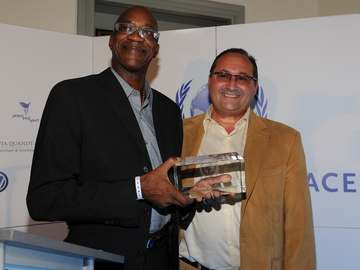
D. Wessfeldt hands over award to E. Moses
Sportsforpeace / CC BY 3.0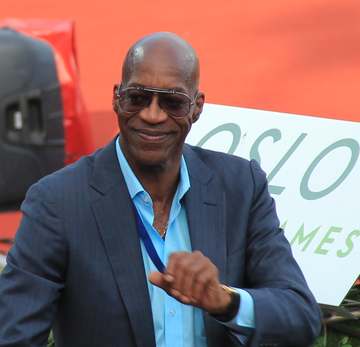
Edwin Moses at the 2017 Bislett Games
Chell Hill / CC BY-SA 4.0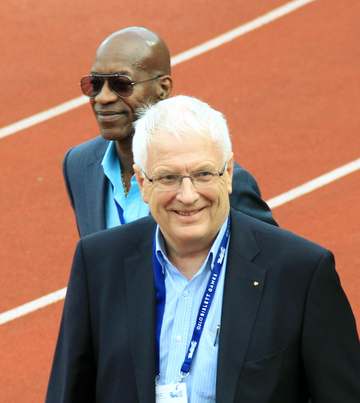
Svein Arne Hansen at the 2017 Bislett Games.
Chell Hill / CC BY-SA 4.0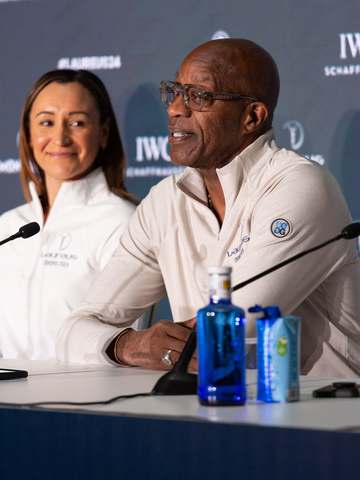
Speaking at the 25th Laureus World Sports Awards press conference, hurdling great Edwin Moses shares his exper...
Barcex / CC BY-SA 4.0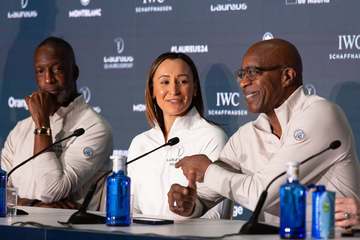
Speaking at the 25th Laureus World Sports Awards press conference, hurdling great Edwin Moses shares his exper...
Barcex / CC BY-SA 4.0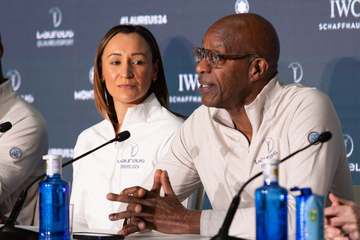
Speaking at the 25th Laureus World Sports Awards press conference, hurdling great Edwin Moses shares his exper...
Barcex / CC BY-SA 4.0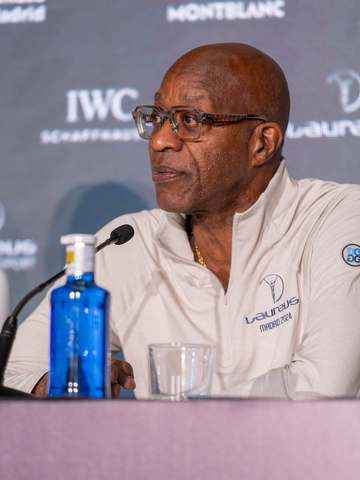
Speaking at the 25th Laureus World Sports Awards press conference, hurdling great Edwin Moses shares his exper...
Barcex / CC BY-SA 4.0


Sources
Confidence. Medium: the main facts were confirmed, but some details (often an address or ZIP code) were not.
- https://en.wikipedia.org/wiki/Edwin_Moses
- https://www.usatf.org/athlete-bios/edwin-moses
- https://www.teamusa.com/hall-of-fame/hall-of-fame-members/edwin-moses
- https://andscape.com/features/film-reveals-morehouse-alum-edwin-moses-imprint-on-the-track-and-field-stars-of-today/
- https://www.yahoo.com/news/edwin-c-moses-speaks-growing-015940701.html
- https://worldathletics.org/news/news/laureus-awards-2018-ed-moses-lifetime-achieve
- https://en.wikipedia.org/wiki/Dayton_Public_Schools
- https://commons.wikimedia.org/wiki/File:Edwin_Moses_2008.jpg
- https://commons.wikimedia.org/wiki/File:2017-BG_Ed_Moses_02.jpg
- https://commons.wikimedia.org/wiki/File:P093009CK-0293_(3969427553).jpg

Every link goes to the original source. Profile researched 2026-10-15.