Notable people · Native History · Politics
Leatherlips
Wyandot leader and signer of the Treaty of Greenville who was executed on the Scioto north of Columbus in June 1810 by Wyandot followers of the Shawnee Prophet, on a public charge of witchcraft, for refusing to join the movement against the United States.
Born c. 1732 (the City of Dublin's profile says c. 1750)
Died June 1, 1810, His camp on the east bank of the Scioto River, about fourteen miles north of Columbus near the Delaware County line, in present Dublin
At a glance
- Born
- c. 1732 (the City of Dublin's profile says c. 1750) source
- Died
- June 1, 1810, His camp on the east bank of the Scioto River, about fourteen miles north of Columbus near the Delaware County line, in present Dublin (Franklin County) source
- Buried
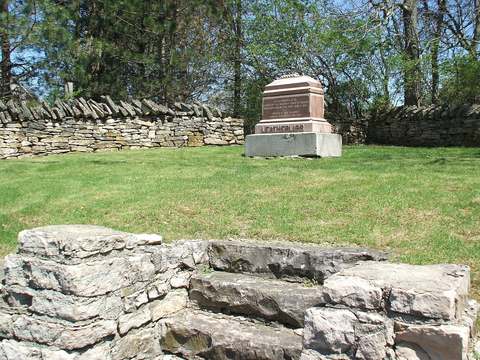
- Shallow grave beside his camp, now under the 1889 Wyandot Club monument on Riverside Drive, Dublin (Franklin County) source
- Also known as
- Shateyaronyah, Šaʔteyarǫnyes, Shateyyaronyah, Sha-Te-Yah-Ron-Ya
- Known as
- Native History, Politics
Life story
Šaʔteyarǫnyes, called Leatherlips by Ohio settlers, was a Wyandot of the Porcupine clan and a noted warrior, a clan relative of Tarhe and Roundhead, who signed the Treaty of Greenville in 1795 as 'Shateyyaronyah, or Leather Lips'. In his later years he kept a camp on the Scioto River in present Dublin and stood by the Greenville pledge never again to fight the United States, which set him against Tenskwatawa and Tecumseh as they built their alliance. On June 1, 1810, a party of Wyandots who had come from the Prophet's town on the Tippecanoe held a council at his camp, reaffirmed a death sentence for witchcraft, refused a horse offered by the settler John Sells for his life, and killed him with a tomahawk beside a grave they had already dug. Settlers who watched told the story, and Otway Curry's 1838 article and later county histories kept it alive. The Wyandot Club of Columbus put a granite monument over the grave in 1889, and Dublin dedicated Ralph Helmick's 12-foot limestone head in Scioto Park in 1990.
Ohio ties
- Scioto River camp, present Dublin (to 1810)
his last camp, about two miles above the Sells family home and roughly twelve miles above Columbus; site of his execution and grave Franklin County · source - Greenville (1795)
signed the Treaty of Greenville with the Wyandot delegation on August 3 Darke County · source - Scioto Park, 7377 Riverside Drive, Dublin (1990)
Ralph Helmick's Leatherlips sculpture, at the site believed to be his last hunting camp Franklin County · source
Timeline
- 1732 Born about this year according to Wikipedia; the City of Dublin's profile gives about 1750. source
- 1795 Signed the Treaty of Greenville on August 3 as 'Shateyyaronyah, or Leather Lips', one of ten Wyandot signers with Tarhe. source
- 1810 On June 1 Wyandot warriors who had come from the Prophet's town on the Tippecanoe held a two-hour council at his Scioto camp, reaffirmed his death sentence and killed him with a tomahawk. source
- 1838 Otway Curry published 'The Doomed Wyandot', an account drawn from settler witnesses, in the Columbus magazine The Hesperian. source
- 1843 The Wyandot, the last nation removed from Ohio, left Upper Sandusky on July 11. source
- 1858 William T. Martin's History of Franklin County reprinted the execution account, noting the witness William Sells of Dublin was perhaps the last white survivor present. source
- 1889 The Wyandot Club of Columbus erected a Scotch granite monument at the place where he was executed and buried. source
- 1990 The Dublin Arts Council dedicated Ralph Helmick's 12-foot limestone Leatherlips sculpture in Scioto Park on July 1, the first work in its public art program. source
- 2023 The City of Dublin published a profile using the modern Wyandot spelling Šaʔteyarǫnyes and the work of Wyandot historian Lloyd Divine Jr. source
Stories
The council on the Scioto, June 1810
Martin's 1858 Franklin County history, abridging Otway Curry's 1838 account and checked with the witness William Sells of Dublin, describes what settlers saw. Six Wyandots came to Leatherlips's camp on the Scioto, about fourteen miles north of Columbus; General Harrison believed they came straight from the Prophet's town on the Tippecanoe. In a two-hour council the accusers spoke with bitterness and Leatherlips answered calmly, and the sentence already passed on him was reaffirmed. White neighbours led by John Sells offered a horse for his life and were refused. Leatherlips ate a meal of jerked venison, washed, dressed in his best clothes and painted his face, shook hands with the spectators, and walked singing his death song to a shallow grave his executioners had already dug. He and the party's leader each prayed in Wyandot, and then one of the warriors drew a hidden tomahawk and struck him.
A pledge kept at Greenville
The City of Dublin's 2023 profile, which draws on the Wyandot historian Lloyd Divine Jr., argues that his integrity is what got Leatherlips killed. At Greenville in 1795 he and the other signers pledged never again to take up arms against the United States, and his clan relative Tarhe held to the same course. Another relative, Roundhead, sided with Tecumseh and Tenskwatawa, neither of whom had signed. The profile says witchcraft, the misuse of power for personal gain and a capital offence, was only the public charge: Leatherlips had to die publicly before his opposition could damage the alliance the Prophet was helping his brother build, and unlike Tarhe he had no political protection. It quotes the Moravian John Heckewelder: 'His only crime was honesty'.
Two monuments on Riverside Drive
In 1889 the Wyandot Club of Columbus set a Scotch granite monument at the spot where Leatherlips was executed and buried, near the east bank of the Scioto north of Upper Arlington; a photograph of it ran with a December 1918 article in the Norwester magazine. A century after the first monument, the Dublin Arts Council commissioned the Boston artist Ralph Helmick for its first public artwork. His Leatherlips, dedicated in Scioto Park on July 1, 1990, is a 12-foot head of mortared limestone slabs whose hair sweeps back into the hillside and whose face looks west over the river; visitors can climb onto it from behind. It stands at the site believed to be his last hunting camp, a few miles south of the grave.
Named for Leatherlips
- Leatherlips (sculpture), Scioto Park (Dublin, Franklin County) source
Sites to know
Homes, graves, markers, museums and monuments; the numbered ones are on the map.
- 1 Leatherlips grave and Wyandot Club monument (1889)
Riverside Drive at Stratford Avenue, Dublin Franklin County · source - Leatherlips sculpture by Ralph Helmick (1990), Scioto Park
7377 Riverside Drive, Dublin Franklin County · source - 2 Ohio Historical Marker 4-19, Treaty of Greene Ville 1795
Public Square, W. Main and S. Broadway, Greenville Darke County · source
Ohio places
Where Leatherlips was born, lived, worked and is remembered, with the ZIP code, town and county pages for each.
- Connected: Scioto River camp, Franklin County Franklin County
- Connected: Greenville, Darke County Greenville · Darke County
- Connected: Scioto Park, Franklin County Franklin County
- Buried: Shallow grave beside his camp, Franklin County Franklin County
Myths and corrections
Things often said about Leatherlips, and what the record shows.
Often said His brother Roundhead ordered or carried out the execution.
The record The 1858 county history only says the party was headed, 'it is supposed', by Roundhead, and Roundhead was a clan relative, not a brother. The City of Dublin's 2023 profile says neither Roundhead nor Tarhe, both clan relatives, would have agreed to it, that William Henry Harrison was sure Tarhe was not involved, and that the Wyandot William Walker Jr. named Peter Gould, a Michigan Wyandot follower of Tecumseh and the Prophet, as the executioner. source
Often said Leatherlips was killed because he was a witch.
The record Witchcraft was the public charge. Wikipedia, the Dublin profile and Harrison's own view all point to politics: he kept his Greenville pledge and refused to join the Prophet's movement. The Dublin profile states plainly that he 'was not, and would never be, a witch'. source
Often said Leatherlips's ghost brings rain to the Memorial Tournament at Muirfield Village, built on an Indian burial ground.
The record The Dublin Historical Society notes the golf course and the execution site are on opposite sides of the Scioto, and a 1997 AP story said there is no evidence the course was built on a burial ground. In 1993 Barbara Nicklaus left glasses of gin at the monument at Winnie Palmer's suggestion; the rain kept coming. source
Documents
Primary records: patents, letters, court and government files, nominations and old county histories, each at the archive that holds it.
- City of Dublin, 'Shateyyaronyah (Šaʔteyarǫnyes), Leatherlips, A Wyandot Chief' (profile with references) 2023, City of Dublin, Ohio
- William T. Martin, History of Franklin County (1858), with the account of the execution of Leatherlips, pp. 34-36 1858, Internet Archive, via Wikimedia Commons
- Treaty of Greenville, August 3, 1795 (text, with the mark of 'Shateyyaronyah, or Leather Lips') 1795, Avalon Project, Yale Law School
Pictures
Free to use with the credit shown. Select a picture for the original and its license.
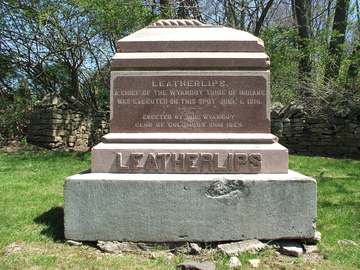
Leatherlips gravestone at 40.140081, -83.118450.
No known restrictions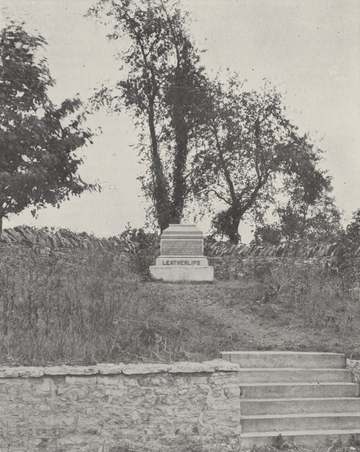
On June 1, 1810, Chief Shateyaronyah of the Native American Wyandot tribe, who was also known as Leatherlips t...
No known restrictions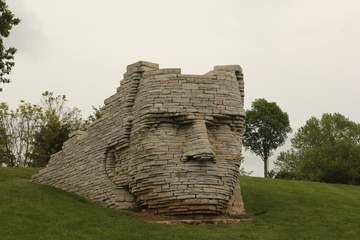
A monument to Leatherlips and a memorial art sculpture are tourist stops in Dublin, Ohio.
Robbt / CC BY 2.0


Sources
Confidence. High: the main facts were confirmed in sources we opened.
- https://en.wikipedia.org/wiki/Leatherlips
- https://dublinohiousa.gov/alpha/wp-content/uploads/2023/05/Sa%CA%94teyar%C7%ABnyes.pdf
- https://dublinohiohistory.org/history/historical-people/chief-leatherlips/
- https://archive.org/download/historyoffrankli00mart/historyoffrankli00mart_djvu.txt
- https://www.roadsideamerica.com/story/9791
- https://www.worthingtonmemory.org/scrapbook/last-wyandots-c-1860
- https://en.wikipedia.org/wiki/Dublin,_Ohio
- https://avalon.law.yale.edu/18th_century/greenvil.asp
- https://remarkableohio.org/marker/4-19-treaty-of-greene-ville-1795/
- https://remarkableohio.org/marker/8-88-the-wyandot-removal-trail-upper-sandusky-july-11-1843/
- https://commons.wikimedia.org/wiki/File:Leatherlips_Monument,_1918_(4721378929).jpg
- https://commons.wikimedia.org/wiki/File:Leatherlips_Cemetery_01.jpg
- https://commons.wikimedia.org/wiki/File:Leatherlips_sculpture_-_DPLA_-_95cc3b08393cf9487b5390587d1be77e_(page_1).jpg
- https://commons.wikimedia.org/wiki/File:History_of_Franklin_County_(Ohio)-_(IA_historyoffrankli00mart).pdf
Every link goes to the original source. Profile researched 2026-10-15.