Notable people · Justice · Judge · Suffrage
Florence E. Allen
Cleveland suffragist and lawyer who in 1922 became the first woman on a state supreme court (Ohio) and in 1934 the first woman on a federal court of appeals, the U.S. Sixth Circuit.
Born March 23, 1884, Salt Lake City, Utah
Died September 12, 1966, Waite Hill
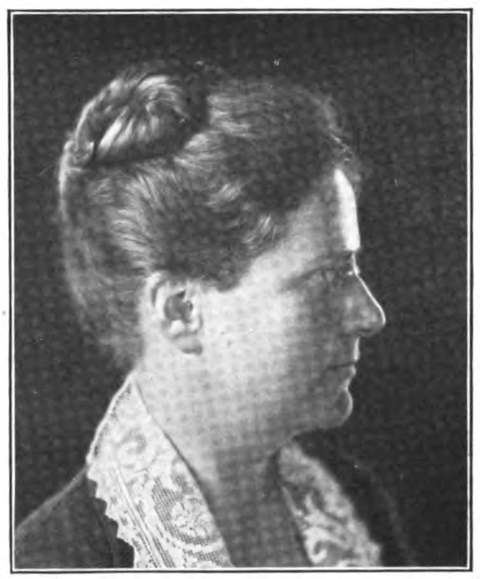
At a glance
- Born
- March 23, 1884, Salt Lake City, Utah source
- Died
- September 12, 1966, Waite Hill (Lake County) source
- Buried
- Waite Hill Village Cemetery, Waite Hill (Lake County) source
- Also known as
- Florence E. Allen, Judge Florence Allen, First lady of the law
- Education
- Western Reserve University (now Case Western Reserve), Cleveland, OH, to 1908, B.A. 1904; M.A. 1908
- University of Chicago Law School, Chicago, IL, one year
- New York University School of Law, New York, NY, to 1913, LL.B.
- Known as
- Justice, Judge, Suffrage
Life story
Florence Allen was born in Salt Lake City in 1884, and her family moved to Cleveland when her father, a professor and linguist, took a post there. She earned a music degree at Case Western Reserve in 1904 and a master's in political science in 1908.
She studied law for a year at Chicago and finished an NYU law degree with honors in 1913. She was admitted to the Ohio bar in 1914.
She became Cuyahoga County's first woman assistant prosecutor in 1919, a common pleas judge in 1920, and in 1922 was elected to the Ohio Supreme Court, the first woman on any state supreme court.
President Franklin Roosevelt named her to the Sixth Circuit Court of Appeals in 1934, making her the first woman federal appeals judge. She became chief judge in 1958, wrote two books, and died in Waite Hill, Ohio, in 1966.
Ohio ties
- New Lyme (1890s-1900)
student at the New Lyme Institute, where her grandfather Prof. Jacob E. Tuckerman had been president from 1882 Ashtabula County · source - Cleveland (1900-1922)
Western Reserve student (B.A. 1904, M.A. 1908); Plain Dealer music critic; lawyer and suffrage organizer; assistant county prosecutor; Common Pleas judge Cuyahoga County · source - Shaker Heights (Laurel School) (1906-1909)
taught at Laurel School, where her Ohio historical marker now stands Cuyahoga County · source - East Cleveland (1916)
successfully defended the city charter provision letting women vote in municipal elections Cuyahoga County · source - Columbus (1922-1934)
justice of the Supreme Court of Ohio Franklin County · source - Waite Hill (1959-1966)
lived in retirement with a cousin; died there and is buried in the village cemetery Lake County · source
Timeline
- 1884 Born March 23 in Salt Lake City, Utah, to Clarence Emir Allen and Corinne Tuckerman Allen. source
- 1890s Attended Hammond Hall in Salt Lake City and then the New Lyme Institute in New Lyme, Ohio, until 1900. source
- 1900 Entered the Women's College of Western Reserve University in Cleveland at 16. source
- 1904 Graduated from Western Reserve, Phi Beta Kappa, and went to Berlin to study piano until 1906. source
- 1906 Became music critic of the Cleveland Plain Dealer (1906-1909) and taught at Laurel School. source
- 1908 Earned an M.A. in political science at Western Reserve, whose law school then refused her because she was a woman. source
- 1913 Graduated second in her class from New York University School of Law after a year at the University of Chicago. source
- 1914 Admitted to the Ohio bar and opened a practice in Cleveland, while stumping the state in the 1912 and 1914 suffrage amendment campaigns. source
- 1916 Successfully defended before the Ohio Supreme Court East Cleveland's charter provision giving women the vote in municipal elections. source
- 1919 Appointed assistant prosecutor for Cuyahoga County. source
- 1920 Elected in November to the Cuyahoga County Court of Common Pleas, where she refused to be confined to divorce cases and tried nearly 900 cases. source
- 1921 In mid-May sentenced gangster Frank Motto, convicted by a jury that included women, to the electric chair. source
- 1922 Elected to the Supreme Court of Ohio, defeating both the Democratic and Republican candidates, and became the first woman to sit on a state supreme court. source
- 1922 Two days after the election, Associated Press returns printed in Mount Vernon's Democratic Banner showed her about 23,000 votes ahead of sitting Justice Benson W. Hough in the race for the second of two open Supreme Court seats. source
- 1928 Re-elected to the Ohio Supreme Court; the same year she lost the Democratic U.S. Senate primary to Atlee Pomerene. source
- 1932 Lost a race for the U.S. House of Representatives to Republican Chester C. Bolton. source
- 1934 Nominated by Franklin D. Roosevelt on March 6, confirmed March 15 and commissioned March 21 as judge of the U.S. Court of Appeals for the Sixth Circuit. source
- 1940 Published This Constitution of Ours. source
- 1958 Became chief judge of the Sixth Circuit (1958-1959) and sat on the Judicial Conference of the United States. source
- 1959 Took senior status on October 5. source
- 1965 Published her memoir, To Do Justly, through the Press of Western Reserve University. source
- 1966 Died September 12 and was buried in Waite Hill Village Cemetery. source
- 2005 Inducted into the National Women's Hall of Fame. source
What Florence is known for
- Ohio Supreme Court justice 1923-1934
- Sixth Circuit judge 1934-1959; chief judge 1958-59
- This Constitution of Ours (1940)
- To Do Justly (autobiography, 1965)
Stories
A suffragist in the Ohio Supreme Court's courtroom
In New York, Florence Allen met suffrage leaders Carrie Chapman Catt, Anna Howard Shaw and Maud Wood Park, who gave her a job as an organizer for the College Equal Suffrage Organization. Back in Cleveland she became one of the city's leading suffragists, a stump speaker, debater and fundraiser who travelled all over Ohio in the failed 1912 and 1914 campaigns to amend the state constitution. In 1916 East Cleveland's city charter gave its women the vote in municipal elections, and the provision was challenged. Allen defended it before the Ohio Supreme Court and won. The Encyclopedia of Cleveland History says this success and name recognition laid the groundwork for her career as the 'first lady of the law'.
Judge Allen and Frank Motto
Elected to the Cuyahoga County Common Pleas bench in 1920, Allen refused her colleagues' plan to put her in a special divorce division and insisted on hearing the court's full range of cases. Her hardest test was the murder trial of gangster Frank Motto, accused of killing two men in a robbery. With a woman on the bench and women on the jury, critics waited to see whether the supposed leniency of women would show. Motto was convicted, and in mid-May 1921 Allen sentenced him to the electric chair. She tried nearly 900 cases before her election to the Supreme Court of Ohio in 1922.
'Naturally unqualified'
When Franklin Roosevelt nominated Allen to the Sixth Circuit Court of Appeals on March 6, 1934, the FBI's background check found the Cleveland bar divided. Some lawyers called her able, fair and independent. Others, including sitting male judges, told investigators that as a woman she was 'naturally unqualified', and that her appointment would lower standards and make them a laughingstock. The Senate confirmed her nine days later. Supporters pushed her for the U.S. Supreme Court in 1939 and afterwards without success. She was later told that Harry Truman worried the male justices would be uncomfortable: 'They say they couldn't sit around with their robes off and their feet up and discuss the problems.'
Grandfather's school at New Lyme
Allen's Ohio story began not in Cleveland but in rural Ashtabula County. Her maternal grandfather, Prof. Jacob E. Tuckerman, became president of the New Lyme Institute in 1882 and ran it for 15 years, when it drew more than 300 students a year. The school, founded with the help of Judge William S. Deming and dedicated in 1879, taught Latin, Greek, surveying and pedagogy and prepared students for college. Florence attended it before entering Western Reserve in 1900. The institute closed in 1923, when its buildings were handed to the township for a centralized school.
Honors and things named for them
- Ohio Women's Hall of Fame (1978)
- National Women's Hall of Fame (2005)
Family
- father: Clarence Emir Allen
- mother: Corinne Tuckerman Allen
Sites to know
Homes, graves, markers, museums and monuments; the numbered ones are on the map.
- 1 Ohio Historical Marker 41-18, Florence E. Allen, at Laurel School (where she taught 1906-1909), 1 Lyman Circle
Shaker Heights Cuyahoga County · source - 2 Flora Stone Mather College Historic District (the Women's College of Western Reserve University she attended)
Cleveland Cuyahoga County · source - New Lyme Institute (NRHP 74001442), 929 Brownville Road, South New Lyme (unknown)
New Lyme Township Ashtabula County · source - Grave, Waite Hill Village Cemetery
Waite Hill Lake County · source
Ohio places
Where Florence E. Allen was born, lived, worked and is remembered, with the ZIP code, town and county pages for each.
- Lived: Cleveland, Cuyahoga County ZIP 44106 · Cleveland · Cuyahoga County
- Lived: Waite Hill, Lake County ZIP 44094 · Waite Hill · Lake County
Myths and corrections
Things often said about Florence E. Allen, and what the record shows.
Often said Florence Allen was the first woman elected to a judgeship in the United States (National Women's Hall of Fame).
The record Women were elected to lower judicial offices earlier. Catharine Waugh McCulloch, for example, was elected justice of the peace in Evanston, Illinois, in 1907 and re-elected in 1909, and Esther Morris had been appointed a Wyoming justice of the peace in 1870. Allen's well-documented firsts are as a woman on a state supreme court (1922) and on a federal court of appeals (1934). source
Often said She was the first woman federal judge.
The record Genevieve R. Cline had been appointed in 1928 to the U.S. Customs Court, then an Article I court. Allen was the first woman appointed to an Article III federal court and the first on a federal court of appeals. source
Often said In 1958 she became Chief Justice of the Sixth Circuit (wording on Ohio Historical Marker 41-18).
The record The Federal Judicial Center records her as chief judge, 1958-1959, the title used for the presiding judge of a federal court of appeals. The National Women's Hall of Fame dates her chief judgeship to 1959. source
Often said She was elected a municipal judge in Cleveland in 1920 (Encyclopedia of Cleveland History).
The record The Federal Judicial Center and the 1921 Bench and Bar of Northern Ohio both record her November 1920 election as judge of the Cuyahoga County Court of Common Pleas, a county trial court of general jurisdiction. source
- Disputed: She is described as the first woman to serve on a state supreme court. That claim comes from a single source and has not been checked against others.
Documents
Primary records: patents, letters, court and government files, nominations and old county histories, each at the archive that holds it.
- William B. Neff, ed., Bench and Bar of Northern Ohio: History and Biography (1921), entry 'Florence Ellinwood Allen', p. 266 1921, Internet Archive (Google Books scan)
- Federal Judicial Center, Biographical Directory of Article III Federal Judges: Allen, Florence Ellinwood Federal Judicial Center
- The Democratic Banner (Mount Vernon, Ohio), November 10, 1922, p. 1: 'Woman May Be Elected One of Judges of the Supreme Court' 1922, Library of Congress, Chronicling America (Ohio History Connection batch)
Pictures
Free to use with the credit shown. Select a picture for the original and its license.
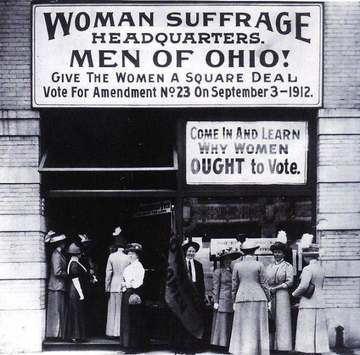
Women's Suffrage Headquarters on Euclid Avenue in Cleveland Ohio in 1912. Individuals in the picture include B...
Public domain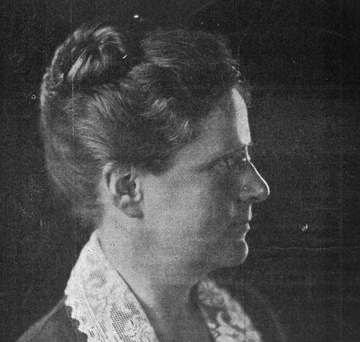
Judge Florence Allen of Cleveland, from a 1921 publication.
Public domain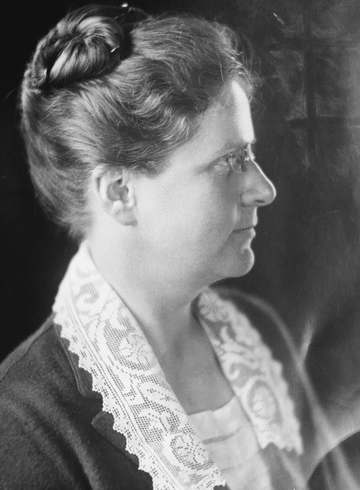
Title: Florence E. Allen Abstract/medium: 1 negative : glass ; 5 x 7 in. or smaller.
Public domain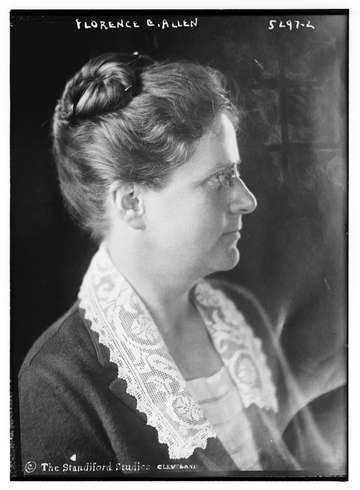
Title: Florence E. Allen Abstract/medium: 1 negative : glass ; 5 x 7 in. or smaller.
Public domain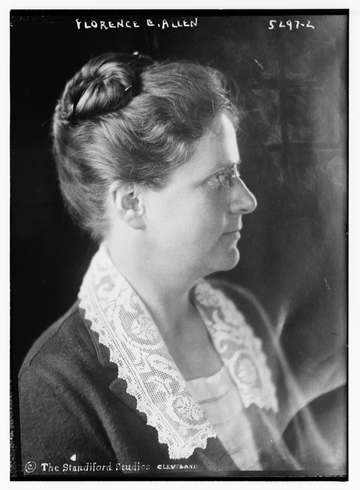
Title: Florence E. Allen Abstract/medium: 1 negative : glass ; 5 x 7 in. or smaller.
Public domain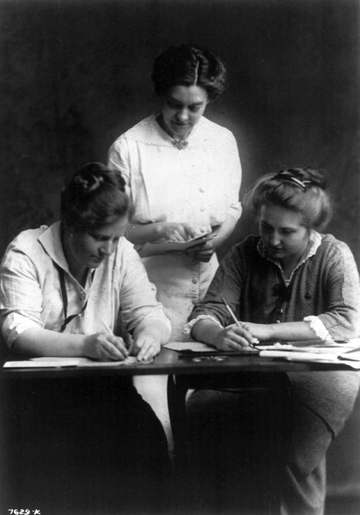
Florence E. Allen (seated, left), Elizabeth J. Hauser, and Greta Coleman
Public domain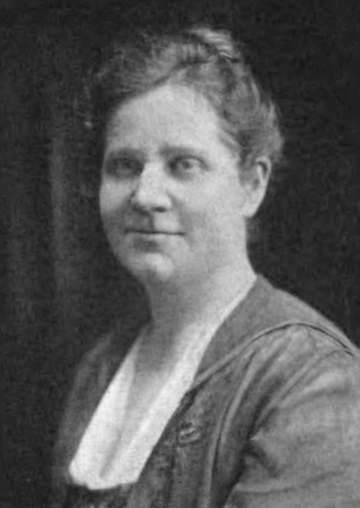
Florence E. Allen. Lawyer. From a 1919 publication.
Public domain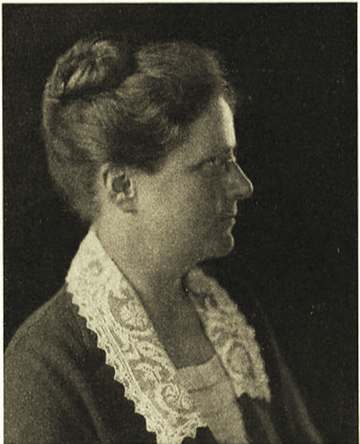
From a 1921 publication.
Public domain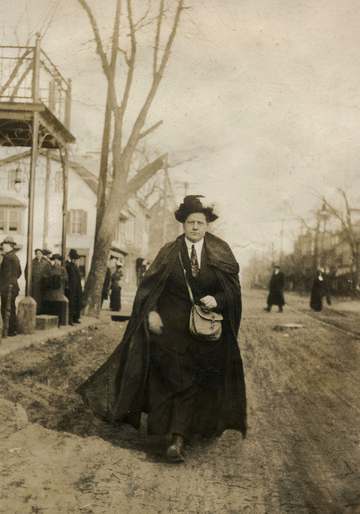
Florence Ellinwood Allen marching for women's suffrage in 1913.
Public domain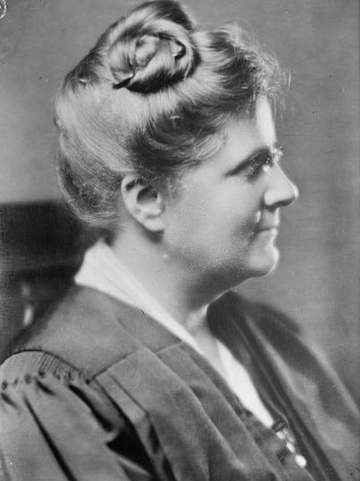
Florence Ellinwood Allen (1884 - 1966)
Public domain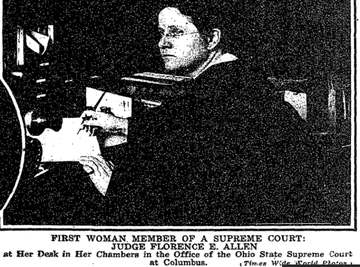
Florence E. Allen, First Woman Member of a Supreme Court, at her desk.
Public domain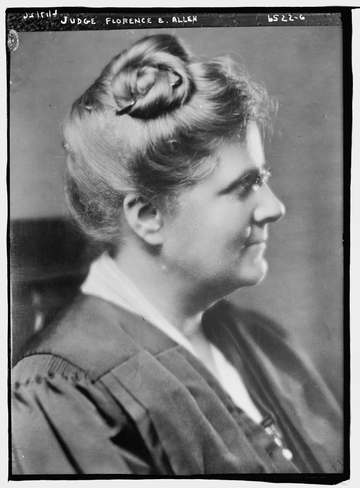
Title: Judge Florence E. Allen Abstract/medium: 1 negative : glass ; 5 x 7 in. or smaller.
Public domain


Further reading
Sources
Confidence. Medium: the main facts were confirmed, but some details (often an address or ZIP code) were not.
- Wikipedia: Florence E. Allen dates, offices, death in Waite Hill, Ohio (Wikipedia, opened; pointer-level source)
- fjc.gov: allen florence ellinwood
- case.edu: allen florence ellinwood
- womenofthehall.org: florence ellinwood allen
- remarkableohio.org: 41 18 florence e allen
- archive.org: bub gb DgwwAAAAYAAJ
- Wikipedia: New Lyme Institute
- Wikipedia: Flora Stone Mather College Historic District
- Wikipedia: Catharine Waugh McCulloch
- Wikipedia: Esther Hobart Morris
- Wikimedia Commons: Category:Florence Ellinwood Allen
- findagrave.com
- loc.gov: ed 1
Every link goes to the original source. Profile researched 2026-10-15.
