Notable people · Inventor · Business
Charles F. Brush
Cleveland inventor of a practical dynamo and self-regulating series arc lamp, who lit Public Square with twelve arc lights on 29 April 1879 and built an automatic wind-powered dynamo behind his Euclid Avenue mansion in 1888.
Born March 17, 1849, his parents' farm in Euclid Township
Died June 15, 1929, Cleveland
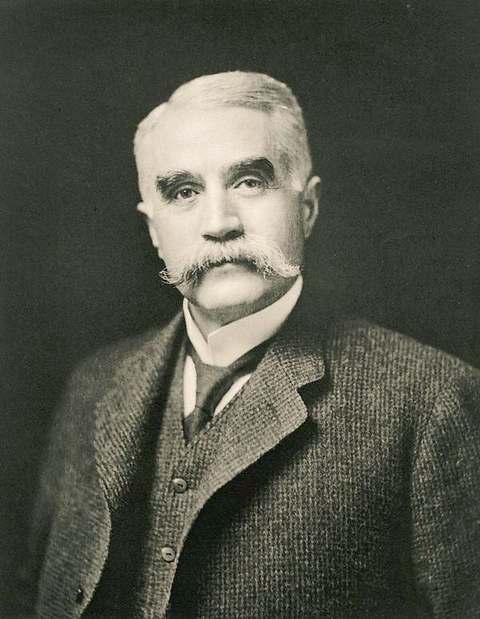
At a glance
- Born
- March 17, 1849, his parents' farm in Euclid Township (Cuyahoga County) source
- Died
- June 15, 1929, Cleveland (Cuyahoga County) source
- Buried
- Lake View Cemetery, Cleveland (Section 10) (Cuyahoga County) source
- Also known as
- Charles F. Brush, Charles Brush, C. F. Brush
- Education
- Central High School, Cleveland, OH, to 1867
- University of Michigan, Ann Arbor, MI, to 1869, mining engineering
- Western Reserve University, Cleveland, OH, 1880, PhD
- Known as
- Inventor, Business
- Organizations
- Brush Electric Company
Life story
Charles Brush was born in Euclid Township in 1849, from old New England families. He graduated with honours from Cleveland's Central High School in 1867 and took a mining engineering degree at the University of Michigan in 1869.
In the 1870s he built a dynamo and arc lamps that burned longer and needed less care than rival systems. The Franklin Institute judged his dynamo superior in 1878, and Brush Electric lit streets in major cities.
He built a Euclid Avenue mansion in 1884 to show off his inventions. In 1888 he built the world's first automatically operated wind turbine, a 12 kW machine that powered his home for 20 years.
Thomson-Houston bought Brush Electric in 1889. He died in Cleveland in 1929.
Ohio ties
- Euclid Township (1849; 1876)
born on his parents' farm; built his first dynamo there in 1876, driven by a horse treadmill Cuyahoga County · source - Cleveland (Central High School) (to 1867)
graduated with honors; built an arc light as a student Cuyahoga County · source - Cleveland (Public Square) (1879)
site of his 29 April 1879 demonstration of twelve arc street lights Cuyahoga County · source - Cleveland (Mason Street works) (1880-1889)
Brush Electric Company factory between Belden and McHenry streets, employing about 400 Cuyahoga County · source - Cleveland (Euclid Avenue at East 37th Street) (1884-1929)
mansion with basement laboratory and the 1888 wind dynamo in the back yard Cuyahoga County · source - Lyndhurst (1927-present)
Charles F. Brush High School named for him Cuyahoga County · source - Lake View Cemetery, Cleveland (1929)
trustee of the cemetery; buried there Cuyahoga County · source
Timeline
- 1849 Born on 17 March in Euclid Township to Isaac Elbert and Delia Williams Phillips Brush. source
- 1867 Graduated with honors from Cleveland's Central High School, where he had built an arc light. source
- 1869 Graduated from the University of Michigan in mining engineering, at age 20. source
- 1873 Went into business with Charles Bingham selling Lake Superior pig iron and ore, while working as a consulting chemist in Cleveland. source
- 1876 Assembled his first dynamo in the summer at his parents' farm, powered by a horse-drawn treadmill, with backing from George Stockly of the Telegraph Supply Company. source
- 1877 Received U.S. Patent 189,997, 'Improvement in Magneto-Electric Machines', on 24 April. source
- 1878 Received U.S. Patent 203,411 on 7 May for a self-regulating arc lamp, and installed his first commercial arc lamp on a doctor's balcony in Cincinnati. source
- 1879 On 29 April lit Cleveland's Public Square, then called Monumental Park, with twelve arc lamps on high poles, powered from the Telegraph Supply Company. source
- 1879 Received U.S. Patent 219,208 on 2 September for a double-carbon lamp that could burn all night without retrimming. source
- 1880 The Brush Electric Company was organized to make and sell his lighting system, with works on Mason Street employing about 400. source
- 1880 On 20 December, Broadway in New York from 14th to 26th Street was lit by fifteen Brush lamps from the Brush Electric Light Company's station. source
- 1881 Made a chevalier of the French Legion of Honor. source
- 1882 The Brush Electric Company gave the first exhibition of arc lights in Japan, on the main street of Tokyo, in early summer. source
- 1884 Moved into his mansion on Euclid Avenue at East 37th Street, with a laboratory in the basement. source
- 1888 Put into service a wind-driven dynamo behind the mansion: a 56-foot wheel on a 60-foot tower charging batteries in the house. source
- 1889 Charles Coffin's Thomson-Houston Company bought the Brush Electric Company; it later became part of General Electric, and the Cleveland works closed in 1896. source
- 1890 Scientific American of 20 December described his windmill dynamo as the only successful wind-powered electric lighting system it knew of. source
- 1899 Received the Rumford Medal of the American Academy of Arts and Sciences. source
- 1905 Published 'The Arc-Light', his own history of the industry, in the May issue of The Century Magazine. source
- 1913 Received the AIEE Edison Medal for the series arc lighting system. source
- 1927 Charles F. Brush High School opened in Lyndhurst. source
- 1928 Founded the Brush Foundation in Cleveland with $500,000, in memory of his son Charles F. Brush Jr., who died in 1927. source
- 1929 Died in Cleveland on 15 June and was buried at Lake View Cemetery. source
What Charles is known for
- Arc lamp and dynamo systems 1870s
- Early central-station electricity sales 1879
- Automatically operated wind turbine 1888
- Edison Medal 1913
- Arc lamp and dynamo
- Brush Electric Company (1880)
- 1888 wind turbine
Stories
The night Public Square lit up
On 29 April 1879 Brush put twelve arc lamps around Cleveland's Public Square, then called Monumental Park, and ran them in series from a dynamo at the nearby Telegraph Supply Company. The Plain Dealer reported that the lamps came on at about 7:55 p.m. before a crowd of thousands, with a band playing and an artillery salute. The crowd was enthusiastic, though some had expected light as bright as day, and the arcs gave off a purplish hue.
Smoked glass and the double-carbon lamp
Writing in 1905, Brush remembered that while his men put up the poles and wires on Public Square the public watched closely, and that on the opening night many people came with colored spectacles or smoked glass, expecting a blinding glare. At first they were disappointed, though everyone agreed they could read anywhere in the square, and after a few weeks the verdict was favorable. Because the lamps had to burn all night and one set of carbons would not last until morning, a man had to retrim every lamp in the dark, which added to the cost. To end that, Brush designed the double-carbon lamp, which became standard for all-night lighting and, as he put it, famous through much patent litigation.
The windmill behind the mansion
Scientific American visited Brush's Euclid Avenue home in December 1890. Behind the house stood a rectangular tower about 60 feet high and weighing 80,000 pounds, turning on a 14-inch iron pivot set eight feet into masonry. Its wheel was 56 feet across with 144 blades twisted like ship propellers, and a 60-foot tail kept it facing the wind, while a side vane turned it edgewise in a gale. Belts geared it so the dynamo turned fifty times for each turn of the wheel, giving 12,000 watts at full load, with automatic switches and a regulator that held the voltage under 90. The current charged 408 battery cells in the basement that fed some 350 incandescent lamps, two arc lights and three motors. The magazine noted that wind power was not cheap, since the cost of the plant more than offset the free wind.
Wabash and the fight over 'first'
Two newspaper editors from Wabash, Indiana, read about Brush's 1879 Cleveland demonstration, met with him, and arranged a free two-week trial. On 31 March 1880 four 3,000-candlepower Brush lamps hung from the courthouse flagstaff were switched on, set up by electricians sent from Cleveland, and the town bought the $1,800 system. Wabash later called itself the first city in the world 'generally' lighted by electricity. In 2013 the Indiana Historical Bureau reviewed its marker and dropped the superlative, noting that Brush's own 1905 history dates public street lighting to Cleveland in 1879 and does not mention Wabash.
Inventions and firsts
Honors and things named for them
- French Legion of Honor (1881)
- Rumford Prize (1899)
- Edison Medal (1913)
- Charles F. Brush High School, Lyndhurst
- Medallion in the Cleveland Arcade
Named for Charles F. Brush
- Charles F. Brush High School (teams called the Arcs) (Lyndhurst, Cuyahoga County) source
- Brushwood area of Furnace Run Metro Park, on land given by the Brush family (Furnace Run Metro Park, Summit County) source
- Brush Foundation (Cleveland, Cuyahoga County) source
- USS Brush (DD-745) source
Family
- father: Isaac Elbert Brush
Sites to know
Homes, graves, markers, museums and monuments; the numbered ones are on the map.
- 1 Brush grave, Lake View Cemetery (Section 10)
Cleveland Cuyahoga County · source - 2 Public Square, site of the 29 April 1879 arc-light demonstration
Cleveland Cuyahoga County · source - Replica of Brush's arc light lamp, north end of Public Square
Cleveland Cuyahoga County · source - 3 Cleveland Arcade (Brush was among its financiers; a medallion portrait of him is in the building)
Euclid and Superior avenues, Cleveland Cuyahoga County · source - Brush mansion and wind dynamo site, Euclid Avenue at East 37th Street (demolished)
Cleveland Cuyahoga County · source - Brush Electric Company works site, Mason Street between Belden and McHenry streets (unknown)
Cleveland Cuyahoga County · source - 4 Charles F. Brush High School
4875 Glenlyn Road, Lyndhurst Cuyahoga County · source - Brush family farm (Walnut Hills Farm), birthplace and site of the first dynamo (unknown)
Euclid Township Cuyahoga County · source
Places in Ohio to see
- Charles F. Brush High School (park)
4875 Glenlyn Rd, Lyndhurst, Cuyahoga County ZIP 44124 · Lyndhurst · Cuyahoga County · official page - Cleveland Arcade medallion (marker)
Cleveland, Cuyahoga County Cleveland · Cuyahoga County · official page - Lake View Cemetery (grave) (grave)
12316 Euclid Ave, Cleveland, Cuyahoga County ZIP 44106 · Cleveland · Cuyahoga County · official page
Ohio places
Where Charles F. Brush was born, lived, worked and is remembered, with the ZIP code, town and county pages for each.
- Born: Euclid Township, Cuyahoga County ZIP 44117 · Cuyahoga County
- Worked: Cleveland, Cuyahoga County ZIP 44114 · Cleveland · Cuyahoga County
- Buried: Cleveland (Lake View Cemetery), Cuyahoga County (12316 Euclid Ave) ZIP 44106 · Cleveland · Cuyahoga County
Myths and corrections
Things often said about Charles F. Brush, and what the record shows.
Often said Brush invented the arc lamp.
The record Arc lamps were known long before him; Yablochkov 'candles' were already lighting Paris in 1877-78. Brush's own claim, in his 1905 history, was narrower: in 1878 he invented the 'modern series arc-lamp with its regulating shunt coil', which, with his dynamo, made lighting many lamps from one central station commercially possible. source
Often said Cleveland's Public Square was the first street in the world lit by electricity.
The record Yablochkov arc candles lit the Avenue de l'Opéra during the Paris Exhibition of 1878 and London's Victoria Embankment in December 1878, both before Cleveland's April 1879 demonstration. Brush himself called Public Square the first public street lighting 'in this country'. source
Often said Brush's 1888 windmill was the first wind turbine to make electricity.
The record James Blyth built an electricity-generating wind turbine at his cottage in Marykirk, Scotland, in July 1887, months before Brush's. Brush's machine is better described as the first automatically operated wind turbine for generating electricity. source
Often said Brush's windmill produced about 1,200 watts, and it ran from 1886 to 1900.
The record Scientific American's December 1890 account gives the dynamo's normal capacity at full load as 12,000 watts (1,200 pounds was the load on the dynamo belts), and says the plant had been in constant operation for more than two years, which fits an 1888 start rather than 1886. source
Often said Wabash, Indiana, was the first city lighted by electricity (with Brush lights, in 1880).
The record Wabash's four Brush lamps went on on 31 March 1880, eleven months after Brush lit Cleveland's Public Square. The Indiana Historical Bureau's 2013 review of the Wabash marker dropped 'first' as unverifiable; the town's claim rested on its contract for lights that would 'generally' light the whole town. source
- Disputed: The date of his wind turbine is given as 1887 in some accounts and 1888 in others.
Documents
Primary records: patents, letters, court and government files, nominations and old county histories, each at the archive that holds it.
- U.S. Patent 189,997, Improvement in Magneto-Electric Machines (Brush dynamo) 1877, Google Patents
- U.S. Patent 203,411, Improvement in Electric Lamps (self-regulating arc lamp) 1878, Google Patents
- U.S. Patent 219,208, Improvement in Electric Lamps (double-carbon lamp) 1879, Google Patents
- U.S. Patent 234,456, Automatic cut-out apparatus for electric lights or motors 1880, Google Patents
- U.S. Patent 312,184, Electric-arc lamp 1885, Google Patents
- Patent drawing, C. F. Brush: Electric Lamp (NARA 312775020), first of 8 images 1878, National Archives (RG 241)
- Charles F. Brush, 'The Arc-Light', The Century Magazine, May 1905 (vol. 70, no. 1), pp. 110-118 1905, Internet Archive
- 'Mr. Brush's Windmill Dynamo', Scientific American, 20 December 1890 (vol. 63, no. 25) 1890, Internet Archive
- Indiana Historical Bureau, marker text review 85.1966.1 'First Electrically Lighted City' (Wabash) 2013, Indiana Historical Bureau
Pictures
Free to use with the credit shown. Select a picture for the original and its license.
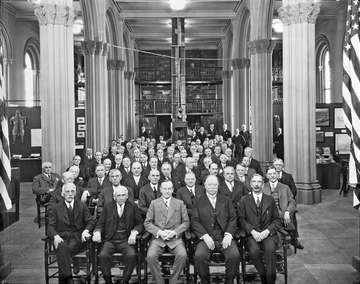
Gathering in the Great Hall of fifty leaders of the scientific, political and industrial life of the country a...
Public domain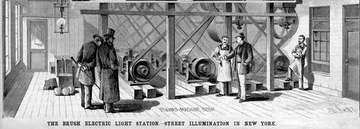
Brush Electric Company's New York central power plant's dynamo room which powered arc lamps for public lightin...
Public domain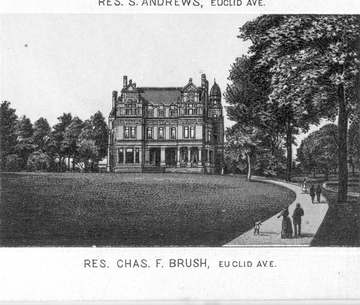
Charles F. Brush house on Euclid Ave. at E. 37th St., Cleveland, Ohio in 1888. It was demolished n 1930.
Public domain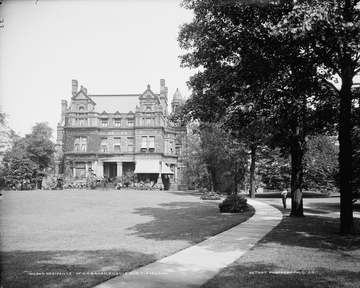
Charles F. Brush Mansion in Cleveland
Public domain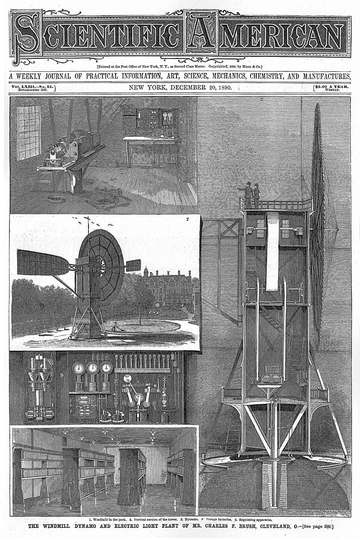
Charles F. Brush's 60 foot, 80,000 pound turbine that supplied 12kW of power to 350 incandescent lights, 2 arc...
Public domain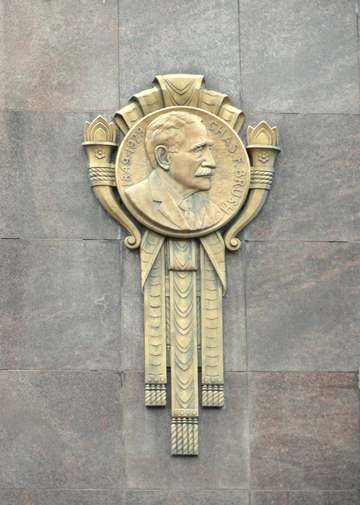
Cleveland Arcade, Cleveland, Ohio, USA. This artwork is in the public domain because the artist died more than...
CC0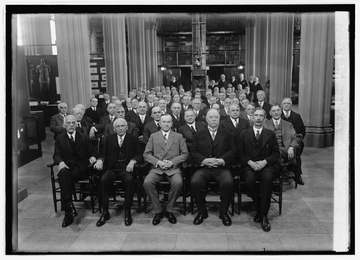
Title: Smithsonian regents, 2/11/27 Gathering in the Great Hall of fifty leaders of the scientific, political ...
Public domain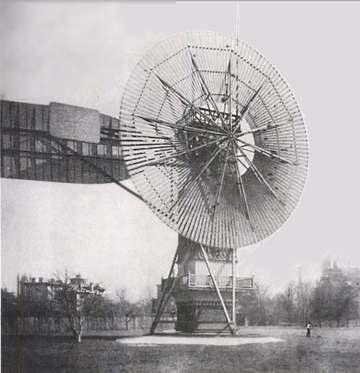
Charles F. Brush's 60 foot, 80,000 pound turbine that supplied 12kW of power to 350 incandescent lights, 2 arc...
Public domain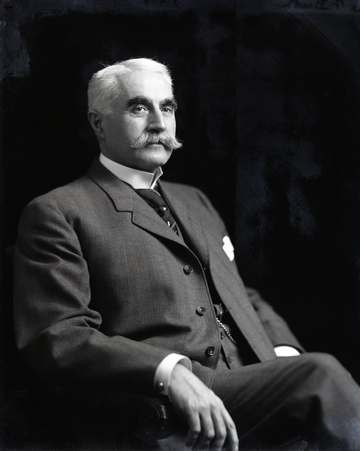
Charles Francis Brush (1849 – 1929) , Cleveland inventor foundedof the Brush Electric company in 1880.
Public domain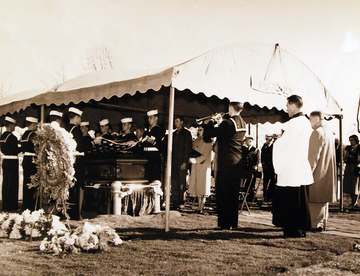
330-PS-844 (USN 707992): U.S. Navy’s First Arlington Burial of Korean Casualty. A bugler blows taps at the fir...
Public domain
USS Brush (DD-745) insignia
Public domain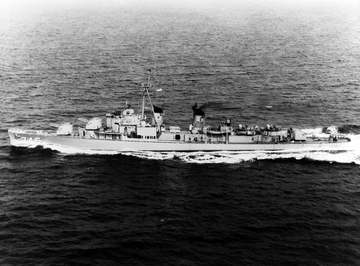
The U.S. Navy destroyer USS Brush (DD-745) underway in the 1960s, after being fitted with Mk 32 anti-submarine...
Public domain


Further reading
Sources
Confidence. Medium: the main facts were confirmed, but some details (often an address or ZIP code) were not.
- Charles F. Brush (Wikipedia) dates, Euclid Township, wind turbine 1888, Lake View burial, honors
- case.edu: brush charles francis
- case.edu: brush electric co
- case.edu: brush foundation
- ethw.org: Charles F. Brush
- lafavre.us: brushbio
- findagrave.com: charles francis brush
- archive.org: sim century illustrated monthly magazine 1905 05 70 1
- archive.org: sim scientific american 1890 12 20 63 25
- in.gov: 85.1966.1review
- teachingcleveland.org: charles brush used wind power 120 years ago
- clevelandmagazine.com: cleveland inventions charles brush was the inventor on millionaires row
- clevelandmagazine.com: hidden in plain sight
- blogs.loc.gov: lighting america the early adoption of electric light
- Wikipedia: History of street lighting in the United States
- Wikipedia: Wind power in Ohio
- Wikipedia: James Blyth (engineer)
- Wikipedia: Yablochkov candle
- Wikipedia: Public Square, Cleveland
- Wikipedia: Cleveland Arcade
- Wikipedia: Charles F. Brush High School
- patents.google.com
- patents.google.com
- patents.google.com
- patents.google.com
- patents.google.com
- catalog.archives.gov
- Wikimedia Commons: Category:Charles F. Brush
- Wikimedia Commons: Residence of Mr. Charles Brush, Cleveland, O. DPLA 785ed60232192183dfc029eeedf27

Every link goes to the original source. Profile researched 2026-10-15.