Notable people · Inventor
Garrett A. Morgan
Cleveland inventor of the safety hood breathing device and a patented three-position traffic signal, who used his hood in the 1916 Waterworks tunnel rescue under Lake Erie.
Born March 4, 1877, Paris (Claysville section), Bourbon County, Kentucky
Died July 27, 1963, Cleveland
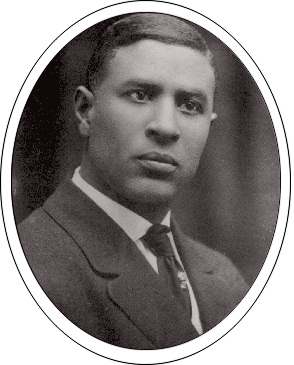
At a glance
- Born
- March 4, 1877, Paris (Claysville section), Bourbon County, Kentucky source
- Died
- July 27, 1963, Cleveland (Cuyahoga County) source
- Buried
- Lake View Cemetery, Section 50, Cleveland (Cuyahoga County) source
- Also known as
- Garrett Morgan, Garrett A. Morgan, G. A. Morgan
- Education
- Branch Elementary School, Claysville, KY, to sixth grade
- Known as
- Inventor
- Organizations
- G.A. Morgan Hair Refining Co.
Life story
Garrett Morgan was born in Paris, Kentucky, the seventh of eleven children of freed parents. He finished sixth grade and left at 14 for Cincinnati, then Cleveland in 1895.
He repaired sewing machines, opened his own shop in 1907 and added a clothing store and a hair-care company. He co-founded the Cleveland Association of Colored Men and later the Cleveland Call.
In 1914 he patented a smoke hood, and in 1916 he was part of the rescue at the Lake Erie tunnel disaster. In 1923 he patented a three-way traffic signal and sold the rights to General Electric.
He died in Cleveland in 1963. The city has a school and other places named for him.
Ohio ties
- Cincinnati (before 1895)
worked as a handyman and studied with a tutor after leaving Kentucky Hamilton County · source - Cleveland (1895-1963)
home, businesses, inventions, newspaper and civic work Cuyahoga County · source - Cleveland (5204 Harlem Avenue) (1895-1963)
house where he lived and worked; demolished in the early 1990s Cuyahoga County · source - Wakeman (1923-1940s)
bought a farm near the village and opened the Wakeman Country Club for Black members Huron County · source
Timeline
- 1895 Arrived in Cleveland on 17 June and went to work repairing sewing machines. source
- 1905 Found by accident a solution that straightened hair, which later became the base of his hair-products business. source
- 1907 Opened his own sewing-machine sales and repair shop on West 6th Street. source
- 1908 Helped found the Cleveland Association of Colored Men. source
- 1909 Opened a tailoring shop that employed 32 people making suits, dresses and coats. source
- 1913 Organized the G. A. Morgan Hair Refining Company. source
- 1914 Patented his breathing device (safety hood) and set up the National Safety Device Company. source
- 1916 Used the safety hood on 25 July to rescue men from the Waterworks tunnel under Lake Erie after an explosion. source
- 1920 Founded the Cleveland Call, a weekly newspaper that merged into the Cleveland Call and Post in 1938. source
- 1923 Received U.S. Patent No. 1,475,024 on 20 November for a three-position traffic signal and sold the rights to General Electric for $40,000. source
- 1931 Ran unsuccessfully for Cleveland City Council as an independent. source
- 1963 Died in Cleveland on 27 July. source
- 2024 An Ohio historical marker for Garrett Morgan's Wakeman Country Club was dedicated on 21 September at Wakeman Community Park. source
What Garrett is known for
- Safety hood patented 1914
- Traffic signal patented 1923, rights sold to General Electric
- Took part in the 24 July 1916 Cleveland waterworks tunnel rescue
- Safety (smoke) hood patent (1914)
- Three-position traffic signal patent (1923)
- G. A. Morgan Hair Refining Company (1913)
- National Safety Device Company
Stories
The tunnel under Lake Erie
On 25 July 1916 an explosion in a Cleveland Waterworks tunnel being dug beneath Lake Erie trapped workers in smoke and gas. Morgan had introduced his breathing device in 1912 and patented it in 1914, and he went into the tunnel wearing it to bring men out. Teaching Cleveland's biography notes that after the rescue, fire departments and mine owners in the United States and Europe ordered the hood, and the U.S. Army used a slightly redesigned version in World War I. In 1917 Cleveland citizens gave him a diamond-studded gold medal for the rescue.
A country club for Black Clevelanders in Huron County
In 1923, the year he sold his traffic signal patent to General Electric, Morgan bought a farm near the village of Wakeman in Huron County. There he established the Wakeman Country Club, which was open to Black members. On 21 September 2024 the village dedicated an Ohio historical marker to the club at Wakeman Community Park on East Main Street.
Inventions and firsts
- Three-position traffic signal (1923) credit is disputed
- Safety hood (early gas mask) and Lake Erie tunnel rescue (1914) credit is disputed
- Cleveland Call newspaper founded (1920)
- Garrett Morgan's hair-straightening products (1905)
- Cleveland Association of Colored Men (1908)
Honors and things named for them
- Garrett A. Morgan School of Science, Cleveland
- Gold medal, Second International Exposition of Safety and Sanitation
- Diamond-studded gold medal from Cleveland citizens (1917)
- Honorary member, International Association of Fire Engineers
Named for Garrett A. Morgan
- Garrett A. Morgan Water Treatment Plant (Cleveland, Cuyahoga County) source
- Garrett A. Morgan Cleveland School of Science (Cleveland, Cuyahoga County) source
- Cleveland Fire Department fireboat (named 2023) (Cleveland, Cuyahoga County) source
Family
- spouse: Madge Nelson
- spouse: Mary Anne Hassek
- son: John Pierpont Morgan
Sites to know
Homes, graves, markers, museums and monuments; the numbered ones are on the map.
- 1 Garrett Morgan House site (NRHP 82001369) (demolished)
5204 Harlem Avenue, Cleveland Cuyahoga County · source - 2 Garrett Morgan grave, Lake View Cemetery (Section 50)
Cleveland Cuyahoga County · source - Ohio historical marker 10-39, Garrett Morgan's Wakeman Country Club
Wakeman Community Park, 9 East Main Street, Wakeman Huron County · source
Places in Ohio to see
- Lake View Cemetery (grave) (grave)
12316 Euclid Ave, Cleveland, Cuyahoga County ZIP 44106 · Cleveland · Cuyahoga County · official page - Garrett Morgan High School (park)
4600 Detroit Ave, Cleveland, Cuyahoga County ZIP 44102 · Cleveland · Cuyahoga County · official page
Ohio places
Where Garrett A. Morgan was born, lived, worked and is remembered, with the ZIP code, town and county pages for each.
- Worked: Cleveland, Cuyahoga County ZIP 44114 · Cleveland · Cuyahoga County
- Buried: Cleveland (Lake View Cemetery), Cuyahoga County (12316 Euclid Ave) ZIP 44106 · Cleveland · Cuyahoga County
Myths and corrections
Things often said about Garrett A. Morgan, and what the record shows.
Often said Garrett Morgan invented the traffic light (or the first traffic signal in the United States).
The record Signals came well before him. A gas-lit, police-operated signal stood outside the Houses of Parliament in London from 1868 and exploded in January 1869. In Cleveland itself, the American Traffic Signal Company had already installed an electric red-and-green signal at Euclid Avenue and East 105th Street, based on James Hoge's design. Detroit police officer William Potts built a four-way, three-colour light with an amber phase. Morgan's 1923 patent, No. 1,475,024, was for a manually operated three-position signal with an extra all-stop position. It was an improvement, not the first signal, and General Electric bought the rights. source
- Disputed: Morgan's role in the 1916 tunnel rescue is disputed. Morgan and his supporters say he and his brother entered the tunnel wearing his hood and saved men, and that he was denied recognition for racial reasons. The Carnegie Hero Fund's investigation of the rescuers' actions was complicated, and Morgan was passed over for a hero award.
Pictures
Free to use with the credit shown. Select a picture for the original and its license.
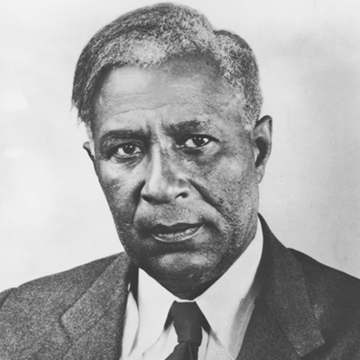
Garrett Morgan, African American innovator, invented the three-positioned traffic light to prevent car acciden...
Public domain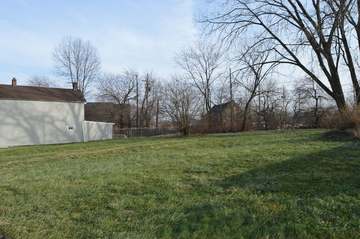
Open land on the southern side of the 5200 block of Harlem Avenue in Cleveland, Ohio, United States. This was ...
Public domain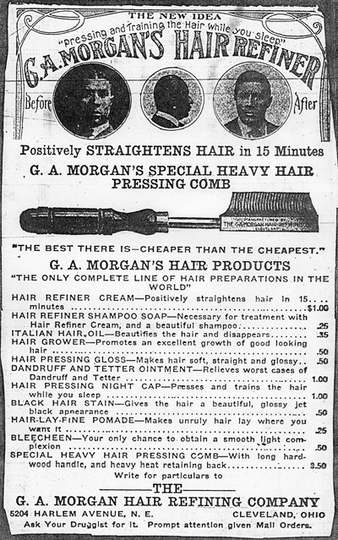
1913 advertisement for Morgan Hair Refining Company (defunct)
Public domain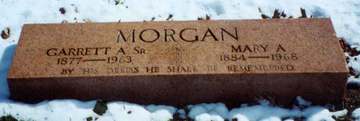
I took this photograph of the gravestone of Garrett Morgan in Cleveland, Ohio, in February of 2003. I hereby r...
Public domain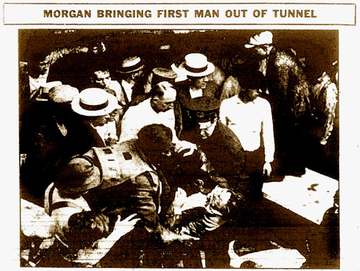
Garrett A. Morgan rescuing a man at the 1917 Lake Erie Crib Disaster
Public domain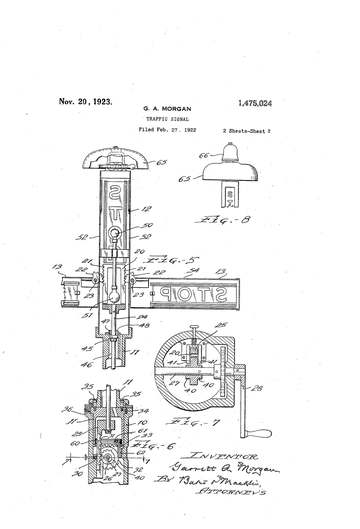
Garrett Morgan US patent US1475024A for a traffic signal, 1923, page 2
CC0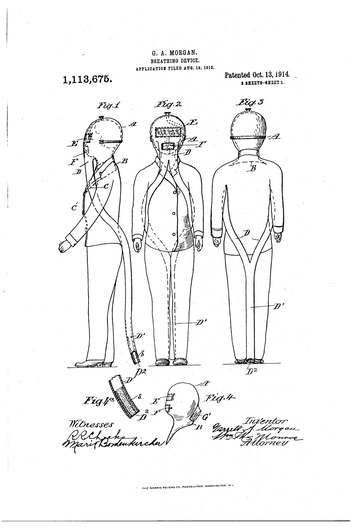
Garrett Morgan US patent US1113675A for a 'smoke hood' breathing device, 1914, page 1
CC0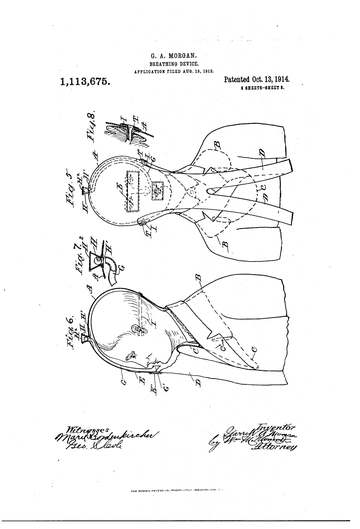
Garrett Morgan US patent US1113675A for a 'smoke hood' breathing device, 1914, page 2
CC0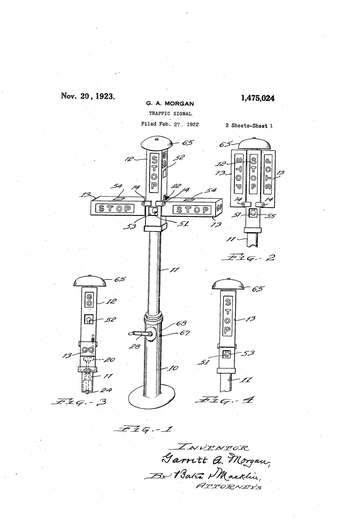
Garrett Morgan US patent US1475024A for a traffic signal, 1923, page 1
CC0


Further reading
Sources
Confidence. Medium: the main facts were confirmed, but some details (often an address or ZIP code) were not.
- Garrett Morgan (Wikipedia) dates, Paris KY birth, hood 1914, traffic signal 1923, GE sale, Lake View burial
- case.edu: morgan garrett a
- teachingcleveland.org: garrett a morgan biography 2
- findagrave.com
- theclio.com
- Wikipedia: History of traffic lights
- Wikipedia: Lake View Cemetery (Cleveland)
- wgpfoundation.org: ohio marker dedication for garrett morgans wakeman country club garrett augustus
- Wikimedia Commons: Garrett Morgan House site
- Wikimedia Commons: US1475024 drawings page 1
Every link goes to the original source. Profile researched 2026-10-14.