Notable people · Science · Medicine
Albert B. Sabin
Virologist who developed the live, oral polio vaccine during 30 years at Cincinnati Children's Hospital and the University of Cincinnati, first given to the American public on 'Sabin Sunday', April 24, 1960.
Born August 26, 1906, Białystok, Russian Empire (now Poland)
Died March 3, 1993, Georgetown University Hospital, Washington
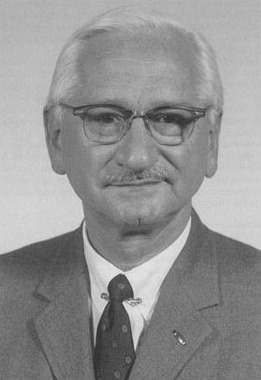
At a glance
- Born
- August 26, 1906, Białystok, Russian Empire (now Poland) source
- Died
- March 3, 1993, Georgetown University Hospital, Washington source
- Buried
- Arlington National Cemetery, Section 3, Grave 1885-RH source
- Also known as
- Albert B. Sabin, Dr. Sabin
- Education
- New York University, New York, NY, to 1931, BS 1928, MD 1931
- Known as
- Science, Medicine
- Organizations
- Cincinnati Children's Hospital, University of Cincinnati
Life story
Albert Sabin was born Abram Saperstejn in Bialystok, in the Russian Empire, and came to the US in 1921, settling in Paterson, New Jersey. He earned his degrees from New York University.
He became a citizen and took the name Albert Bruce Sabin in 1930, trained at Bellevue Hospital, and from 1939 to 1969 led research at Cincinnati Children's Hospital.
He built an oral polio vaccine from weakened live viruses. First trials were at the Chillicothe reformatory in 1954, and in 1960 Cincinnati schoolchildren were given it in a mass immunization.
His vaccine could prevent spread of the virus through the gut and was easier to give than Salk's injection. He received the National Medal of Science (1970) and Presidential Medal of Freedom (1986).
Ohio ties
- Cincinnati (Children's Hospital Research Foundation and University of Cincinnati College of Medicine) (1939-1969)
associate professor of pediatrics and research fellow in virology from 1939; head of pediatric research from 1946; developed the oral polio vaccine here Hamilton County · source - Chillicothe (federal reformatory) (1954-1955)
first trials of his live oral vaccine on about 30 adult volunteer prisoners Ross County · source - Cincinnati and Hamilton County (1960)
'Sabin Oral Sundays' mass vaccination, the vaccine's first public distribution in the United States Hamilton County · source - Cleveland (1972)
emergency coronary bypass surgery at age 66 Cuyahoga County · source - Cincinnati (University of Cincinnati, Winkler Center) (1993-present)
his papers (nearly 400 linear feet), medals and artifacts, donated by his widow Heloisa Hamilton County · source
Timeline
- 1906 Born August 26 in Białystok, then in the Russian Empire, as Abram Saperstejn. source
- 1921 Emigrated with his family to Paterson, New Jersey; he graduated from Paterson High School in 1923. source
- 1930 Became a naturalized U.S. citizen and took the name Albert Bruce Sabin. source
- 1931 Graduated from New York University's medical school and began an internship at Bellevue Hospital. source
- 1939 Accepted a joint post at the University of Cincinnati College of Medicine and the Children's Hospital Research Foundation, as associate professor of pediatrics and research fellow in virology. source
- 1943 Joined the U.S. Army Medical Corps, working on sandfly fever, encephalitis and dengue vaccines; he rose to lieutenant colonel. source
- 1946 Returned to Cincinnati and became head of pediatric research at the University of Cincinnati. source
- 1951 Elected to the National Academy of Sciences. source
- 1954 Began the first human trials of his live oral vaccine on about 30 adult volunteers at the federal prison in Chillicothe in the winter of 1954-55; all developed antibodies without illness. source
- 1956 A Soviet delegation including Mikhail Chumakov visited him in Cincinnati in February, beginning the collaboration that led to Soviet field trials. source
- 1959 About ten million people in the Soviet Union received his vaccine in the first half of the year, the largest field trial ever run. source
- 1960 On Sunday, April 24, more than 20,000 Cincinnati-area children received the vaccine in its first public distribution in the United States, and about 180,000 more followed over the next weeks. source
- 1961 The vaccine was formally licensed for production and use in the United States in August; it was the country's polio vaccine of choice by 1963. source
- 1969 Retired from the University of Cincinnati and Children's Hospital after 30 years and went to Israel as president of the Weizmann Institute of Science (1970-1972). source
- 1970 Received the National Medal of Science from President Nixon. source
- 1985 Cincinnati's convention center was renamed for him on November 14, after national criticism that the city had named Second Street for Pete Rose instead. source
- 1986 President Reagan presented him the Presidential Medal of Freedom in the East Room of the White House on May 12. source
- 1993 Died of congestive heart failure on March 3 in Washington and was buried in Arlington National Cemetery; his widow donated his papers to the University of Cincinnati. source
- 2000 The street between the UC College of Medicine and Cincinnati Children's was renamed Albert Sabin Way on April 28. source
- 2003 Ohio historical marker 34-31 was dedicated at the entrance of UC's Vontz Center for Molecular Studies on June 19, beside a permanent exhibit of his work. source
- 2010 UC and Cincinnati Children's marked the 50th anniversary of Sabin Sunday on April 23 with a pediatrician who had given the vaccine in 1960. source
- 2012 Named a 'Great Ohioan' by the Capitol Square Review and Advisory Board. source
What Albert is known for
- Oral polio vaccine; first trials at Chillicothe reformatory 1954
- Given to 90+ million people 1955-61
- Head of pediatric research, Cincinnati 1946
- Oral polio vaccine
Stories
Sabin Sunday
By early 1960 Sabin's vaccine had been given to millions of children abroad but had no wide use in the United States. On the morning of Sunday, April 24, 1960, more than 20,000 children in greater Cincinnati lined up to receive it, the first public distribution in the country. Families queued outside Children's Hospital, schools and churches, and the bitter drops were given on sugar cubes. About 180,000 more children took it on the following Sundays, which came to be called 'Sabin Oral Sundays.' The next day Sabin wrote to Thomas Rivers of the National Foundation that the campaign showed what an American city could do under a voluntary system. The vaccine was licensed on a trial basis that August and fully in August 1961.
Thirty volunteers at Chillicothe
Sabin's first test subjects were himself, his family and his colleagues, who swallowed the weakened strains before anyone else. In the winter of 1954-55 he gave them to 30 adult volunteers at the federal prison in Chillicothe, Ross County. All of them developed antibodies to the three strains, and none fell ill. In February 1956 a Soviet delegation visited him in Cincinnati, and his working friendship with virologist Mikhail Chumakov led to the 1959 Soviet trials that finally proved the vaccine.
A street for Pete Rose, a hall for Sabin
Cincinnati was slow to put Sabin's name on anything. In 1985 the city renamed Second Street for the Reds' Pete Rose, and the New York Times remarked that Sabin was less honoured in his adopted city than elsewhere. The expanded convention center was then named for him at a ceremony his family attended. A 1999 Enquirer article reported that an earlier push to rename Elland Avenue by Children's Hospital had been blocked by his former boss and rival, Dr. Edward Pratt, and in 1993 the county named the Cross County Highway for Ronald Reagan rather than Sabin. The city did eventually rename the street by the hospital Albert Sabin Way.
Inventions and firsts
- Sabin oral polio vaccine (1954-1962)
Honors and things named for them
- National Medal of Science (1970)
- Presidential Medal of Freedom (1986)
- US postage stamp (2006)
- Albert Sabin Way, Cincinnati (2000)
- Sabin education centre, Cincinnati Children's (1999)
Named for Albert B. Sabin
- Albert Sabin Way (renamed April 28, 2000) (Cincinnati, Hamilton County) source
- Albert B. Sabin Convention and Exposition Center (1985-2006) (Cincinnati, Hamilton County) source
- Sabin Education and Conference Center, Cincinnati Children's Hospital Medical Center (1999) (Cincinnati, Hamilton County) source
- Albert B. Sabin Professor (endowed title), Cincinnati Children's (Cincinnati, Hamilton County) source
- Sabin Vaccine Institute (founded 1993) (Washington, D.C.) source
Family
- spouse: Sylvia Tregillus
- spouse: Jane Warner
- spouse: Heloisa Dunshee de Abranches
- daughter: Deborah Sabin
Sites to know
Homes, graves, markers, museums and monuments; the numbered ones are on the map.
- 1 Ohio historical marker 34-31, Albert B. Sabin, M.D., 1906-1993 (Vontz Center)
Cincinnati, 3125 Eden Avenue, north of Piedmont Avenue Hamilton County · source - Sabin exhibit, Vontz Center for Molecular Studies lobby (regalia and awards) (unknown)
Cincinnati, University of Cincinnati medical campus Hamilton County · source - 2 Cincinnati Children's Hospital Medical Center (Children's Hospital Research Foundation)
Cincinnati, 3333 Burnet Avenue Hamilton County · source - 3 Former Albert B. Sabin Convention and Exposition Center (1985-2006; now First Financial Center)
Cincinnati, downtown Hamilton County · source - Federal reformatory at Chillicothe (site of the 1954-55 prisoner trials) (private)
Chillicothe Ross County · source - Sabin grave, Arlington National Cemetery, Section 3, Grave 1885-RH
Arlington, Virginia source
Places in Ohio to see
- Cincinnati Children's Hospital Medical Center (museum)
3333 Burnet Ave, Cincinnati, Hamilton County ZIP 45229 · Cincinnati · Hamilton County · official page
Ohio places
Where Albert B. Sabin was born, lived, worked and is remembered, with the ZIP code, town and county pages for each.
- Worked: Cincinnati, Hamilton County (3333 Burnet Ave (Children's Hospital; address from prior knowledge)) ZIP 45229 · Cincinnati · Hamilton County
Myths and corrections
Things often said about Albert B. Sabin, and what the record shows.
Often said Sabin's Ohio historical marker lists a 1970 'U.S. National Medal of Medicine'.
The record There is no such award. In 1970 President Nixon gave Sabin the National Medal of Science. source
Often said Sabin Sunday in 1960 was the first time the oral vaccine was given to people.
The record Sabin tested it on 30 adult volunteer prisoners at the federal prison in Chillicothe in the winter of 1954-55, and about ten million children in the Soviet Union received it in 1959. Sabin Sunday was its first public, mass distribution in the United States. source
Often said Sabin turned down a fortune by refusing to patent his vaccine.
The record Sabin did not patent it and gave strains and production rights away free, saying he did not want to patent it. But Wikipedia, citing patent analyses, notes that neither he nor Salk would probably have qualified for a patent, since neither was the sole developer of the methods used. source
Documents
Primary records: patents, letters, court and government files, nominations and old county histories, each at the archive that holds it.
- Albert B. Sabin 1906-1993, National Academy of Sciences Biographical Memoir, by Marguerite Rose Jiménez (cites letters in the Sabin archives at UC) 2014, National Academy of Sciences
- Remarks at the Presentation Ceremony for the Presidential Medal of Freedom, May 12, 1986 (Reagan's tribute to Sabin) 1986, Ronald Reagan Presidential Library
- Albert B. Sabin Papers, digitized correspondence and photographs (about 35,000 letters), University of Cincinnati Digital Resource Commons 1930-1993, University of Cincinnati, Henry R. Winkler Center
Pictures
Free to use with the credit shown. Select a picture for the original and its license.
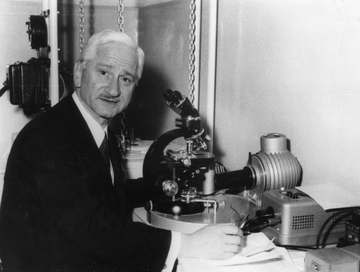
This is a photograph of Albert Bruce Sabin (1906–1993), the man who made the oral polio vaccine.
Public domain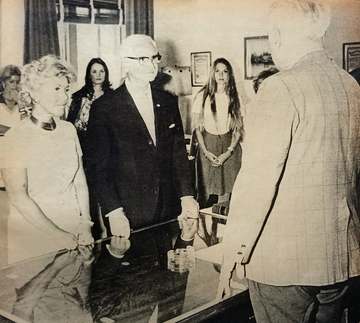
Albert Sabin y su esposa Eloísa durante la ceremonia de su casamiento en 1972.
CC0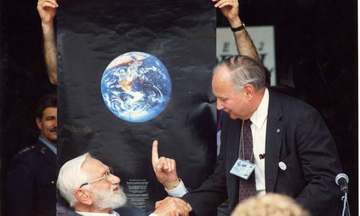
O pesquisador Albert Sabin, criador da vacina contra a poliomielite, conversa com Maurice Strong, secretário-g...
Public domain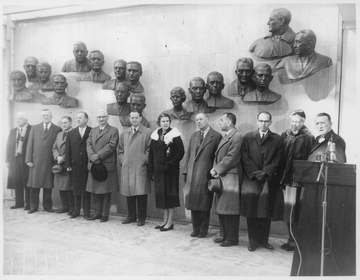
Public domain 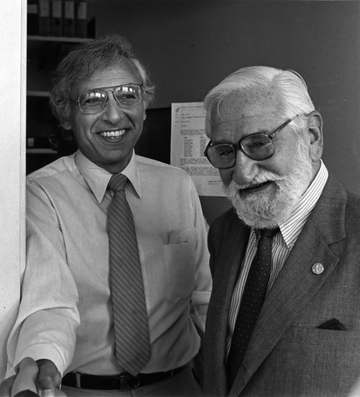
Title: Historical: People: Gallo, Robert C. and Sabin, Albert B. Description: On the left: Robert C. Gallo, M....
Public domain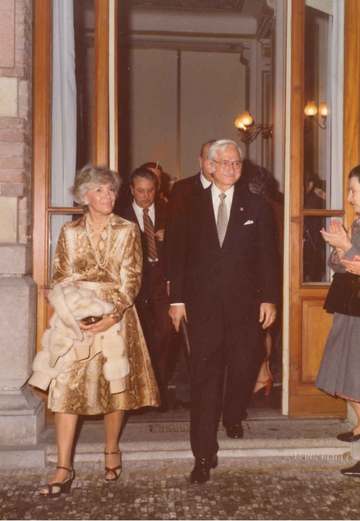
Albert Bruce Sabin (medico e virologo) con la consorte, ospiti del dott. Mario Pisaneschi (dietro) a Salsomagg...
Public domain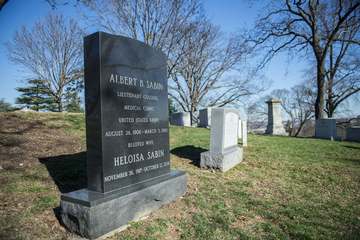
Headstone of Dr. Albert Bruce Sabin in Section 3 of Arlington National Cemetery, Arlington, Virginia, February...
Public domain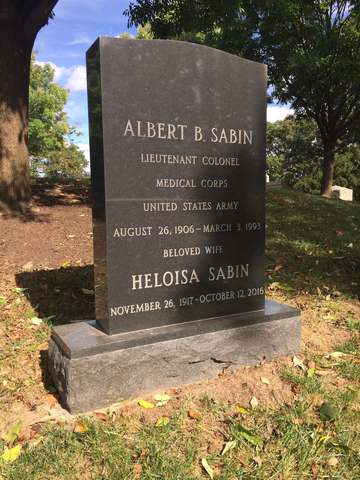
Grave of Albert Sabin at Arlington National Cemetery
Public domain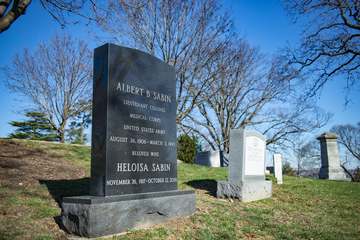
Gravesite of U.S. Army Lt. Col. Albert Bruce Sabin in Section 3 of Arlington National Cemetery, Arlington, Vir...
Public domain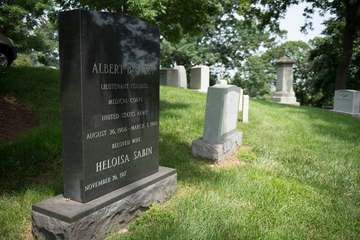
Lt. Col. Albert B. Sabin, buried in Arlington National Cemetery’s Section 3, Grave 1885-RH, invented the oral ...
Public domain
Visita ao "Templo da Paz" da LBV em Brasília, DF. Foto: Equipe <a href="http://www.mercadoviagens.com" rel=...
Mercado Viagens from Brasil / CC BY 2.0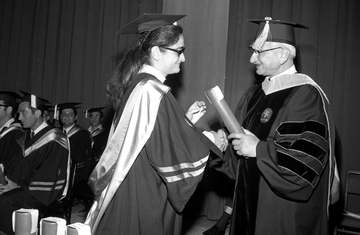
The Feinberg Graduate School of the Weizmann Institute recently awarded 42 PhD's and 17 M.Sc. Degrees.s abd 17...
IPPA photographer / CC BY 4.0


Further reading
Sources
Confidence. Medium: the main facts were confirmed, but some details (often an address or ZIP code) were not.
- Albert Sabin (Wikipedia) born Bialystok, Cincinnati from 1939, vaccine timeline, died Washington DC
- nasonline.org: sabin albert
- sites.libraries.uc.edu: time line
- sites.libraries.uc.edu: archives
- libapps.libraries.uc.edu: albert sabin an incredible cincinnatian
- uc.edu: uc cincinnati childrens to host 50th anniversary celebration of sabin sundays
- uc.edu: uc medical center to honor developer of polio vaccine with ohio historical marke
- remarkableohio.org: 34 31 albert b sabin m d 1906 1993
- cincinnatichildrens.org: our history
- pmc.ncbi.nlm.nih.gov: PMC8888238
- hekint.org: a cold war vaccine albert sabin russia and the oral polio vaccine
- wcpo.com: from the vault dr albert sabin saved the world from polio
- sciencehistory.org: jonas salk and albert bruce sabin
- sabin.org: dr albert b sabin
- reaganlibrary.gov: 51286b
- Wikipedia: Duke Energy Convention Center
- Wikipedia: Cincinnati Children's Hospital Medical Center
- Wikimedia Commons: Albert Sabin
- Wikimedia Commons: Eleanor Roosevelt, Albert Sabin, Jonas Salk, and Basil O'Connor at The Infantile
- Wikimedia Commons: Gallo, Robert C. and Sabin, Albert B
- Wikimedia Commons: Gravesite of Lieutenant Colonel Albert Bruce Sabin in Section 3 of Arlington Nat
- Wikimedia Commons: Lt. Col. Albert B. Sabin (18974711170)

Every link goes to the original source. Profile researched 2026-10-15.