Notable people · Pioneer
Moses Cleaveland
Connecticut Land Company agent whose 1796 survey party laid out the town at the mouth of the Cuyahoga that became Cleveland.
Born January 29, 1754, Canterbury, Connecticut
Died November 16, 1806, Canterbury, Connecticut
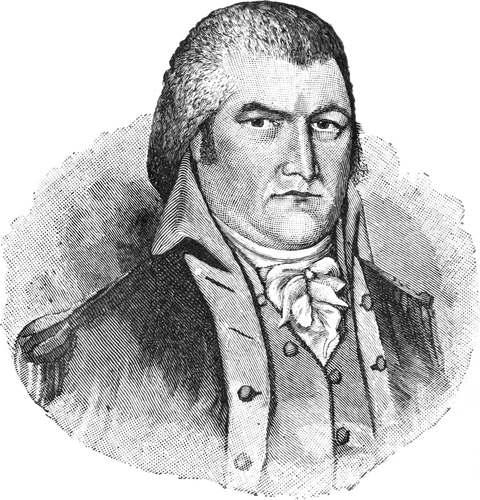
At a glance
Life story
Moses Cleaveland was born in 1754 in Canterbury, Connecticut, the son of Colonel Aaron Cleaveland. He studied at Yale, graduating in 1777, and served in the Continental Army, rising to captain of sappers and miners in 1779 before resigning in 1781.
He practiced law in Connecticut and was commissioned brigadier general of militia in 1796. That year the Connecticut Land Company hired him to survey the Western Reserve.
The party left Schenectady in June, landed at Conneaut Creek on July 4, calling it Port Independence, and reached the mouth of the Cuyahoga on July 22, 1796, where they laid out a town.
He never returned to Ohio. He married Esther Champion in 1797 and died in 1806. The Cleveland city name came from his own, with an 'a' dropped by a newspaper. His statue stands on Public Square.
Ohio ties
- Conneaut (1796)
survey party landed at Conneaut Creek on July 4 and named it Port Independence Ashtabula County · source - Cleveland (1796)
chose the site and had the town and Public Square surveyed, July-October 1796 Cuyahoga County · source
Timeline
- 1777 Commissioned an ensign in the Continental Army; he became a captain of engineers in 1779 and resigned in 1781. source
- 1796 Asked by the Connecticut Land Company in May to lead the survey of the Western Reserve and the land purchases; commissioned a militia brigadier general the same year. source
- 1796 At Buffalo Creek, Mohawk and Seneca delegates, among them Red Jacket and Joseph Brant, dropped their objections to the survey in exchange for goods worth $1,200. source
- 1796 Landed at the mouth of Conneaut Creek on July 4 and celebrated Independence Day; survey crews set out the next day. source
- 1796 Reached the mouth of the Cuyahoga River on July 22 and, in August, settled on it as the capital town of the Reserve. source
- 1796 Returned to Connecticut in October and never came back to the Western Reserve. source
- 1806 Died in Canterbury, Connecticut. source
- 1831 The Cleveland Advertiser's first issue, January 6, spelled the town 'Cleveland', calling the extra 'a' superfluous. source
- 1888 His bronze statue by James C. Hamilton was dedicated on Public Square on July 22, the 92nd anniversary of his arrival. source
- 1906 The Cleveland Chamber of Commerce put up a memorial near his grave in Canterbury. source
- 1946 The Moses Cleaveland Trees programme began with 150 trees. source
What Moses is known for
- Led the 1796 survey that founded Cleveland
Stories
Pork, beans and sixteen guns at Port Independence
Cleaveland's party left Schenectady in June 1796 and came ashore at the mouth of Conneaut Creek on July 4. They pitched tents and built a rough shelter for their provisions and instruments. The state marker in Conneaut says they marked the day with toasts and salutes. Historian John Grabowski adds that they named the place Port Independence, fired a salute, ate pork and beans and drank six patriotic toasts. The next day they broke into field crews and began running the township and range lines of the Western Reserve.
He nearly called it Cuyahoga
The party reached the Cuyahoga's mouth on July 22, 1796, eighteen days after Conneaut, and climbed a hill on the east bank near today's St. Clair Avenue. Cleaveland took several weeks to decide whether the spot should be the centre of the survey, settling it in August. According to Grabowski, he considered naming the town Cuyahoga, but his colleagues talked him into using his own name. His surveyors laid out a New England-style town around a 9.5-acre Public Square, and by October he and most of his men had gone home.
The statue that was too tall
The Early Settlers Association of the Western Reserve paid $4,378 for a bronze statue of Cleaveland by James C. Hamilton and installed it on Public Square on July 22, 1888. City Council at first objected that it was too tall, so a section was cut out of the middle and the halves were joined again. The finished figure stands 7 feet 10 inches on a 7-foot pedestal and holds a compass and a Jacob's staff, the tools of his survey. The Encyclopedia of Cleveland History places it in the square's southwest quadrant; Cleveland Historical now gives its address as S. Roadway and Ontario Street, on the south side.
Honors and things named for them
- City of Cleveland
- Statue on Public Square by James G.C. Hamilton
- 1936 Cleveland Centennial half dollar
- Moses Cleaveland Trees
Named for Moses Cleaveland
- City of Cleveland (Cleveland, Cuyahoga County) source
- Moses Cleaveland Trees (official living-memorial trees, from 1946) source
Family
- wife: Esther Champion Cleaveland
- father: Aaron Cleaveland
Sites to know
Homes, graves, markers, museums and monuments; the numbered ones are on the map.
- Moses Cleaveland statue, Public Square
Cleveland (S. Roadway and Ontario St.) Cuyahoga County · source - 1 Public Square (surveyed 1796)
Cleveland Cuyahoga County · source - 2 Ohio Historical Marker 3-4, Western Reserve (landing at Conneaut)
Conneaut (294 Main St.) Ashtabula County · source - Cleaveland grave and 1906 memorial (unknown)
Canterbury, Connecticut source
Places in Ohio to see
- Moses Cleaveland statue (statue)
Public Square, Cleveland, Cuyahoga County ZIP 44114 · Cleveland · Cuyahoga County
Ohio places
Where Moses Cleaveland was born, lived, worked and is remembered, with the ZIP code, town and county pages for each.
- Connected: Cleveland, Cuyahoga County (Moses Cleaveland statue, Public Square) ZIP 44114 · Cleveland · Cuyahoga County
Myths and corrections
Things often said about Moses Cleaveland, and what the record shows.
Often said The 'a' was dropped from Cleaveland because a newspaper masthead had no room for it.
The record The Cleveland Advertiser's first issue in January 1831 told readers it was dropping the letter because it was superfluous, and other papers followed within a year. Members of Cleaveland's own survey team had already left the 'a' out on two 1790s maps now at the Western Reserve Historical Society. The city took the short spelling when it incorporated in 1836. Cleveland Magazine rates the masthead story busted. source
Often said Portraits show what Moses Cleaveland looked like.
The record No likeness drawn in his lifetime is known. All portraits, and the 1888 statue, are based on written descriptions. source
Often said Cleaveland settled in the city he founded.
The record He spent about three months in the Reserve in 1796, left for Connecticut in October, and never returned to Ohio. source
- The story that a newspaper typesetter dropped the 'a' in Cleaveland to fit a headline is common, but the sources checked do not support it.
Pictures
Free to use with the credit shown. Select a picture for the original and its license.
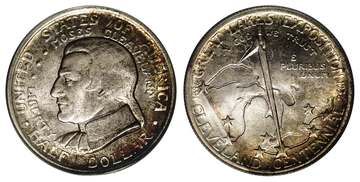
1936 50C Cleveland(394-7319)
Public domain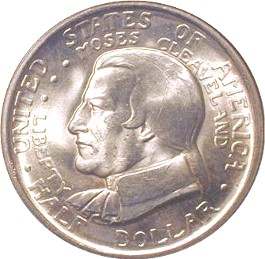
Public domain 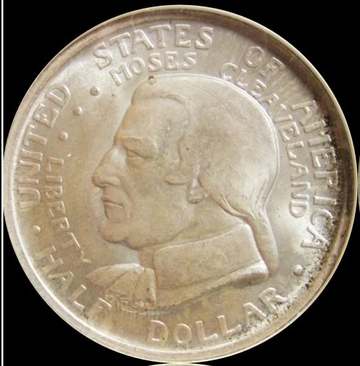
Obverse of an Cleveland Centennial half dollar
Public domain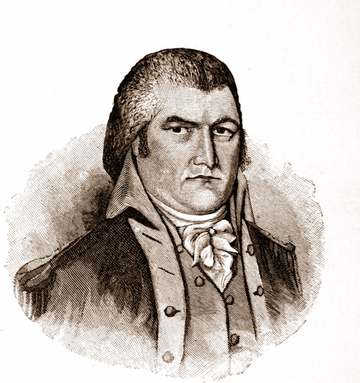
General Moses Cleaveland
Public domain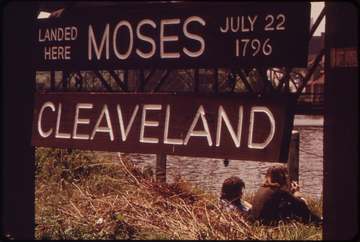
Public domain 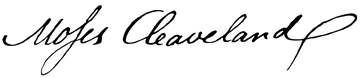
Signature of Moses Cleaveland
Public domain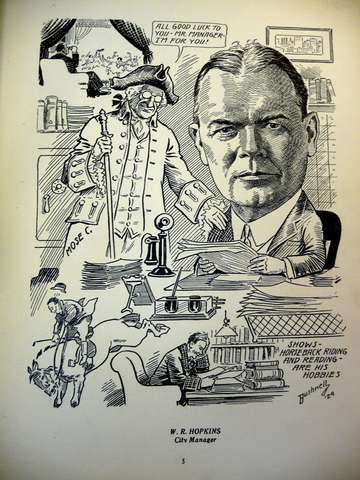
William R. Hopkins, caricatured in 1924 by E. A. Bushnell
Public domain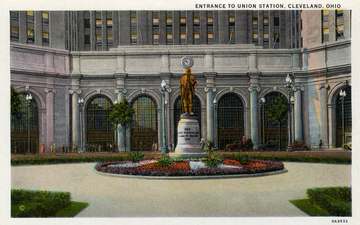
Entrance to Union Station
Public domain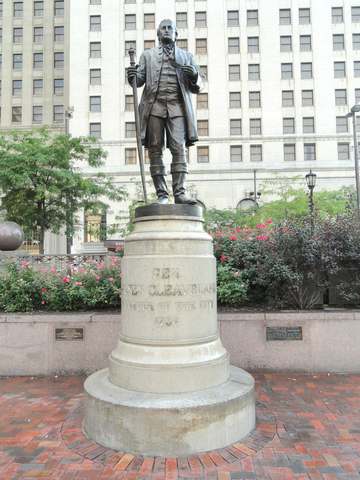
Gen. Moses Cleaveland by James G. C. Hamilton, Public Square, Cleveland, Ohio, USA. Dedicated in 1888. This ar...
CC0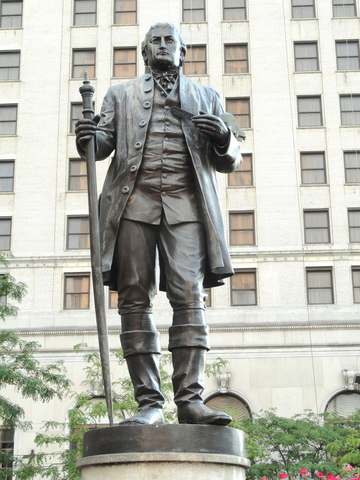
Gen. Moses Cleaveland by James G. C. Hamilton, Public Square, Cleveland, Ohio, USA. Dedicated in 1888. This ar...
CC0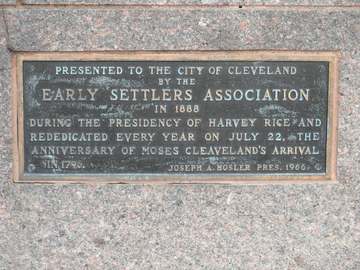
Gen. Moses Cleaveland by James G. C. Hamilton, Public Square, Cleveland, Ohio, USA. Dedicated in 1888. This ar...
CC0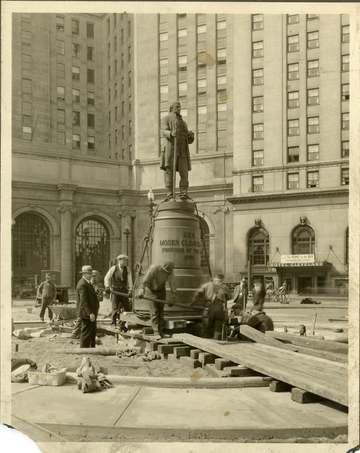
Historic photograph of crews moving the General Moses Cleaveland statue in Cleveland's Public Square using tim...
Public domain


Further reading
Sources
Confidence. Medium: the main facts were confirmed, but some details (often an address or ZIP code) were not.
- Wikipedia: Moses Cleaveland born Jan 29 1754 Canterbury CT, died Nov 16 1806, landing July 22 1796, statue, buried Canterbury
- case.edu: cleaveland moses
- case.edu: moses cleaveland statue
- mail.clevelandhistorical.org
- clevelandmagazine.com: cle myths the a in cleaveland
- remarkableohio.org: 3 4 western reserve
- teachingcleveland.org: the consequences of cleaveland by dr john grabowski
- Wikipedia: Public Square (Cleveland)
- Wikimedia Commons: General Moses Cleaveland

Every link goes to the original source. Profile researched 2026-10-14.