Notable people · Business · Inventor
James Ritty
Dayton saloon keeper who, with his brother John, patented a mechanical 'cash register and indicator' in 1879, the machine that John H. Patterson later built into the National Cash Register Company.
Born October 29, 1836, Dayton
Died March 29, 1918, Dayton (his rooms in the Dayton Arcade)
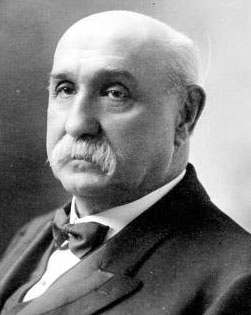
At a glance
- Born
- October 29, 1836, Dayton (Montgomery County) source
- Died
- March 29, 1918, Dayton (his rooms in the Dayton Arcade) (Montgomery County) source
- Buried
- Woodland Cemetery and Arboretum, Dayton (Section 108, Lot 2051, Ritty Mausoleum) (Montgomery County) source
- Also known as
- James Ritty, Jake Ritty, J. Ritty
- Known as
- Business, Inventor
- Organizations
- Ritty Model I, National Cash Register
Life story
James Jacob Ritty was born October 29, 1836, and became a saloonkeeper in Dayton, where he opened his first saloon in 1871. His birthplace is not given on the page.
In 1878, on a European steamboat, he saw a propeller counter and thought of a machine to count sales. With his brother John, a skilled mechanic, he patented the Cash Register and Indicator on November 4, 1879. The patent describes an improvement on earlier registers, so it was not the first such device.
He sold the business in 1881. In 1884 John H. Patterson became the majority owner and the firm was renamed National Cash Register. Ritty opened the Pony House saloon on South Jefferson Street in 1882, retired from the bar business in 1895, and died March 29, 1918. The Pony House bar, with 32 feet of Honduras mahogany, now stands at Jay's Seafood in Dayton.
Ohio ties
- Dayton (1836-1918)
birthplace, lifelong home, saloons, cash register workshop and death Montgomery County · source - Dayton (Empire Saloon, 10 South Main Street) (1870s-1882)
his saloon, with his apartment on the second floor, where the first registers were worked out Montgomery County · source - Dayton (Pony House, 123 South Jefferson Street) (1882-1895)
his second saloon, known for its carved mahogany bar Montgomery County · source - Dayton (Dayton Arcade) (1895-1918)
lived in an apartment in the Arcade after retiring, and died there Montgomery County · source - Woodland Cemetery, Dayton (1918)
entombed in the Ritty Mausoleum with his wife Susan and brother John Montgomery County · source
Timeline
- 1836 Born on 29 October. source
- 1871 Opened his first saloon in Dayton, advertising himself as a 'Dealer in Pure Whiskies, Fine Wines, and Cigars'. source
- 1878 On a steamboat trip to Europe, saw a device that counted the turns of the ship's propeller and thought a similar mechanism could record saloon sales. source
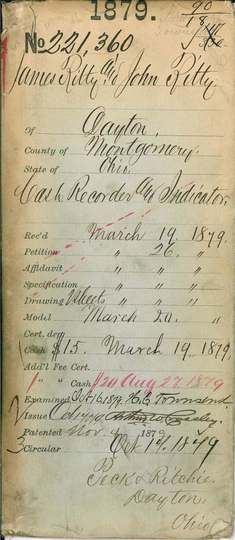
- 1879 James and John Ritty of Dayton filed their application for a 'cash register and indicator' on 26 March. source
- 1879 Received U.S. Patent 221,360 on 4 November, issued jointly to James and John Ritty. source
- 1881 Sold his cash register interests to investors including Jacob H. Eckert, a Cincinnati china and glassware salesman, and John and Frank Patterson; Eckert reorganized the business as the National Manufacturing Company. source
- 1882 Opened a new saloon at 123 South Jefferson Street, which became known as the Pony House. source
- 1883 Received U.S. Patent 271,363 on 30 January, with John Birch of Dayton, for an improved cash register and indicator assigned to Jacob H. Eckert. source
- 1884 John H. Patterson became majority owner of the register business and renamed it the National Cash Register Company. source
- 1895 Retired from the bar business and moved into an apartment in the Dayton Arcade. source
- 1913 His brother and co-inventor John Ritty died on 28 December. source
- 1918 Died of heart trouble on 29 March at his residence in the Dayton Arcade, aged 81. source
- 1967 The Pony House building was demolished; William Eicher of United Moving & Storage removed and stored the carved bar. source
- 2011 James and John Ritty were inducted into the National Inventors Hall of Fame for the mechanical cash register. source
What James is known for
- Patented 'Cash Register and Indicator' with brother John (1879-11-04); marketed as Ritty's Incorruptible Cashier
- Sold interests 1881; Patterson gained majority 1884, NCR followed
- Cash Register and Indicator patent, 4 Nov 1879 (patent number not stated on the page)
- Pony House saloon, Dayton
Stories
A propeller counter and a saloon's missing cash
Ritty believed his bartenders were stealing from the till but could not prove it. On a steamboat trip to Europe in 1878 he noticed a mechanism that counted how many times the ship's propeller turned, and he wondered whether a similar counter could record every sale in his Dayton saloon so that both owner and customer could check it. Back home he worked on the idea with his brother John, a skilled mechanic. Their first two designs failed. The third worked: each key stood for a fixed sum, and a dial kept the running total. It had no cash drawer.
The Pony House bar
In 1882 Ritty opened a new saloon at 123 South Jefferson Street that came to be called the Pony House. He hired wood carvers from Dayton's Barney and Smith Car Works, the railroad-car builder, to make a 30-foot bar from 5,400 pounds of Honduras mahogany, with carved animals including an owl, and with side sections styled like the inside of a passenger railcar. Buffalo Bill Cody, John Dillinger and Jack Dempsey are all said to have drunk there, though those stories are secondhand. When the building came down in 1967 for the block that became the Crowne Plaza hotel and Dave Hall Plaza, William Eicher of United Moving & Storage photographed the bar, took it apart and stored it. It was reassembled at Jay's Seafood in the Oregon District, where it still stands.
No fortune, no grudge
Ritty and his brother sold their interests in 1881 to a group that included Jacob H. Eckert and John and Frank Patterson, and the business was first sold as 'James Ritty's New Cash Register and Indicator'. John H. Patterson bought out the other investors and renamed the business the National Cash Register Company. Ritty never shared in that success. He stayed on good terms with Patterson and was sometimes invited to NCR meetings and celebrations as the man who started it all. He spent his last years in an apartment in the Dayton Arcade and died there in 1918.
Inventions and firsts
Family
- brother: John Ritty
- wife: Susan
Sites to know
Homes, graves, markers, museums and monuments; the numbered ones are on the map.
- 1 Ritty Mausoleum, Woodland Cemetery and Arboretum (Section 108, Lot 2051)
118 Woodland Avenue, Dayton Montgomery County · source - 2 NCR Cash Register Room, Heritage Center of Dayton Manufacturing & Entrepreneurship, Carillon Historical Park (reproduction Ritty Dial)
1000 Carillon Boulevard, Dayton Montgomery County · source - Cash Register invention station, Dayton Inventors River Walk, RiverScape MetroPark
Monument Avenue and Main Street, Dayton Montgomery County · source - Pony House bar, now at Jay's Seafood
225 East Sixth Street, Oregon District, Dayton Montgomery County · source - Pony House saloon site, 123 South Jefferson Street (demolished)
Dayton Montgomery County · source - Empire Saloon site, 10 South Main Street (first registers built upstairs) (unknown)
Dayton Montgomery County · source - 3 Dayton Arcade (his home 1895-1918; NRHP 75001498) (unknown)
Third, Fourth and Ludlow Streets, Dayton Montgomery County · source
Places in Ohio to see
- Jay's Seafood (original Pony House bar) (marker)
Dayton, Montgomery County ZIP 45402 (approximate) · Dayton · Montgomery County - Woodland Cemetery and Arboretum (grave) (grave)
118 Woodland Ave, Dayton, Montgomery County ZIP 45409 · Dayton · Montgomery County · official page
Ohio places
Where James Ritty was born, lived, worked and is remembered, with the ZIP code, town and county pages for each.
- Worked: Dayton, Montgomery County ZIP 45402 · Dayton · Montgomery County
- Buried: Dayton (Woodland Cemetery), Montgomery County (118 Woodland Ave) ZIP 45409 · Dayton · Montgomery County
Myths and corrections
Things often said about James Ritty, and what the record shows.
Often said Ritty sold his cash register patent directly to John H. Patterson (often given as 1882, for $6,500).
The record In 1881 Ritty and his brother sold their interests to a group of investors led by Jacob H. Eckert, a Cincinnati china and glassware salesman, who reorganized the business as the National Manufacturing Company. John and Frank Patterson were among the investors, and John H. Patterson bought out the others and became majority owner in 1884, when the company became the National Cash Register Company. Patterson did not buy the patent from Ritty himself. source
Often said Ritty opened the Pony House in 1871.
The record Ritty's first saloon dates to 1871, but that was the Empire Saloon at 10 South Main Street. He opened the saloon at 123 South Jefferson Street that became the Pony House in 1882. source
Often said The cash register patent was issued in 1883 to James Ritty and John Birch.
The record Patent 271,363, issued to James Ritty and John Birch on 30 January 1883 and assigned to Jacob H. Eckert, was a later improvement. The original register patent, No. 221,360, was issued on 4 November 1879 to James and his brother John Ritty. source
Often said Ritty's register had a cash drawer and a bell.
The record The patented 1879 machine only added up sales on a dial and had no cash drawer. Eckert's National Manufacturing Company added a cash till and a bell that rang on each sale after it bought the business. source
- He is often called the inventor of the first cash register, but the patent's own text calls it an improvement, so it was not the first such register.
Documents
Primary records: patents, letters, court and government files, nominations and old county histories, each at the archive that holds it.
- U.S. Patent 221,360, Improvement in Cash Register and Indicator (James and John Ritty) 1879, Google Patents
- U.S. Patent 271,363, Cash Register and Indicator (James Ritty and John Birch, assigned to Jacob H. Eckert) 1883, Google Patents
- Patent drawing for J. and J. Ritty's Cash Register and Indicator (NARA 7451602), sheet 1 of 2 1879, National Archives (RG 241)
- Patent drawing for J. and J. Ritty's Cash Register and Indicator (NARA 7451602), sheet 2 of 2 1879, National Archives (RG 241)
- Patent Case File No. 221,360 (NARA 167820312), first of 55 page images of the Patent Office file 1879, National Archives at Kansas City
- Patent Case File No. 271,363 (NARA 167820516), first of 44 page images of the Patent Office file 1883, National Archives at Kansas City
Pictures
Free to use with the credit shown. Select a picture for the original and its license.
Public domain 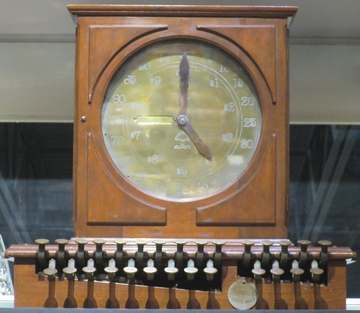
Reproduction of Ritty Dial, the first practical cash register, patented by James and Jacob Ritty in 1879, Cari...
CC0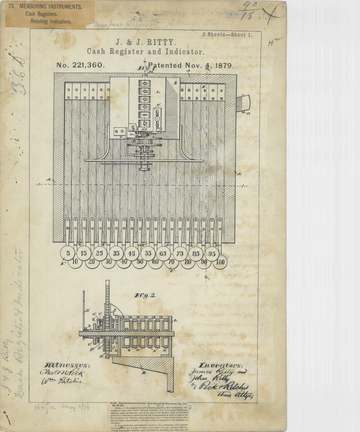
Patent drawing for J. and J. Ritty's Cash Register and Indicator, Patent 221,360
Public domain


Further reading
Sources
Confidence. Medium: the main facts were confirmed, but some details (often an address or ZIP code) were not.
- James Ritty (Wikipedia, pointer) dates, 1879 patent, 1881 sale, burial Woodland
- John Patterson (ETHW) Patterson acquired controlling interest in Ritty's firm in 1884
- wikidata.org: Q321777
- findagrave.com
- invent.org: james ritty
- invent.org: john ritty
- patents.google.com
- patents.google.com
- catalog.archives.gov
- catalog.archives.gov
- catalog.archives.gov
- daytonvistas.com: james ritty invention of cash register
- daytonvistas.com: james rittys pony house saloon
- daytonunknown.com: prominent local figures james ritty
- americantable.org: rittys incorruptible cashier 1879
- blogs.loc.gov: necessity is the mother of invention
- daytonhistory.org: heritage center of dayton manufacturing entrepreneurship
- Wikipedia: Carillon Historical Park
- Wikipedia: Woodland Cemetery and Arboretum
- Wikipedia: Dayton Arcade
- jays.com
- metroparks.org
- Wikimedia Commons: James Jacob Ritty
- Wikimedia Commons: Reproduction of Ritty Dial, the first practical cash register
- Wikimedia Commons: Patent Case File No. 221,360, Improvement in Cash Register and Indicator, Invent

Every link goes to the original source. Profile researched 2026-10-15.