How Thurston began
Thurston grew up around a small settlement its own village history calls Hitedale, formed near two churches that pioneer Job McNamee gave land for about 1816, at the southern tip of Walnut Township. Railroad building after 1869 remade the crossroads three times over -- known in turn as Bush's Corners, Bush City, and Hadley Junction -- before it took the name Thurston, for a well-liked local Methodist preacher, when its post office was recognized on September 27, 1881. The junction of two Toledo and Ohio Central lines made Thurston a terminal for four divisions of the New York Central Railroad, with as many as fourteen passenger trains a day by 1920 and, at one point, some 150 of the village's 450 residents on the railroad payroll; the last passenger train stopped on June 2, 1950. Incorporated in 1913, Thurston today is the quiet village of a few hundred people the railroad's decline left behind.
Settled about 1816 (Job McNamee donates land for a Primitive Baptist and a Methodist church; the surrounding neighborhood is known as Hitedale by 1849), platted 1880-1881; the railroad junction here was called in succession Bush's Corners/Bush Station, Bush City (1878), and Hadley Junction (1880) before taking the name Thurston when its post office was recognized September 27, 1881. Graham's 1883 and Miller's 1912 county histories simplify this whole process to a single laying-out in 1881 by George W. Bush, incorporated 1913, by George W. Bush, the railroad-era landowner; the lasting name honors Rev. Thurston, a Methodist preacher.
Where the name comes from
According to the village's own history, a Rev. Thurston, a resident of nearby New Salem who regularly preached Methodist services in the community, was well enough loved that residents chose to name the hamlet for him when T. D. Ketner circulated a petition for a post office; the name was accepted in Washington on September 27, 1881. The three names that came before it were tied to the railroad era: Bush's Corners and Bush City for landowner George Bush, and Hadley Junction, which Miller's 1912 county history guesses "possibly" honored a railroad official, a claim no source confirms.
Before the town
No source consulted records a Native village, trail, mound, or documented encounter at the specific site of Thurston, which did not exist as a settlement until the railroad era of the 1870s and 1880s. Graham's 1883 county history's chapter on Walnut Township, the township Thurston sits in, records only a general trade in furs between an early settler near Millersport, several miles north, and unnamed "Indians" around 1800, with no site named farther south near Thurston itself. Fairfield County as a whole lay in territory traveled by the Wyandot and Lenape (Delaware) in this period; see the county file for that broader record.
Timeline
- — Job McNamee donates two adjoining tracts of land for churches, one to the Primitive Baptists and one to the Methodists; log meeting houses go up on both, the Baptist church first.
- — The Atlantic and Lake Erie Railroad is extended from Toledo to Pomeroy, crossing the site later called Thurston, at that time known as Bush's Corners or Bush Station.
- — A rail line north to Millersport gives the settlement a new name, Bush City.
- — Completion of a rail branch to Columbus brings a further renaming, to Hadley Junction; Graham's 1883 county history records the same renaming under proprietor George W. Bush.
- — The community, containing fourteen dwellings, is formally recognized as "Thurston" for postal purposes after T. D. Ketner's petition reaches Washington.
- — Natural gas is discovered at Thurston; by January 1890 it is being piped to Columbus by a company formed for the purpose.
- — A shirt-waist factory east of the Harley Hiles property, one of Thurston's early employers, burns down in a fire visible for miles.
- — Thurston incorporates as a village.
- — Fourteen passenger trains a day stop at the Thurston depot, the terminal point for four divisions of the New York Central Railroad.
- — Mayor-elect Alva Groves, age 62, is killed when the #9 passenger train strikes his truck at the New York Central crossing on his way home from a barbershop, a week before he was to take office.
- — The last passenger train stops at Thurston.
- — A tornado destroys the village's original two-room schoolhouse building, by then converted to a dwelling, east of the railroad tracks.
- — Thurston's schools consolidate with Liberty Union.
Stories
Four Names in Sixty-Five Years
Before it was Thurston, the railroad crossing at the south end of Walnut Township went by three other names in barely more than a decade. It started as Bush's Corners or Bush Station, for landowner George Bush, whose land the tracks crossed; when a branch line opened north to Millersport in 1878 it became Bush City; when the Columbus branch was finished in 1880 the railroad's own officials renamed it again, to Hadley Junction. Both names were turned down for post-office recognition because they were too close to other incorporated towns' names. It was only in 1881, when T. D. Ketner circulated a petition naming the settlement for Rev. Thurston, a well-liked Methodist preacher from neighboring New Salem, that the post office finally approved a name, and Thurston it has been since.
A Terminal for Four Divisions
At its railroad-era height, Thurston was more than just a whistle-stop: it was a genuine terminal, the meeting point for four divisions of the New York Central Railroad, built where a train could turn a full 360 degrees and choose which track to take next. By 1920, fourteen passenger trains a day stopped at the Thurston depot, and at least 150 of the village's roughly 450 residents worked for the railroad in some capacity. That world faded gradually with the rise of the automobile: by the early 1930s only four passenger trains a day still stopped, and the last one pulled out on June 2, 1950, closing a chapter that had defined the village for seventy years.
The Fire That Could Be Seen for Miles
In the early 1890s, a shirt-waist factory operated east of the old Harley Hiles property, with Morgan Grush tending the motors that ran the machines and a crew of local women, including a fourteen-year-old Allie Reedy, working the line. The factory burned down in 1905 in a blaze the village's own history says "could be seen for miles," taking with it one of Thurston's early manufacturing employers. Reedy herself lived on in the community into old age, remembered decades later at ninety as one of the last people who could describe the factory firsthand.
Photographs
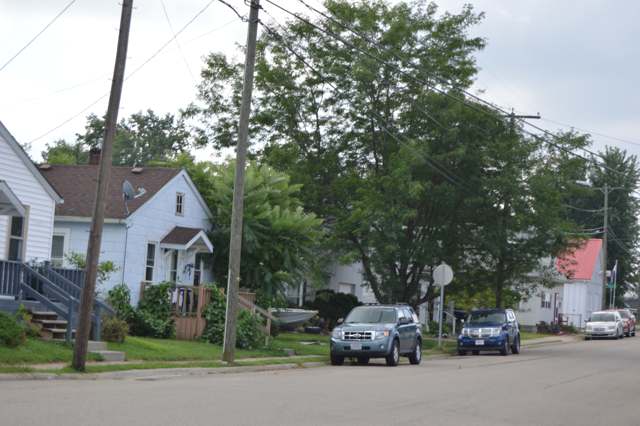
Photo: Nyttend, via Wikimedia Commons, public domain · Wikimedia Commons
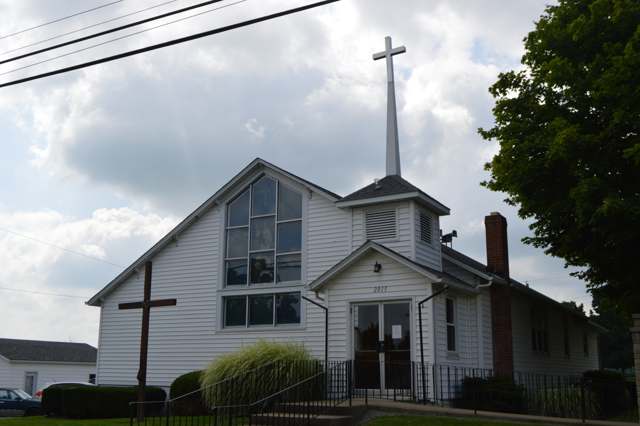
Photo: Nyttend, via Wikimedia Commons, public domain · Wikimedia Commons
Local history sources: thurstonohio.com · archive.org · archive.org · en.wikipedia.org · en.wikipedia.org · commons.wikimedia.org · commons.wikimedia.org
Water
Groundwater wells (2 wells) The water here
- Thurston Village100% of residentsGroundwater wells (2 wells)
Its ZIP codes
Each ZIP code that touches Thurston, with the share of its residents who live here and the same headline figures as the ZIP page.
| ZIP | Share | Water | Radon | Home value | Schools | Flood |
|---|---|---|---|---|---|---|
| 43157 Thurston | 99% | Groundwater wells (2 wells) | 5.5 pCi/L average radon | Median year built 1900 | Liberty Union-Thurston Local · 4.5 stars overall | 0.0% of residents in the 1% floodplain |
The county
Fairfield County: 13 ZIP codes, 27 cities, villages and townships, 144,692 people.
Nearby places
Cite this page
Cite this page as:
Cracked Buckeye (Open Shower Co), "Thurston, Fairfield County", https://crackedbuckeye.com/place/thurston/, built 2026-09-16, accessed [date].
Machine-readable: /api/place/thurston.json (open JSON, CC BY 4.0 for the compilation; the underlying records keep their own terms) · How to cite · Report a correction · Built 2026-09-16